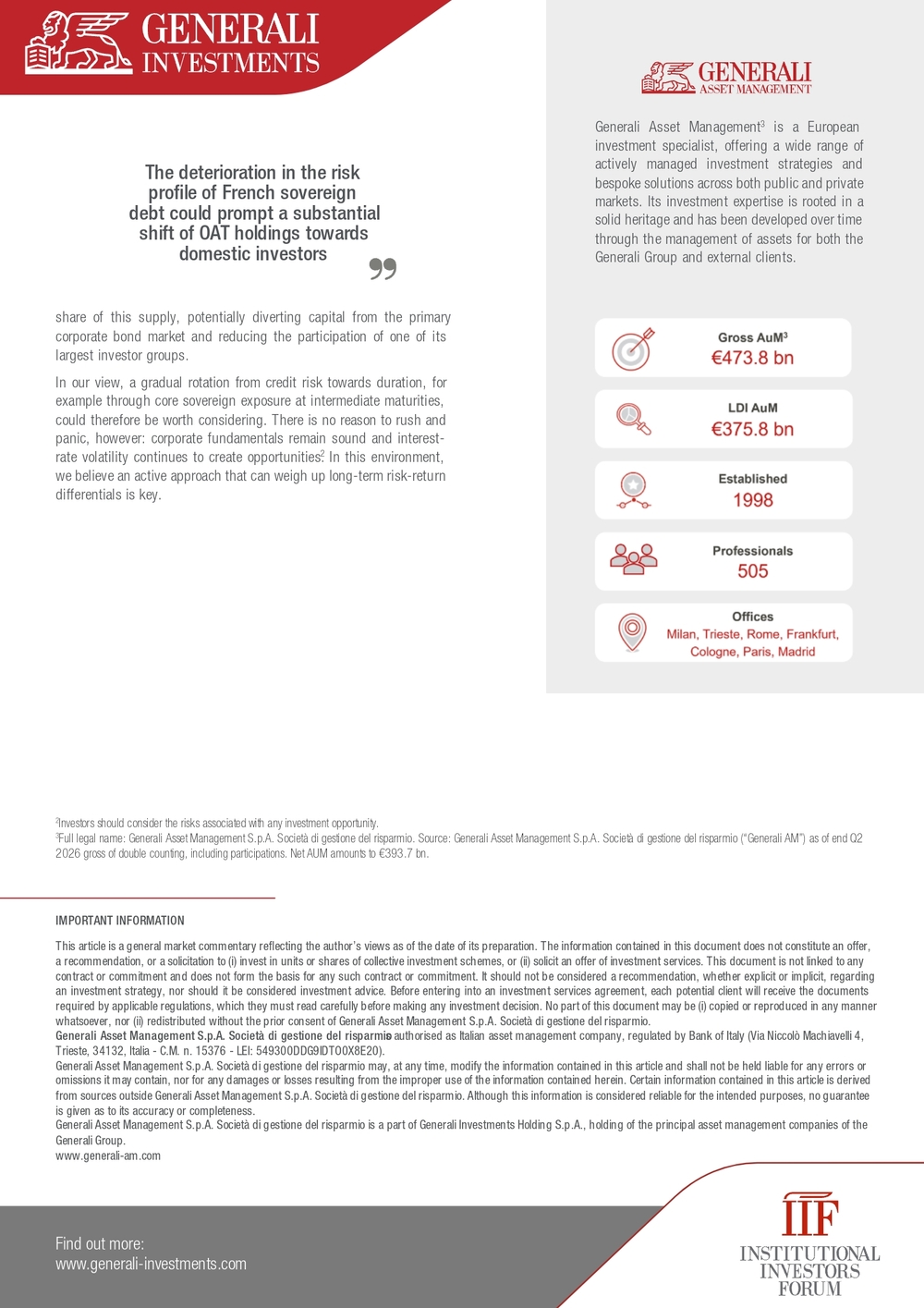
Fixed Income LDI_10 26
by Generali Investments
Sebastiano Chiodino Head of LDI at Generali Asset Management, part of Generali Investments Real interest rates, now back at levels last seen on the eve of the global financial crisis, offer investment opportunities OCTOBER 2026 A DENSE POLITICAL CALENDAR AHEAD Against a backdrop of persistently challenging and volatile global interest rates, exacerbated by elevated energy prices, European bond markets are entering a renewed phase of fragmentation. Government bonds are under pressure amid widespread political instability, which poses a material risk to fiscal discipline in several countries. Although any future political developments may prove less disruptive than current market expectations suggest, the renewed widening of sovereign spreads is likely to persist over the coming months and may intensify as a dense political calendar unfolds. At present, however, neither absolute spread levels nor the extent of contagion appears sufficient to warrant the imminent activation of the backstop instruments available to governments and central banks. We would need to see further market repricing before policy intervention becomes likely. Increasing European bond market fragmentation heightens the need for stronger domestic investor bases, potentially requiring significant portfolio reallocations. Meanwhile, lapse risk remains a material concern for insurance portfolios. France and the OAT market lies at the centre of this emerging source of systemic risk, but any further deterioration could also generate spillover effects to other vulnerable countries, amplifying risk differentiation within the euro area. Despite the bond market sell-off, there is no reason for hasty decision-making, says Sebastiano Chiodino, Head of Liability-Driven Investing (LDI) at Generali Asset Management S.p.A., * as strong corporate fundamentals and interest-rate volatility continue to create opportunities for long-term, active investors. LDI Fixed Income Outlook: Where are the new safe havens? The latest and most acute phases of the French crisis may suggest that German bonds could resume this safe haven role. However, in our view, the energy crisis triggered by US-Iran conflict, together with the resulting inflationary pressures, means that sustained upward pressure on German yields cannot be ruled out and ambitious targets might not be coherent with current geopolitical uncertainties. How, then, can an insurance portfolio be protected in such a complex and unpredictable environment? Inflation is a useful proxy for lapse risk, while real interest rates, now back at levels last seen on the eve of the global financial crisis, may offer investment opportunities. Accordingly, in a market that continues to price inflation as transitory, inflation hedges should be carefully considered and appropriately incorporated into portfolios. But do such high real interest rates and progressively tighter financial conditions pose a threat to corporate bonds, another core component of insurance portfolios? Probably so. Although corporate fundamentals remain sound and the AI investment super cycle is being led by companies with moderate leverage, treating corporate bonds as the new safe haven could be a bold assumption. They have been the place to be, 1 but unfolding market dynamics may affect their future performance. Beside future fundamental threats, and less benign financial conditions, corporate bonds are not immune from a potential new peripheral turmoil. CORPORATE BONDS STILL THE PLACE TO BE AND WILL THE BUND REGAIN ITS SAFE HAVEN STATUS? In this environment, shifts in asset class correlations have significant implications for long-term institutional investors and warrant careful assessment. The interaction between spread risk and duration risk will be a central consideration in portfolio construction and risk management, raising a fundamental question: where, if anywhere, can investors find a reliable safe haven? The Bund may re-emerge as the euro area’s benchmark risk-free asset, but Germany is not insulated from political uncertainty and faces profound structural challenges to its economy.
- Full legal name: Generali Asset Management S.p.A. Società di gestione del risparmio. 1 Past performance does not predict future returns. ARE OATS THE NEW BTPS? The deterioration in the risk profile of French sovereign debt could prompt a substantial shift of OAT holdings towards domestic investors, mirroring the repatriation of Italian BTPs during the euro-area debt crisis. Insurance portfolios are likely candidates to absorb a significant C
The deterioration in the risk profile of French sovereign debt could prompt a substantial shift of OAT holdings towards domestic investors IMPORTANT INFORMATION This article is a general market commentary reflecting the author’s views as of the date of its preparation. The information contained in this document does not constitute an offer, a recommendation, or a solicitation to (i) invest in units or shares of collective investment schemes, or (ii) solicit an offer of investment services. This document is not linked to any contract or commitment and does not form the basis for any such contract or commitment. It should not be considered a recommendation, whether explicit or implicit, regarding an investment strategy, nor should it be considered investment advice. Before entering into an investment services agreement, each potential client will receive the documents required by applicable regulations, which they must read carefully before making any investment decision. No part of this document may be (i) copied or reproduced in any manner whatsoever, nor (ii) redistributed without the prior consent of Generali Asset Management S.p.A. Società di gestione del risparmio. Generali Asset Management S.p.A. Società di gestione del risparmio is authorised as Italian asset management company, regulated by Bank of Italy (Via Niccolò Machiavelli 4, Trieste, 34132, Italia - C.M. n. 15376 - LEI: 549300DDG9IDTO0X8E20). Generali Asset Management S.p.A. Società di gestione del risparmio may, at any time, modify the information contained in this article and shall not be held liable for any errors or omissions it may contain, nor for any damages or losses resulting from the improper use of the information contained herein. Certain information contained in this article is derived from sources outside Generali Asset Management S.p.A. Società di gestione del risparmio. Although this information is considered reliable for the intended purposes, no guarantee is given as to its accuracy or completeness. Generali Asset Management S.p.A. Società di gestione del risparmio is a part of Generali Investments Holding S.p.A., holding of the principal asset management companies of the Generali Group. www.generali-am.com share of this supply, potentially diverting capital from the primary corporate bond market and reducing the participation of one of its largest investor groups. In our view, a gradual rotation from credit risk towards duration, for example through core sovereign exposure at intermediate maturities, could therefore be worth considering. There is no reason to rush and panic, however: corporate fundamentals remain sound and interest- rate volatility continues to create opportunities. 2 In this environment, we believe an active approach that can weigh up long-term risk-return differentials is key. 2Investors should consider the risks associated with any investment opportunity. 3Full legal name: Generali Asset Management S.p.A. Società di gestione del risparmio. Source: Generali Asset Management S.p.A. Società di gestione del risparmio (“Generali AM”) as of end Q2 2026 gross of double counting, including participations. Net AUM amounts to €393.7 bn. Find out more: www.generali-investments.com Generali Asset Management 3 is a European investment specialist, offering a wide range of actively managed investment strategies and bespoke solutions across both public and private markets. Its investment expertise is rooted in a solid heritage and has been developed over time through the management of assets for both the Generali Group and external clients.