Euro Govies Strategy_ 09 26
by Generali Investments
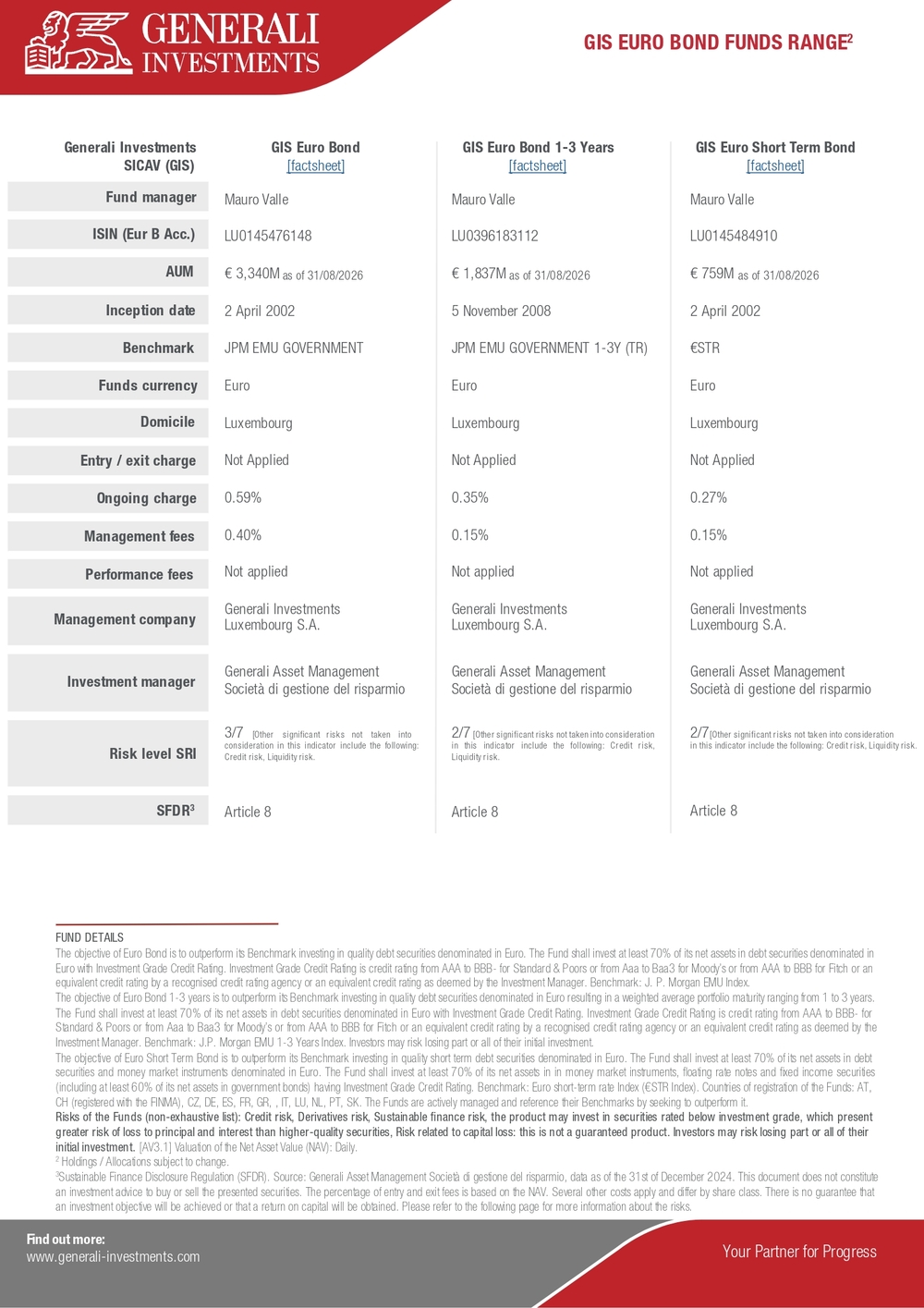
Mauro VALLE Head of Active Fixed Income and Portfolio Manager at Generali Asset Management SEPTEMBER 2026 • Bund yields are already close to levels that adequately compensate investors for remaining inflation and ECB risks. • Our tactical preference remains for short- and medium-dated maturities. • We continue to favour Italian, Spanish and Greek government bonds due to positive growth dynamics and remain underweight to France given fiscal and political uncertainty. After a volatile period for global bond markets, we believe the medium- term opportunity in euro government bonds is becoming increasingly attractive. Yields have repriced significantly, offering investors meaningful carry once again, while corporate credit spreads remain tight and offer relatively limited compensation for additional credit risk. This does not mean that risks have disappeared. Inflation remains above target, central banks are still highly data-dependent, especially about energy prices and second round inflation effects, and fiscal concerns continue to influence longer-dated bonds. But for investors deciding where to allocate within euro fixed income today, we see a stronger relative opportunity in selected government bonds, particularly when combined with active country and yield curve positioning. While performance has been weaker in 2026, the Euro Bond strategy has a track record of navigating the volatile and different interest rate environments of the last two decades, and we believe today’s higher yields have created an attractive starting point for the medium-term outlook.With attractive carry in selected sovereign markets and meaningful differentiation between European issuers, euro government bonds deserve renewed attention, explains Mauro Valle, Head of Active Fixed Income and Portfolio Manager of the Generali Investments Sicav ( GIS) Euro Bond funds range.EUROPEAN BONDS: Why sovereign markets are back in focus GOVERNMENT BONDS OR CORPORATE CREDIT? European credit markets remain fundamentally resilient. Corporate balance sheets are generally healthy, rating momentum has been supportive and investor demand remains strong. However, valuations matter. Credit spreads are now quite tight, while issuance, particularly from so-called hyperscalers, is increasing in both size and maturity. By contrast, higher government bond yields have restored an important source of potential return. Investors can earn attractive carry while retaining exposure to duration, which could provide additional upside if yields begin to decline. We therefore currently see relatively greater value in selected euro government bonds than in adding to corporate credit. This is not a call to abandon credit: within our broader portfolios we continue to find selective opportunities, including in investment grade corporates and parts of the financial sector. But sovereign markets currently offer a more compelling way to take interest rate risk without unnecessarily increasing credit risk. Higher yields have improved the starting point for euro bonds ECB RATE AND BUND YIELDS, 2019-2026 (%) Chart source: Bloomberg as at 11 September 2026. Sovereign markets currently offer a more compelling way to take interest rate risk without unnecessarily increasing credit riskMARKETING COMMUNICATION AIMED TO PROFESSIONAL INVESTORS. PLEASE REFER TO THE PROSPECTUS AND THE KID BEFORE MAKING ANY FINAL INVESTMENT DECISIONS.
THE CURVE MATTERS AS MUCH AS DURATION The ECB raised its key rate by 25 basis-points1 in September, as expected, while delivering a hawkish message of higher inflation forecasts for 2027 and 2028 due to higher energy prices. Another hike in the final quarter is possible. Further tightening in 2027, would take monetary policy into restrictive territory, could begin to weigh more materially on the European economy. Bund yields reached around 3.50% after the ECB meeting, reflecting concerns over tighter policy and higher oil and gas prices. Oil trends and forthcoming inflation data will be important in determining the next equilibrium level for Bunds. In our view, Bund yields are therefore already close to levels that adequately compensate investors for remaining inflation and ECB risks. This supports a constructive medium-term stance on duration, although curve positioning remains crucial. Our tactical preference remains for short- and medium-dated maturities. Recent moves already discount much of the expected ECB path, while further hikes in 2027 could eventually push two-year rates below the deposit rate as markets begin to price recession risk, as occurred in 2023. We remain more cautious at the long end, particularly around 30- year maturities, where fiscal uncertainty, supply and term-premium risk can continue to exert upward pressure on yields. WHERE WE SEE SOVEREIGN OPPORTUNITIES Country selection is equally important as European government bond markets continue to differentiate. We continue to favour Italian government bonds. BTP spreads of around 80 basis points versus Bunds appear sustainable in our view, supported by positive growth dynamics, improving public finances and the absence of immediate electoral risks. We also retain a constructive view on Spanish and Greek government bonds, where growth is stronger than the EU average, public finances are solid and debt-to-GDP ratios are declining. These exposures offer additional carry while benefiting from what we see as relatively supportive underlying fundamentals. France is the clear exception. French government bonds remain vulnerable to fiscal and political uncertainty. The fiscal outlook is likely to keep the deficit above 5% of GDP , while the presidential election cycle is increasingly becoming a market consideration. For now, we remain underweight France relative to our preferred sovereign exposures. LOOKING BEYOND THE NEXT CENTRAL BANK MEETING The debate around peak rates will continue. US yields may already be close to their highs. Fiscal concerns nevertheless remain an important risk. Europe offers a somewhat different opportunity. While volatility is likely to persist, we believe current sovereign yields provide a more attractive starting point for medium-term investors than we have seen for some time. Our Euro Bond process continues to focus on three pillars: carry, country allocation and curve allocation, combined with active duration management and a macro overlay. With credit spreads tight, Bund yields close to what we consider their peak range and attractive carry available in selected sovereign markets, we believe euro government bonds deserve renewed attention. 1 Bloomberg, as at 11 September 2026. IMPORTANT INFORMATION Marketing communication related to Generali Investments SICAV, a Luxembourg UCITS-SICAV, and its Sub-funds Euro Bond, Euro Bond 1-3 Years and Euro Short Term Bond (“the Funds”). Only intended for professional investors in AT, CH, CZ, DE, ES, FR, GR, IT, LU, NL, PT and SK where the Funds are registered for distribution - Not for U.S. Persons. The future performance is subject to taxation, which depends on the personal situation of each investor and which may change in the future. Before making any investment decision, please consider all characteristics, objectives, risks and costs in the Key Information Document (KID) available in one of the official languages of your country and the Prospectus available in English upon request free of charge to the Management Company, Generali Investments Luxembourg S.A., 4 Rue Jean Monnet, L-2180 Luxembourg, Grand Duchy of Luxembourg, e-mail address: GILfundInfo@generali-invest.com or at www.generali-in - vestments.lu, where you can also find a summary of your investor rights (in English or in an authorized language). The Management Company may decide to terminate the agreements made for the marketing of the Fund in your country. Generali Investments Luxembourg S.A., Luxembourg UCITS Management Company of the Fund and Generali Asset Management S.p.A. Società di gestione del risparmio, Italian asset management company, appointed as marketing promoter of the Fund in the EU/EEA countries (Via Niccolò Machiavelli 4, Trieste, 34132, Italia). Generali Investments SICAV is a foreign collective investment undertaking registered with the Spanish National Securities Market Commission (CNMV) under registration number 564. This document is dated 17 September 2026 and may be subject to change.
www. generali-investments.comFind out more:Your Partner for ProgressGIS EURO BOND FUNDS RANGE2 Generali Investments SICAV (GIS)GIS Euro Bond [factsheet]GIS Euro Bond 1-3 Years [factsheet]GIS Euro Short Term Bond [factsheet] Fund manager ISIN (Eur B Acc.) AUM Inception date Benchmark Funds currency Domicile Entry / exit charge Ongoing charge Management fees Performance fees Management company Investment manager Risk level SRI SFDR3Mauro Valle LU0145476148 € 3,340M as of 31/08/2026 2 April 2002 JPM EMU GOVERNMENT Euro Luxembourg Not Applied 0.59% 0.40% Not applied Generali Investments Luxembourg S.A. Generali Asset Management Società di gestione del risparmio 3/7 [Other significant risks not taken into consideration in this indicator include the following: Credit risk, Liquidity risk. Article 8Mauro Valle LU0396183112 € 1,837M as of 31/08/2026 5 November 2008 JPM EMU GOVERNMENT 1-3Y (TR) Euro Luxembourg Not Applied 0.35% 0.15% Not applied Generali Investments Luxembourg S.A. Generali Asset Management Società di gestione del risparmio 2/7 [Other significant risks not taken into consideration in this indicator include the following: Credit risk, Liquidity risk. Article 8Mauro Valle LU0145484910 € 759M as of 31/08/2026 2 April 2002 €STR Euro Luxembourg Not Applied 0.27% 0.15% Not applied Generali Investments Luxembourg S.A. Generali Asset Management Società di gestione del risparmio 2/7 [Other significant risks not taken into consideration in this indicator include the following: Credit risk, Liquidity risk. Article 8 FUND DETAILS The objective of Euro Bond is to outperform its Benchmark investing in quality debt securities denominated in Euro. The Fund shall invest at least 70% of its net assets in debt securities denominated in Euro with Investment Grade Credit Rating. Investment Grade Credit Rating is credit rating from AAA to BBB- for Standard & Poors or from Aaa to Baa3 for Moody’s or from AAA to BBB for Fitch or an equivalent credit rating by a recognised credit rating agency or an equivalent credit rating as deemed by the Investment Manager . Benchmark: J. P . Morgan EMU Index. The objective of Euro Bond 1-3 years is to outperform its Benchmark investing in quality debt securities denominated in Euro resulting in a weighted average portfolio maturity ranging from 1 to 3 years. The Fund shall invest at least 70% of its net assets in debt securities denominated in Euro with Investment Grade Credit Rating. Investment Grade Credit Rating is credit rating from AAA to BBB- for Standard & Poors or from Aaa to Baa3 for Moody’s or from AAA to BBB for Fitch or an equivalent credit rating by a recognised credit rating agency or an equivalent credit rating as deemed by the Investment Manager. Benchmark: J.P . Morgan EMU 1-3 Years Index. Investors may risk losing part or all of their initial investment. The objective of Euro Short Term Bond is to outperform its Benchmark investing in quality short term debt securities denominated in Euro. The Fund shall invest at least 70% of its net assets in debt securities and money market instruments denominated in Euro. The Fund shall invest at least 70% of its net assets in in money market instruments, floating rate notes and fixed income securities (including at least 60% of its net assets in government bonds) having Investment Grade Credit Rating. Benchmark: Euro short-term rate Index (€STR Index). Countries of registration of the Funds: AT, CH (registered with the FINMA), CZ, DE, ES, FR, GR, , IT, LU, NL, PT, SK. The Funds are actively managed and reference their Benchmarks by seeking to outperform it. Risks of the Funds (non-exhaustive list): Credit risk, Derivatives risk, Sustainable finance risk, the product may invest in securities rated below investment grade, which present greater risk of loss to principal and interest than higher-quality securities, Risk related to capital loss: this is not a guaranteed product. Investors may risk losing part or all of their initial investment. [AV3.1] Valuation of the Net Asset Value (NAV): Daily. 2 Holdings / Allocations subject to change. 3Sustainable Finance Disclosure Regulation (SFDR). Source: Generali Asset Management Società di gestione del risparmio, data as of the 31st of December 2024. This document does not constitute an investment advice to buy or sell the presented securities. The percentage of entry and exit fees is based on the NAV. Several other costs apply and differ by share class. There is no guarantee that an investment objective will be achieved or that a return on capital will be obtained. Please refer to the following page for more information about the risks.