GenAM_IV_2026_Q4
by Generali Investments
Your Partner for Progress. Generali Asset Management | Investment View CONTENT ‘Investment View’ provides our quarterly macro & market outlook and investment recommendations Investment View • The bond vigilantes are back with a vengeance. Mar- kets have aggressively repriced the expected path of policy rates , on renewed inflation fears and the re- markable economic resilience to the US/Iran conflict . • Central banks are ill -equipped to counter supply shocks, and demand shocks (AI capex) with a rela- tively low sensitivity to interest rates. For now, stick to the government bond underweight and prefer curve steepeners. • The sharp rates sell -off has created opportunities in the belly of interest rate curves. But we stay cautious with the long ends. What may flip our duration views? Tactically, (elusive) de -escalation in Iran; more struc- turally, (still absent) signs of fati gue in the AI capex super -cycle . In the meantime, repeated episodes in recent years of evaporating Treasury liquidity argue against catching the falling knife. • We recommend buying the dips in Corporate Credit (after spreads widened in September), as recession risks still appear remote. Energy and Tech have kept global equities afloat, but the bond rout has opened cracks under the hood; we maintain a cautious over- weight, as seasonals improve in the autumn, and an- other stellar earnings season is looming . But hedging has rarely made more sense, as volatility remains low and stock -bond correlation elevated. • The financing of the US current -account deficit is in- creasingly shifting from foreign purchases of Treas- uries toward inflows into US equities. This may erode the safe -haven role of the USD, making the "dollar smile" asymmetric . LIQUIDITY IS CONFIDENCE ................................ ....... 2 MACROECONOMIC OUTLOOK ................................ .. 8 GOVERNMENT BONDS ................................ ............. 11 CREDIT ................................ ................................ ....... 13 EM SOVEREIGN BONDS ................................ ........... 15 CURRENCIES ................................ ............................. 17 EQUITIES ................................ ................................ .... 19 ASSET ALLOCATION ................................ ................ 21 FORECASTS ................................ .............................. 22 IMPRINT ................................ ................................ ...... 24
y y y y und
ctual I pro its o trend yrs to ominal wit out IV & d
Liquidity is confidence
30 September , 2026
2 Generali Asset Management | Investment View LIQUIDITY IS CONFIDENCE Vincent Chaigneau
• The bond vigilantes are back with a vengeance . Markets have aggressively repriced the expected path of policy rates , on renewed inflation fears and the remarkable economic resilience to the US/Iran conflict . • Central banks are ill -equipped to counter supply shocks, and demand shocks (AI capex) with a relatively low sen- sitivity to interest rates. For now, stick to the government bond underweight and prefer curve steepeners. • The sharp rates sell -off has created opportunities in the belly of interest rate curves. But we stay cautious with the long ends. What may flip our duration views? Tactically, (elusive) de -escalation in Iran; more structurally, (still absent) signs of fati gue in the AI capex super -cycle . In the meantime, repeated episodes in recent years of evapo- rating Treasury liquidity argue against catching the falling knife. • We recommend buying the dips in Corporate Credit (after spreads widened in September), as recession risks still appear remote. Energy and Tech have kept global equities afloat, but the bond rout has opened cracks under the hood; we maintain a cautious overweight, as seasonals improve in the autumn, and another stellar earnings season is looming . But hedging has rarely made more sense , as volatility remains low and stock -bond correlation elevated. • The financing of the US current -account deficit is increasingly shifting from foreign purchases of Treasuries toward inflows into US equities . This may erode the safe-haven role of the USD , making the "dollar smile" asymmetric .
Bond rout . Three months ago ( The fight for capital ) we warned that the AI capex super -cycle, combined with elevated government deficits, would “re-shap e the sav- ings–investment balance and support a regime of higher interest rates ” ond yields have surged beyond our expectations, in part because the US/Iran peace -deal that looked within reach in June has proved very elusive. So far, global equities have re- sisted the surge in yields – the drawdown from the mid -August peak has been limited. Looking under the hood, however, the Energy and Tech sectors largely explain that resilience, while others like Real Estate, the Consumer and even Financials have lost 5-10% (in Europe). One key driver has been the sharp repricing of central banks , e.g. chart 2 below shows the implied Fed rate for June 2027. Even after the September hikes, forwards are now pricing a whopping 100bp tightening from both the Fed and the ECB over the coming year. This hawkish repricing has pushed real yields sharply hi gher across the curves, and nominal yields along with them. Long -dated forward yields are reaching
an e ar pr ay un ul u ep I I ld I orp orp ovies reasuries s
ed ed in
ct an pr ul ctImplied une year sy yield une priced at p rom ere ective at currently
y y y y und ond rout… o wants to catch the fall- ing knife?
3 Generali Asset Management | Investment View eye-catching levels, e.g. 10y10y near 6.30% in US Treasuries (chart 3). Who wants to catch the falling knife? Increasingly, the fate of global markets appears to be in the hands of bond investors, as surging yields expose economic and financial stability. Higher for longer public deficits and corporate profits Poor public finance governance . Our faithful readers know that for years our structural preference for Corporate over Government bonds has been rooted in the deteriorating public balance sheets, vs. improving private ones. Rising yields are themselves fuelling budget concerns by increasing the cost of debt. According to the CBO , US debt -service costs are projected to rise from 3.3% of GDP in 2026 to 4.6% in 2036. At unchanged policies, this would add further to a deficit already close to 6% of GDP – even though the economy is operating near potential and unemployment is low (left chart above) . What will the public deficit be through the next recession? Meanwhile, profits are surging . The two middle charts above show the extraordi- nary acceleration in US corporate profits – at the heart of the strong equity market performance since the start of the 2020s. US nominal GDP itself has been unusually strong in this decade – partly on higher inflation trends – yet profits have outshined that by a large margin. Are profits now abnormally high, hence unsustainable? The last chart above shows that, historically, significant deviations from trend have proved temporary and ave o ten een “punis ed” y a severe su sequent correction e last two examples were the dot.com bubble burst and the Great Financial Crisis. Will the Tech margins and profits – which have been the main driver in this cycle – prove to be unsustainable? For now the AI race, d riven y a ‘winner -takes -all’ mentality is looking unstoppable, and lifting many (economic) boats. A very challenging cycle for central banks The global economy has been remarkably resilient to the negative supply shock emanating from Iran. The spectacular AI capex super -cycle largely explains it. The first two charts below show how strong capital spending has revived the global manufacturing sector. The forward -looking indicators, e.g. Orders/Inventories, sug- gest that w e may be past the peak of this manufacturing boom, however. Meanwhile, the mighty US consumer has resisted deteriorating real wage trends. Indeed, the large savings accumulated through the pandemic and the equity -powered positive wealth effect have pushed the saving rate down to a mere 3% (third chart below). Persistently high inflation and rising yields are significant threats to this cycle, but for now AI capex is charging ahead, and the textbooks remind us that private investment has the high- est multipli er effect.
m ud et nemp ate ow unemployment i de icits
ominal orp ro its a ter ta uarterly
real yoy & yoy
ctual trend yrs to ominal wit out IV & d
Historically, significant corporate profit devia- tion from long-term trend have proved tem- porary Rising yields are them- selves fuelling budget concerns by increasing the cost of debt AI capex lifts all boats: the global economy has been remarkably resilient
4 Generali Asset Management | Investment View A demand shock. While we expect the AI revolution to eventually be a positive supply shock – an unlimited supply of intelligence may well support both productivity and disinflation – for now it creates a demand shock in data centres and compute, a oon or ‘picks -and-shovels’ companies is s ock adds to in lation e memory chip prices have surged, impacting electronic goods and the whole, increasingly tech - heavy, manufacturing sector. More generally, the era of excess supply (or insufficient demand) that prevailed aft er the GFC is over (top -right chart above). This creates unusually tough challenges for c entral banks : containing inflation would probably require taking key rates above “neutral ”, at the risk of derailing both the economy and global markets. Indeed, central banks are ill -equipped to counter supply shocks (Iran, climate), while the demand shock stemming from colossal AI capex appears relatively insensitive to interest rates. Yet central banks can scarcely afford another loss of credibility , following the inflationary episode of 2022 –23. A productivity boom may well support disinflation eventually, but timing remains uncer- tain. In the meantime, a deal in Iran would be most welcome, cooling down the price of energy and food, hopefully in time to limit pass -through to core inflation. For n ow, however, Iran might still be willing to impose maximum pain ahead of the US mid -term elections (November). Tracking the AI capex super -cycle So far so strong . The AI cycle is most important to investing in the current environ- ment. Typically, any sign of tech capex plateauing or even reversing would be a very strong trigger to increasing our duration recommendation.
apital oods ew rders onde ircra t o
anu acturin I le t I rder Inv m mva rder Inv
ersonal avin mt ly trend
cess savin
o
otal i ed Investment on esidential only
n
uarterly n
pot las pot pot
The AI revolution will eventually be a posi- tive supply shock, but for now it creates a de- mand shock Central banks are ill - equipped to counter supply shocks , and low rate-sensitivity demand shocks
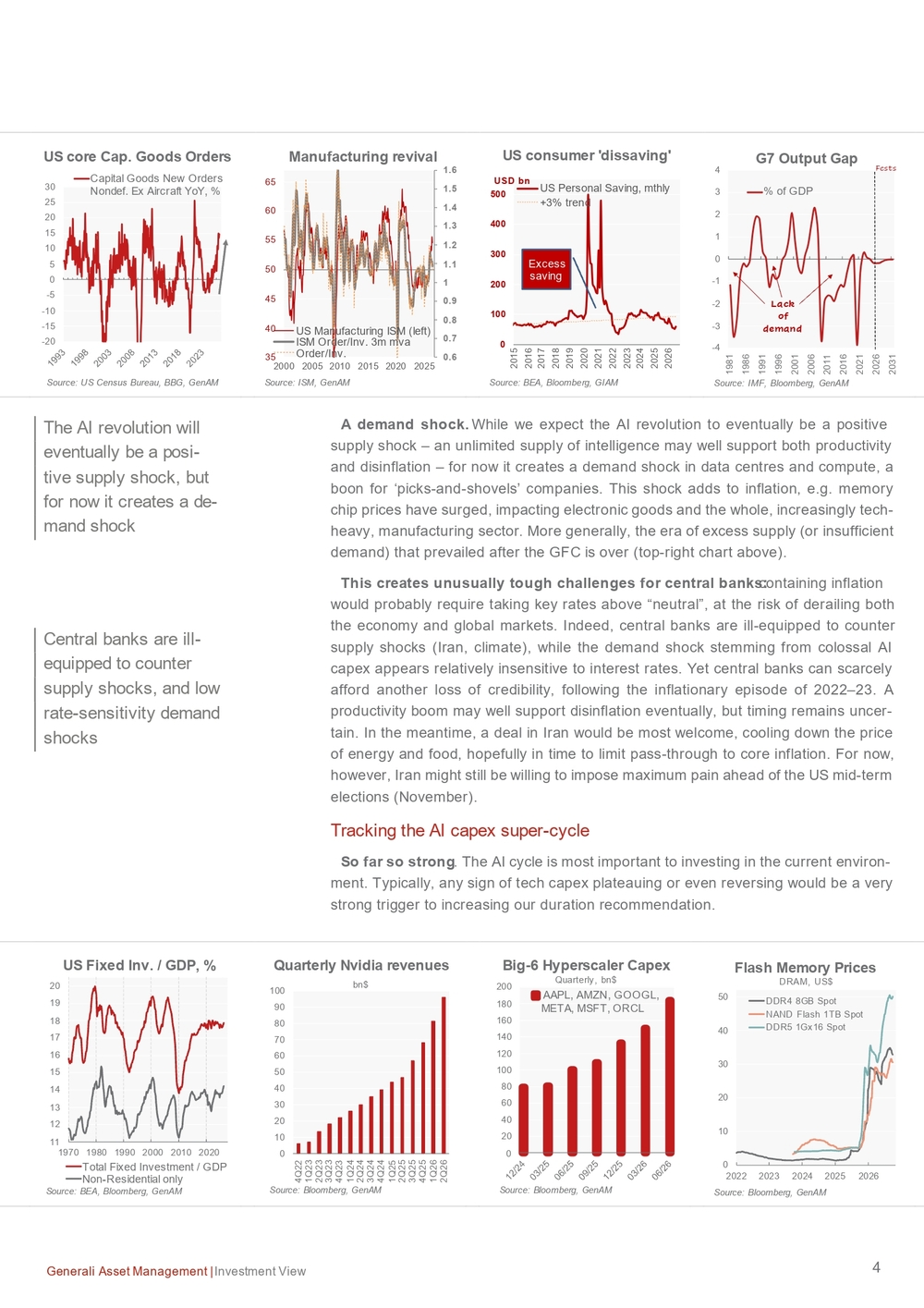
5 Generali Asset Management | Investment View AI capex has pushed total US fixed investment to levels close to, but still lower than those of the late nineties. The latter eventually proved to be an investment bubble, leading to the dot.com crash. Yet Tech investment at the time was far less profitabl e than it is today. We may be concerned about the profitability of AI frontier models – given the sharp competition from open -weight models – but for now the AI race is proving extremely profitable for the overall Tech sector. Profits are likely enjoying a sugar rush, as the capex orders create immediate profits for the infrastructure provid- ers, while costs will be amortised over many years. But for now the profits of the over- all ecosystem, and the large net cash flow of the current winners of that race (the Nvidias of this world), may well feed that investment wave for longer. Arguably, the operating cash flows for the five hyperscalers are no longer sufficient to fund AI capex – corporate re -leveraging is in motion – but the cycle appears to be alive and well. To track this capex super -cycle, investors must look at various metrics, both quan- tities and prices, e.g. AI revenues, hyperscaler capex (quarterly announcements) and memory chip prices. The latter may be finally peaking (right -hand chart above); there is evidence of an ongoing fall in AI token prices too. Yet token consumption is also surging, and even cheaper and smaller AI models are very demanding in compute – e.g. Kimi – hence the capex race may well continue for longer. Are bond yields high enough yet? The loss of fiscal credibility is creating additional challenges for central banks , which risk being caught between price stability and public debt sustainability . reasury ecretary cott essent’s announcement o an peration wist will urt er shorten the average duration of the debt, increase rollover risk, and amplify the impact of Fed decisions on the interest burden. Such interventionism contrasts with the pref- erences of Kevin Warsh, the new Fed Chair, who wants to allow market forces greater scope less “ orward uidance” and reduce oldin s o lon -dated Treasuries on the Fed balance sheet. Such policy contradictions are not helping Treasury market sta- bility. W ’ (hence risk) . The ownership structure of Treasuries has changed profoundly: the shares held by the Fed and foreign central banks have declined, while that of private domestic inves- tors has risen from 30% ten years ago to now well above 50%; these buyers demand reater compensation or risk ed e unds’ s are as clim ed to increasin the well -documented t reat o disorderly unwinds o levera ed positions “ iquidity is con idence ” K ars remarked in March 2007. Repeated episodes of vanishing li- quidity in t e reasury market since t e arc ‘das or cas ’ su est t at t is warning should be taken seriously. Who wants to catch the falling knife? At these levels, intermediate maturities ( 5- to 7-year) are starting to look attractive . USD 5y3m OIS rates stand near 4.75% (left chart below) , above our estimates of the neutral rate and even further above that of the Fed (3.20% for the long -run dot). In the near term, expectations of another 100bp of Fed hikes to c. 5% look excessive in the context of very contained unit labour costs. However, we remain cautious on the long end of yield curves : 1/ the surge in real yields creates carry and value but has only matched the ongoing productivity revival (second chart below); 2/ term premia are still well below historical peaks ; 3/ 10 -year nominal yields are not absurd relative to trend nominal GDP growth . In particular, we fear 10 -year TIPS inflation breakeven, at 2.35%, may still be too low given the poor track record and risk of financial repression; we prefer TIPS to nominal Treasuries. Track th e AI capex su- per-cycle through both quantities and prices No clear sign of AI capex plateauing just yet Policy contradictions hurting investor confi- dence in Treasuries “ iquidity is con i dence ” K ars said Mind the r epeated epi- sodes of vanishing Treasury liquidity since 2020 Still cautious with UST duration; but we would flip the view on AI capex fatigue
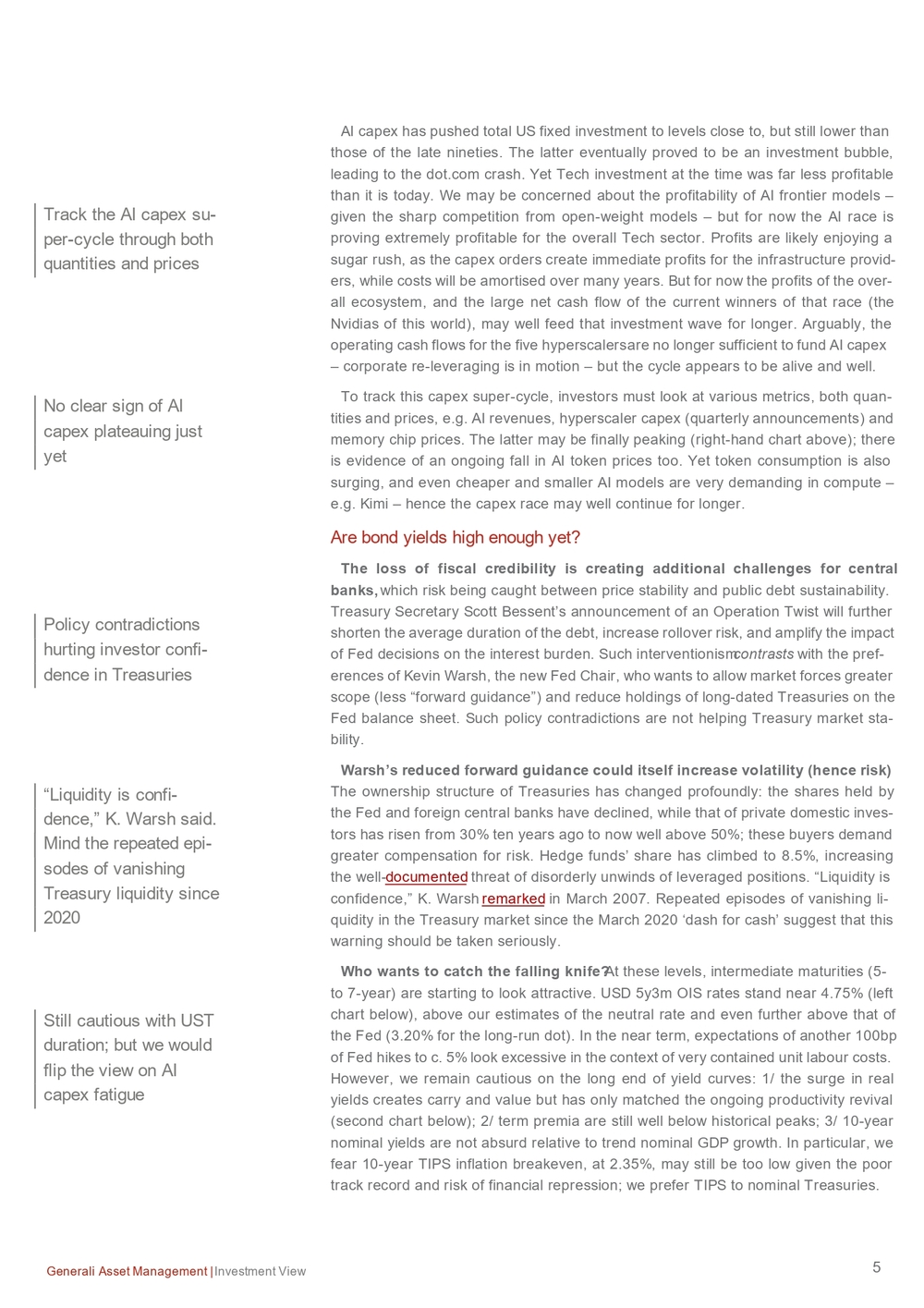
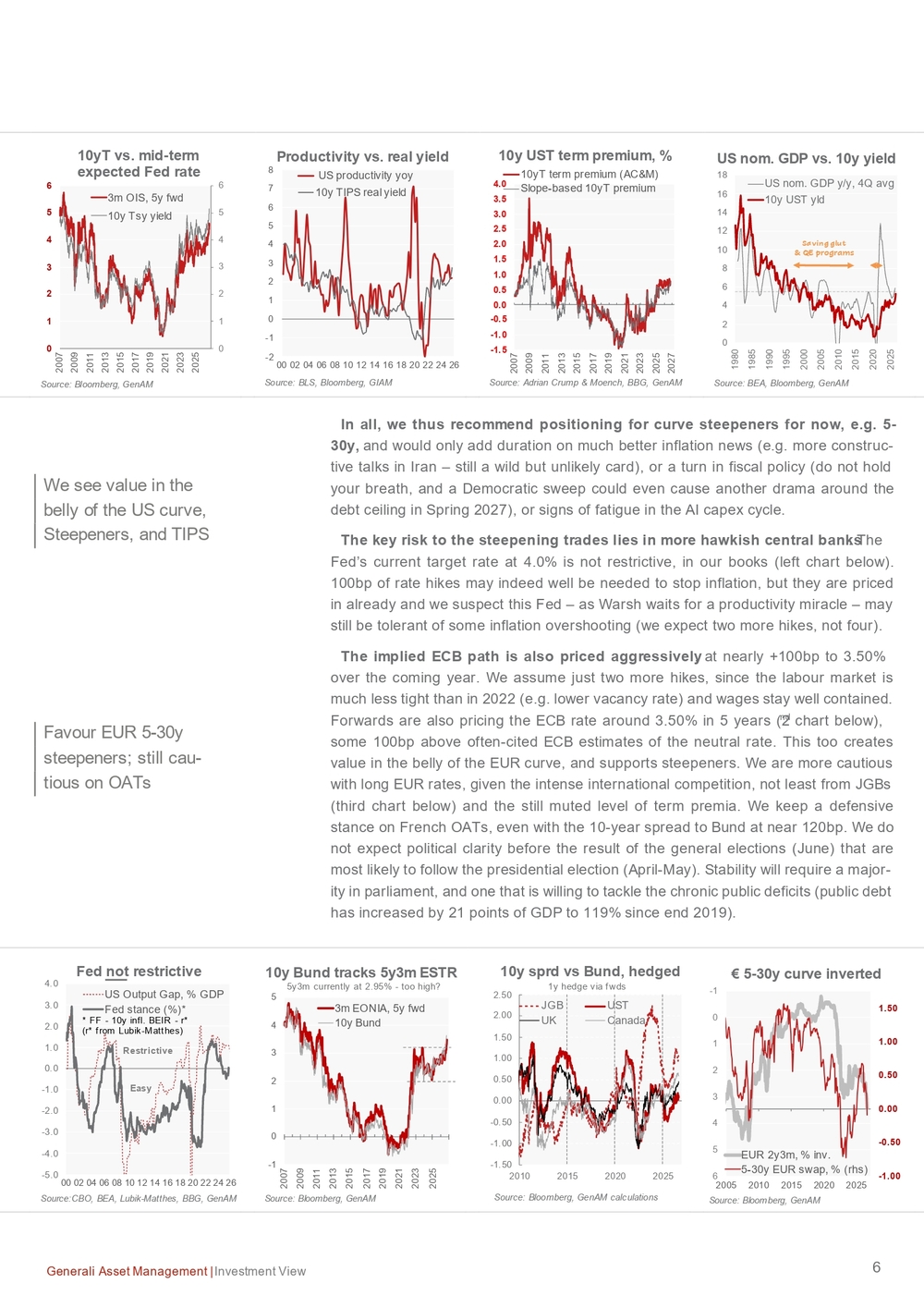
6 Generali Asset Management | Investment View In all, we thus recommend positioning for curve steepeners for now, e.g. 5 - 30y, and would only add duration on much better inflation news (e.g. more construc- tive talks in Iran – still a wild but unlikely card), or a turn in fiscal policy (do not hold your breath, and a Democratic sweep could even cause another drama around the debt ce iling in Spring 2027), or signs of fatigue in the AI capex cycle. The key risk to the steepening trades lies in more hawkish central banks . The ed’s current tar et rate at is not restrictive in our ooks le t c art elow 100bp of rate hikes may indeed well be needed to stop inflation, but they are priced in already and we suspect this Fed – as Warsh waits for a productivity miracle – may still be tolerant of some inflation overshooting (we expect two more hikes, not four). The implied ECB path is also priced aggressively , at nearly +100bp to 3.50% over the coming year. We assume just two more hikes, since the labour market is much less tight than in 2022 (e.g. lower vacancy rate) and wages stay well contained. Forwards are also pricing the ECB rate around 3.50% in 5 years (2nd chart below), some 100bp above often -cited ECB estimates of the neutral rate. This too creates value in the belly of the EUR curve, and supports steepeners . We are more cautious with long EUR rates, given the intense international competition, not least from JGBs (third chart below) and the still muted level of term premia. We keep a defensive stance on French OATs , even with the 10 -year spread to Bund at near 120bp. We do not expect political clarity before the result of the general elections (June) that are most likely to follow the presidential election (April -May). Stability will require a major- ity in parliament , and one that is willing to tackle the chronic public deficits (public debt has increased by 21 points of GDP to 119% since end 2019).
m I y wd y sy yield
productivity yoy y I real yield
y term premium & lope ased y premium
nom y y av y yld
utput ap ed stance
y in l I r r rom u ik att es
m I y wd y und
y m currently at too i
K anada y ed e via wds
y m inv y swap r s We see value in the belly of the US curve, Steepeners, and TIPS Favour EUR 5 -30y steepeners; still cau- tious on OATs
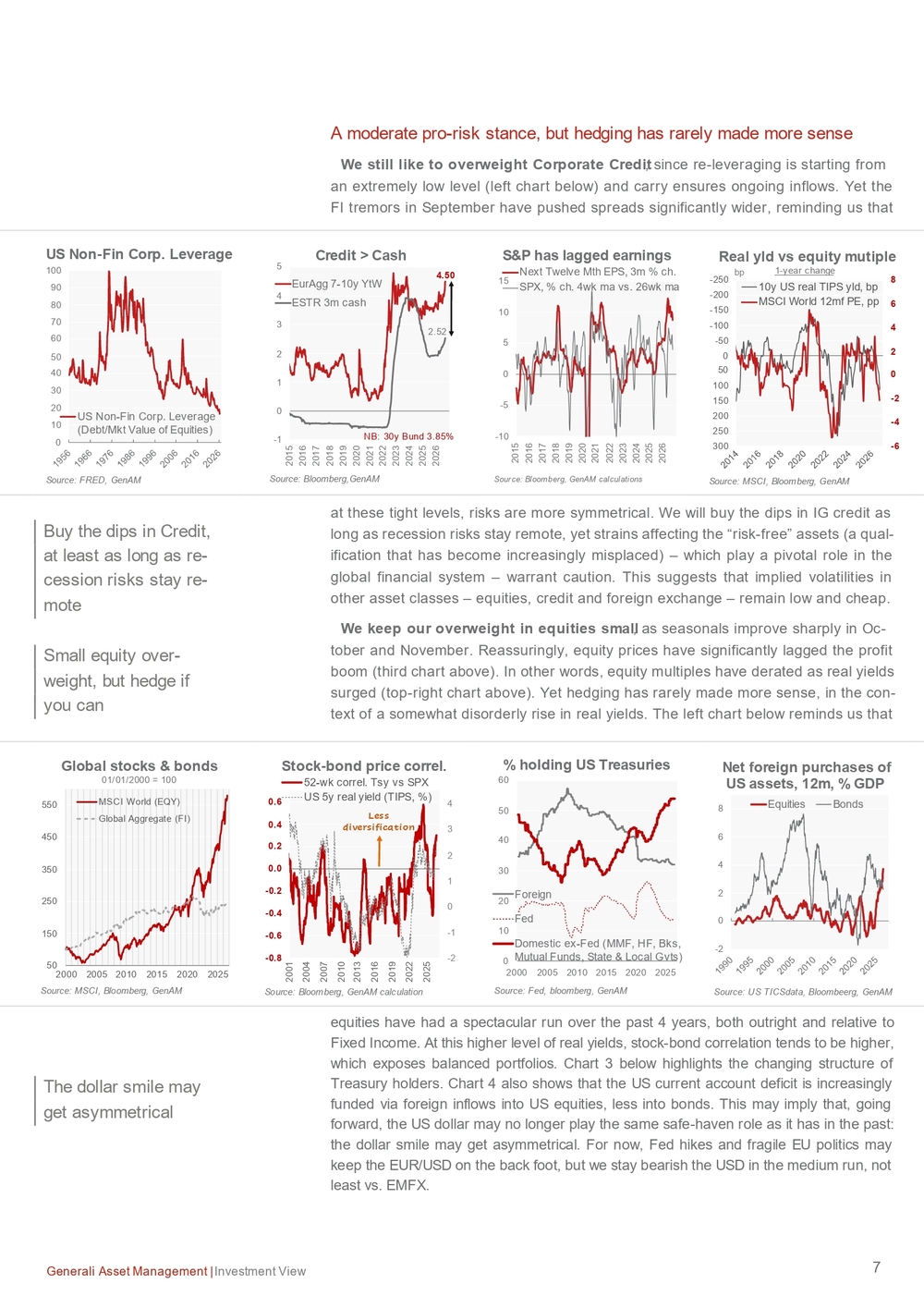
7 Generali Asset Management | Investment View A moderate pro -risk stance, but hedging has rarely made more sense We still like to overweight Corporate Credit , since re -leveraging is starting from an extremely low level (left chart below) and carry ensures ongoing inflows. Yet the FI tremors in September have pushed spreads significantly wider, reminding us that at these tight levels, risks are more symmetrical. We will buy the dips in IG credit as long as recession risks stay remote, yet strains affecting t e “risk - ree” assets (a qual- ification that has become increasingly misplaced) – which play a pivotal role in the global financial system – warrant caution . This suggest s that implied volatilities in other asset classes – equities, credit and foreign exchange – remain low and cheap. We keep our overweight in equities small , as seasonals improve sharply in Oc- tober and November. Reassuringly, equity prices have significantly lagged the profit boom (third chart above). In other words, equity multiples have derated as real yields surged (top -right chart above). Yet hedging has rarely made more sense , in the con- text of a somewhat disorderly rise in real yields. The left chart below reminds us that equities have had a spectacular run over the past 4 years, both outright and relative to Fixed Income. At this higher level of real yields, stock -bond correlation tends to be higher, which exposes balanced portfolios. Chart 3 below highlights the changing structure of Treasury holders. Chart 4 also shows that the US current account deficit is increasingly funded via foreign inflows into US equities, less into bonds. This may imply that, going forward, the US dollar may no longer play the same safe -haven rol e as it has in the past: the dollar smile may get asymmetrical. For now, Fed hikes and fragile EU politics may keep the EUR/USD on the back foot, but we stay bearish the USD in the medium run, not least vs. EMFX.
I orld lo al re ate I
wk correl sy vs y real yield I
orei n ed omestic e ed ks utual unds tate & ocal vts
quities onds
on in orp evera e e t kt Value o quities
ur y t m cas y und
e t welve t m c c wk ma vs wk ma
y real I yld p I orld m pp year c an e p
Buy the dips in Credit, at least as long as re- cession risks stay re- mote Small equity over- weight, but hedg e if you can The dollar smile may get asymmetrical
8 Generali Asset Management | Investment View MACROECONOMIC OUTLOOK Thomas Hempell, Guillaume Tresca, Martin Wolburg, Paolo Zanghieri
• Global growth is set to defy persistent Gulf tensions and carry its momentum into the autumn. • US consumption may soften amid soft real wages and a low savings rate, but capex and fiscal support should keep growth firm. The euro area should expand at close to potential with earlier excess savings cushioning the energy - ’ • High energy prices will lift euro area headline inflation into the autumn, but core inflation should stay contained with second -round effects very contained . US inflation will ease only slowly and remain well above target. • We now expect both the ECB and the Fed to deliver two further hikes , with the next moves possibl e as early as October, amid robust activity and persistent price pressures. ’ beyond this in 2027 looks exaggerated given still contained risks of 2nd-round effects from the energy price shock. • The key risks stem from the Middle East. Our base case assumes a lingering but non -escalating conflict that allows energy flows to normalise gradually in 2027 . The global economy has weathered the re -escalation of tensions in the Middle East with striking resilience over the summer . That strength should carry into the autumn even as major central banks embark on mini hiking cycles . The global AI boom keeps underpinning investment in the US and IT shipments worldwide, to the particular ben- efit of Asian chip exporters. This helps global trade to continue to defy US tariffs and supply -chain frictions. The euro area faces a tougher mix, as high energy -import bills worsen the terms of trade and erode consumers’ real incomes. Even so, solid labour markets, ermany’s unfolding fiscal stimulus, ouse olds’ use of excess savings ac- cumulated in previous years and the supportive global backdrop should keep euro area growth close to its potential rate over the coming quarters. In the US, a de- pressed savings rate and high energy prices will slow consumer demand from its re- cent strong pace, but ongoing fiscal support and robust investment should keep growth above 2 %. China should expand only moderately : weak domestic demand leaves exports as the main growth pillar limitin t e country’s contri ution to lo al activity. Persistent energy -market jitters will keep headline inflation elevated for longer and push both the Fed and the ECB to deliver two further hikes, potentially starting as soon as October. Yet without second -round effects through accelerating wages or de -
uro rea real yoy us climate m adv r s W
comp leadin indicator ampl ad I in yoy advanced m eal rowt yoy r s
ons Inv ov t tocks et port
Global activity is likely to prove resilient, with strong AI investment a key support
ore ervices erv e ousin c yoy
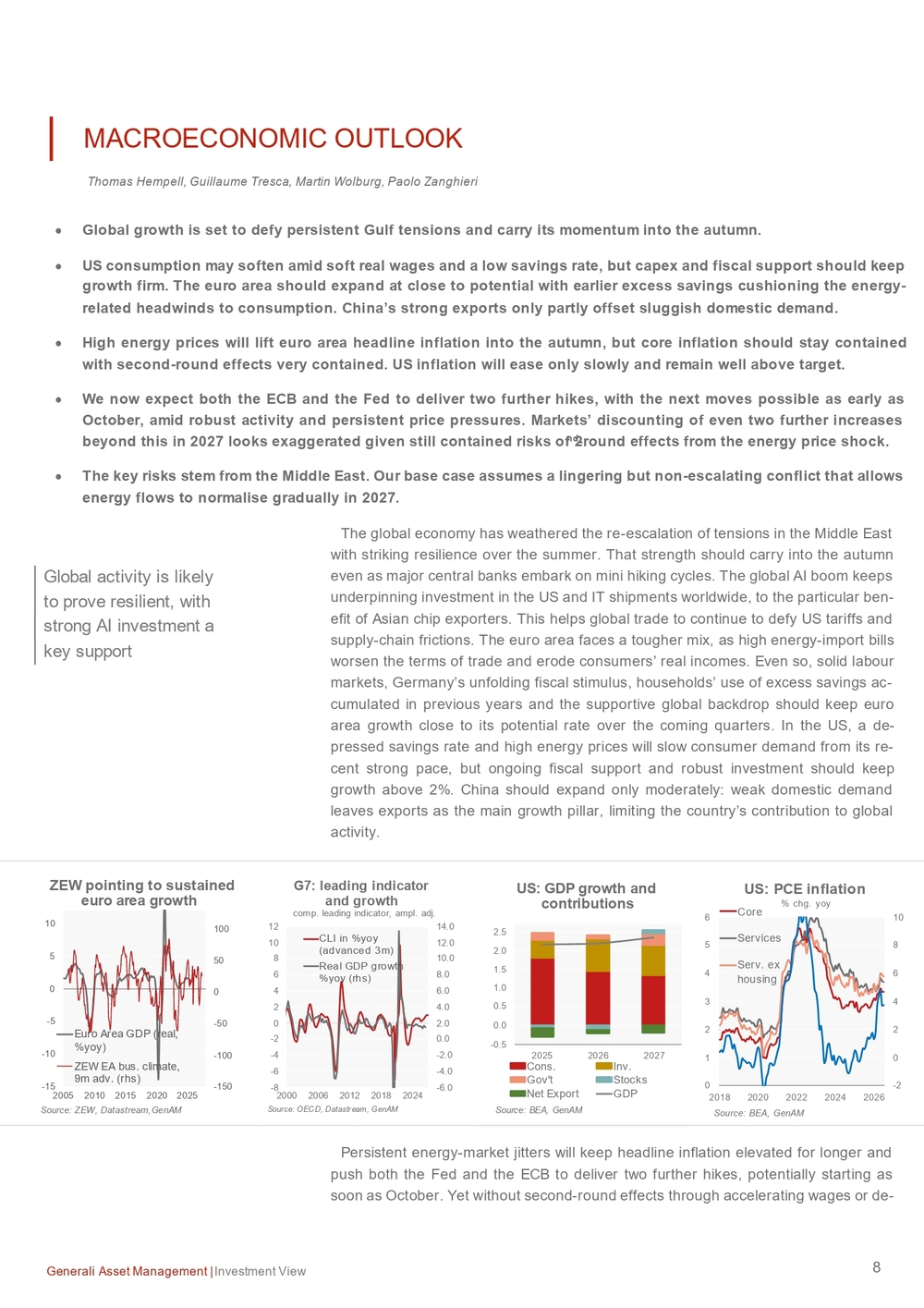
9 Generali Asset Management | Investment View anchored inflation expectations , the impact on core inflation should stay modest. Mon- etary tightening in the US and the euro area will therefore fall short of what markets currently price. Mounting evidence of successful reflation and the desire to support a weak yen argue for at least two further hikes also by the BoJ. We see three key downside risks to this outlook : a further escalation in the Middle East that disrupts energy supply, a sustained sharp rise in bond yields , and disap- pointment over the returns on AI investment. US: growth to accelerate, Fed tilts hawkish US d omestic demand remains strong: we forecast GDP growth of 2.2% this year and 2.3% next. AI -related investment is the main engine, but surveys and orders suggest momentum is broadening beyond technology. Consumption is growing at over 2% annualised despite s tagnant real incomes, supported by equity wealth gains among affluent households and dissaving . Reliance on AI and equity wealth is the key vul- nerability: weaker AI demand could sharply reduce investment and consumption. The labour market remains stable , with unemployment at 4.1% in August. Yet surveys point to limited job creation. Alongside strong productivity, this suggests relatively job - poor growth, constraining household income and spending. Inflation is the central risk as the Gulf conflict keeps lingering . Headline CPI inflation accelerated to 3.4% in August, with motor fuel prices up 28%, threatening spillovers into core inflation. Services PCE inflation remained at 3.7% in July , but s lower wage growth, strong productivity and softer rents should ease price pressures. Higher fuel and technology -goods prices will partly offset this improvement. We expect core PCE inflation to fall from 3.4% in July to 3.2% by year -end. Methodological changes could reduce the reported rate by up to 0.2pps without altering the underlying trend. Strong demand and persistent inflation have prompted a hawkish policy shift by the Fed. We expect two more rate rises by the end of the year, with the possibility of another one in Q1/27. The market pricing of a total of 100 bps rise by mid -2027 is not consistent with our view of an economy that will grow healthily without overheating. ovem er’s mid -term elections are likely to produce a divided Congress, with Demo- crats very likely to take the House by a small majority. This raises the risk of a debt - ceiling confrontation in January 2027. A deal extending healthcare subsidies in ex- change for tax cuts remains possible but would weaken the fiscal outlook further. We expect the deficit to end 2 026 at around 6% of GDP. Euro area: Growth holds up, but energy forces the ECB's hand Euro area growth is proving more resilient than feared even as an energy -driven inflation spike complicates the picture. Q2 2026 GDP growth was revised up to 0.6% q/q, though ex Irish volatility it held closer to ~¼% q/q, with Q3 surveys even pointing to a stronger momentum. The upswing is broadening: manufacturing PMI hit a four - year high in August/September while the services PMI pared the losses made in the first half of the year, and employment rose 0.1% q/q in Q2. Domestic drivers should sustain this: stronger loan growth, a resilient labour market (unemployment at 6.4%), ample excess savings, and German fiscal spending are key drivers. Higher energy prices dampen real incomes, and policy uncertainty — from the Stra it of Hormuz to domestic politics — weighs on confidence but without derailing the expansion. We lift our 2026 growth forecast to 1.0% (from 0.8%) and keep 1.2% for 2027; risks are roughly balanced. AI key driver and main possible fragility of a healthy growth outlook Fed may be forced to strong tightening if dis- inflation does not ma- terialize Resilient EA growth weathers energy price spike Passthrough from high energy prices will lift headline inflation, but the impact on core in- flation is set to prove moderate
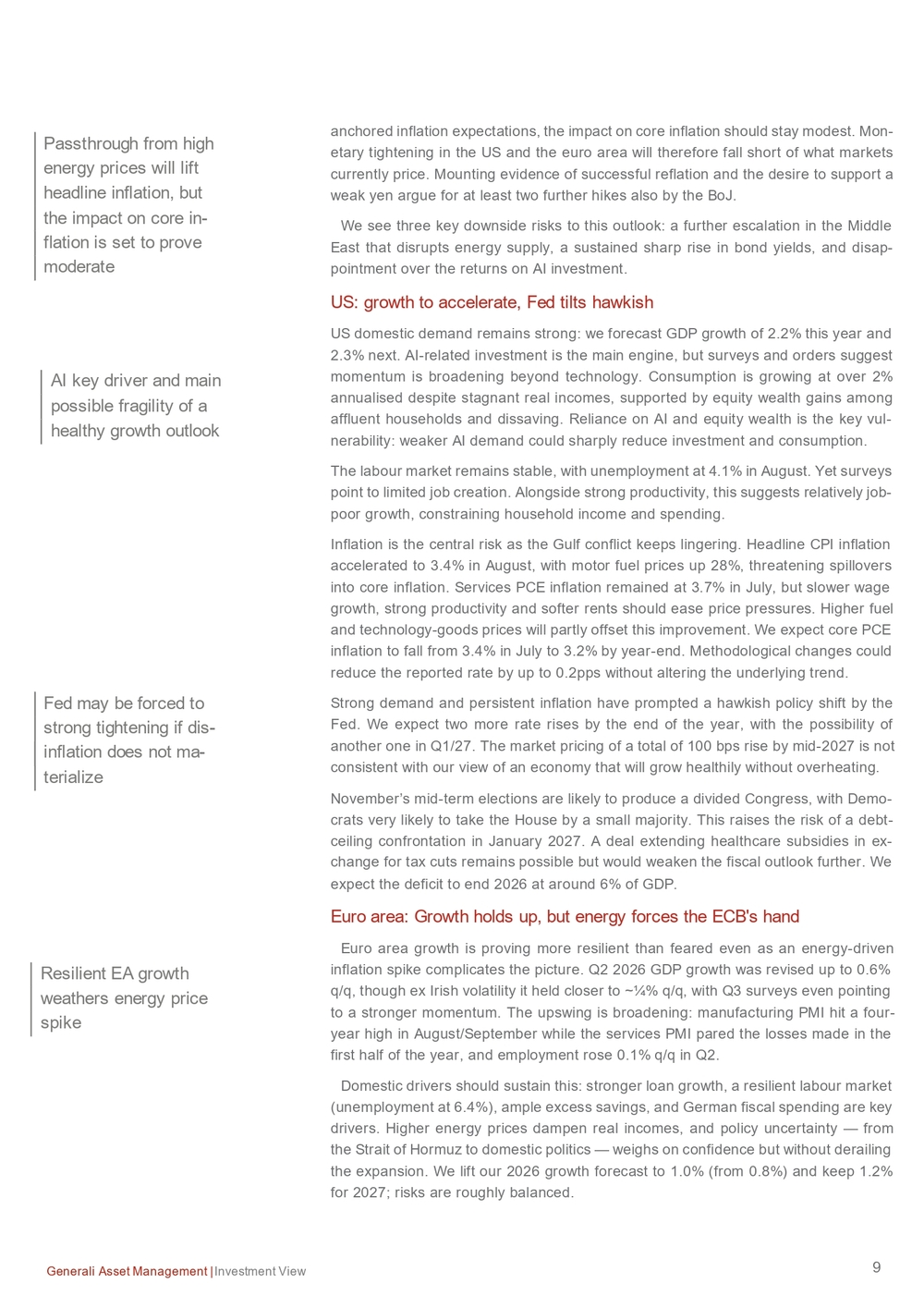
10 Generali Asset Management | Investment View Inflation has re -accelerated: August HICP jumped to 3.2% y/y from 2.9% on energy (+0.37pp), while softer services (3.0% y/y) pulled core to 2.4% y/y. Energy is the clear- est upside risk, with gas prices up ~130% y/y in September. Pipeline pressures — PPI (+ 5.8% y/y), import prices (+3.9%) and commodities (+37%) — point to firmer upstream costs. Wage growth stays moderate, but the longer the spike, the larger the risk of second -round effects. We keep 2026 inflation at 2.9% and lift 2027 to 2.4% (from 2.3%), risks skewed up. The ECB has responded, unanimously raising the key rate by 25 bp to 2.50% in September, citing Middle East tensions as the main driver. Staff lifted the 2026 -27 inflation path by a cumulative 0.4pp (core: +0.2pp) and GDP growth by 0.3pp. Presi- dent Lagarde struck a hawkish tone, warning inflation will stay "well above target for an extended period" with risks "to the upside." We see two further hikes to 3.0%, expecting moves in December and March, with the risk of earlier or stronger tighten- ing. China: the slowdown of a K -shaped economy ina’s economy as continued to lose momentum wit weak domestic demand contrasting with resilient exports and a strong tech sector. The latest data were dis- appointing across the board. Investment weakened, and retail sales remained sub- dued, while PMIs e ventually edged higher. Inflation has also started to soften again. This increasingly K -shaped picture puts the 4.5% growth target at risk. Policymakers have become somewhat more supportive, but there is still little appe- tite for a large stimulus package. The priority is to speed up fiscal spending and make better use of local government bond proceeds. Fiscal room remains available, so fur- ther measures could follow if the data weaken, although support is likely to remain modest. The property sector continues to weigh heavily on household confidence and con- sumption. New announced housing measures may help, but they will not be enough on their own. A more lasting recovery requires a stabilisation of the housing market and a stronger social safety net. On a different front, the trade truce with the US re- mains fragile, albeit the peak of tensions is likely behind us. The gradual decoupling of the two economies is likely to continue, with further sporadic tensions along the way.
inde points erv I an I
yoy wa e tracker smoot ed incl one o s ervices in lation correlation
u u u u iscal e penditures ytd yoy iscal revenues ytd yoy
cumulative sum n Upside risks to inflation but no signs for sec- ond-round effects yet Hawkish ECB is not yet done, 3.0% by Q1/2027 likely Pragmatic policymak- ers but not in rush to provide a big stimulus
11 Generali Asset Management | Investment View GOVERNMENT BONDS Florian Späte
• Government bond yields should remain under pressure as hawkish central banks, resilient US and euro area growth , and underpriced energy -driven inflation risks constrain any rally, although stretched valua- tions leave room for a temporary correction . • Markets price an excessively restrictive Fed and ECB path, but falling rate expectations may not lower long yields: heavy issuance, fiscal uncertainty, and price -sensitive private buyers should instead rebuild term premia . • Euro area non-core spreads are likely to remain broadly range bound as resilient demand and advanced issuance cushion volatility. OATs remain the exception: ’ outlook and the 2027 election should sustain a political premium and drive moderate medium -term widening . Near term, yields should remain under pressure. Hawkish central banks, resili- ent activity, and heavy sovereign issuance continue to test demand for duration, while sticky inflation and volatile energy prices limit the scope for policy easing. The Fed and ECB still need convincing evidence that inflatio n is returning sustainably to target, and firm US demand, resilient labour markets and improving euro area activity give them little reason to turn dovish. Stronger nominal growth therefore remains a head- wind for bonds. Market pricing nevertheless looks too hawkish. The rise in 10 -year yields has re- flected a sharp repricing of expected policy rates rather than duration risk. As inflation gradually recedes, part of this component should unwind. After the speed of the recen t sell-off, stretched valuations could amplify a short -covering rally. We would therefore not chase the move at current levels, even though our directional view remains bear- ish on duration. Our baseline is a limited tactical correction rather than a lasting rally. A material fall in oil and gas prices – most plausibly after durable progress towards resolving the Middle East conflict – would lower headline inflation and rate expectations, pushing yields temporarily lower. Softer economic surprises could reinforce the move. How- ever, energy -driven inflation risks remain underpriced: disruptions around the Strait of Hormuz, AI -related energy demand and geopolitical or weather -related food -price shocks could quickly revive inflation compensation and cap any rally. Even after a setback, yields should remain high over the short -term horizon. We forecast 10 -year Bund yields at 3.65% in 3 months and 3.70% in 12 months, and 10 - year US Treasury yields at 5.25% and 5.35%, respectively. The asymmetry matters for investors: weaker data or lower oil prices may create tactical opportunities, but persistent inflation and policy caution should limit gains. We therefore maintain a cau- tious duration stance. Medium term, a higher -yield regime should prevail. Fiscal risks, sticky inflation, heavier public and private funding needs, and a less supportive buyer base have pushed yields to multi -year highs. Ageing populations, rearmament and the climate transition will keep spending and issuance elevated, while AI , infrastructure and en- ergy investment compete for the same pool of savings. This is a normalisation towards a higher equilibrium yield, not a cyclical overshoot. Stretched valuations leave room for a tacti- cal rally Term premia, not pol- icy expectations, drive the next leg
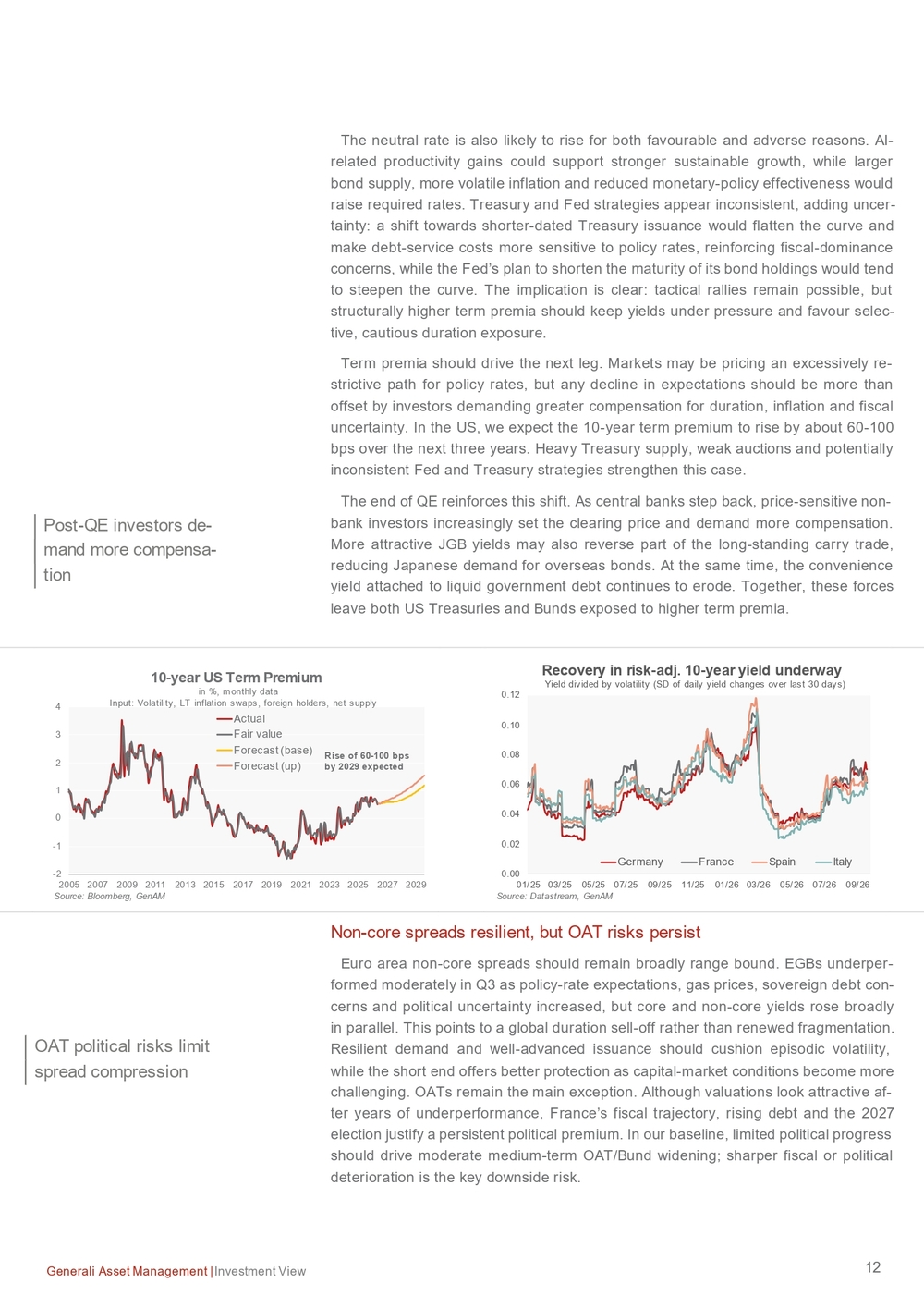
12 Generali Asset Management | Investment View Term premia should drive the next leg. Markets may be pricing an excessively re- strictive path for policy rates, but any decline in expectations should be more than offset by investors demanding greater compensation for duration, inflation and fiscal uncert ainty. In the US, we expect the 10 -year term premium to rise by about 60 -100 bps over the next three years. Heavy Treasury supply, weak auctions and potentially inconsistent Fed and Treasury strategies strengthen this case. The end of QE reinforces this shift. As central banks step back, price -sensitive non - bank investors increasingly set the clearing price and demand more compensation. More attractive JGB yields may also reverse part of the long -standing carry trade, reducin g Japanese demand for overseas bonds. At the same time, the convenience yield attached to liquid government debt continues to erode. Together, these forces leave both US Treasuries and Bunds exposed to higher term premia. Non-core spreads resilient, but OAT risks persist Euro area non -core spreads should remain broadly range bound. EGBs underper- formed moderately in Q3 as policy -rate expectations, gas prices, sovereign debt con- cerns and political uncertainty increased, but core and non -core yields rose broadly in parallel. This points to a global duration sell -off rather than renewed fragmentation. Resilient demand and well -advanced issuance should cushion episodic volatility, while the short end offers better protection as capital -market conditions become more challenging. OATs remain the main exception. Although valuations look attractive af- ter years o underper ormance rance’s iscal tra ectory risin de t and t e election justify a persistent political premium. In our baseline, limited political progress should dr ive moderate medium -term OAT/Bund widening; sharper fiscal or political deterioration is the key downside risk.The neutral rate is also likely to rise for both favourable and adverse reasons. AI - related productivity gains could support stronger sustainable growth, while larger bond supply, more volatile inflation and reduced monetary -policy effectiveness would raise required rates. Treasury and Fed strategies appear inconsistent, adding uncer- tainty: a shift towards shorter -dated Treasury issuance would flatten the curve and make debt -service costs more sensitive to policy rates, reinforcing fiscal -dominance concerns w ile t e ed’s plan to s orten t e maturity o its ond oldin s would tend to steepen the curve. The implication is clear: tactical rallies remain possible, but structurally higher term premia should keep yields under pressure and favour selec- tive, cau tious duration exposure.
ctual air value orecast ase orecast up in mont ly data Input Volatility in lation swaps orei n olders net supply
ield divided y volatility o daily yield c an es over last days ermany rance pain Italy
OAT political risks limit spread compression Post-QE investors de- mand more compensa- tion
13 Generali Asset Management | Investment View CREDIT Elisa Belgacem
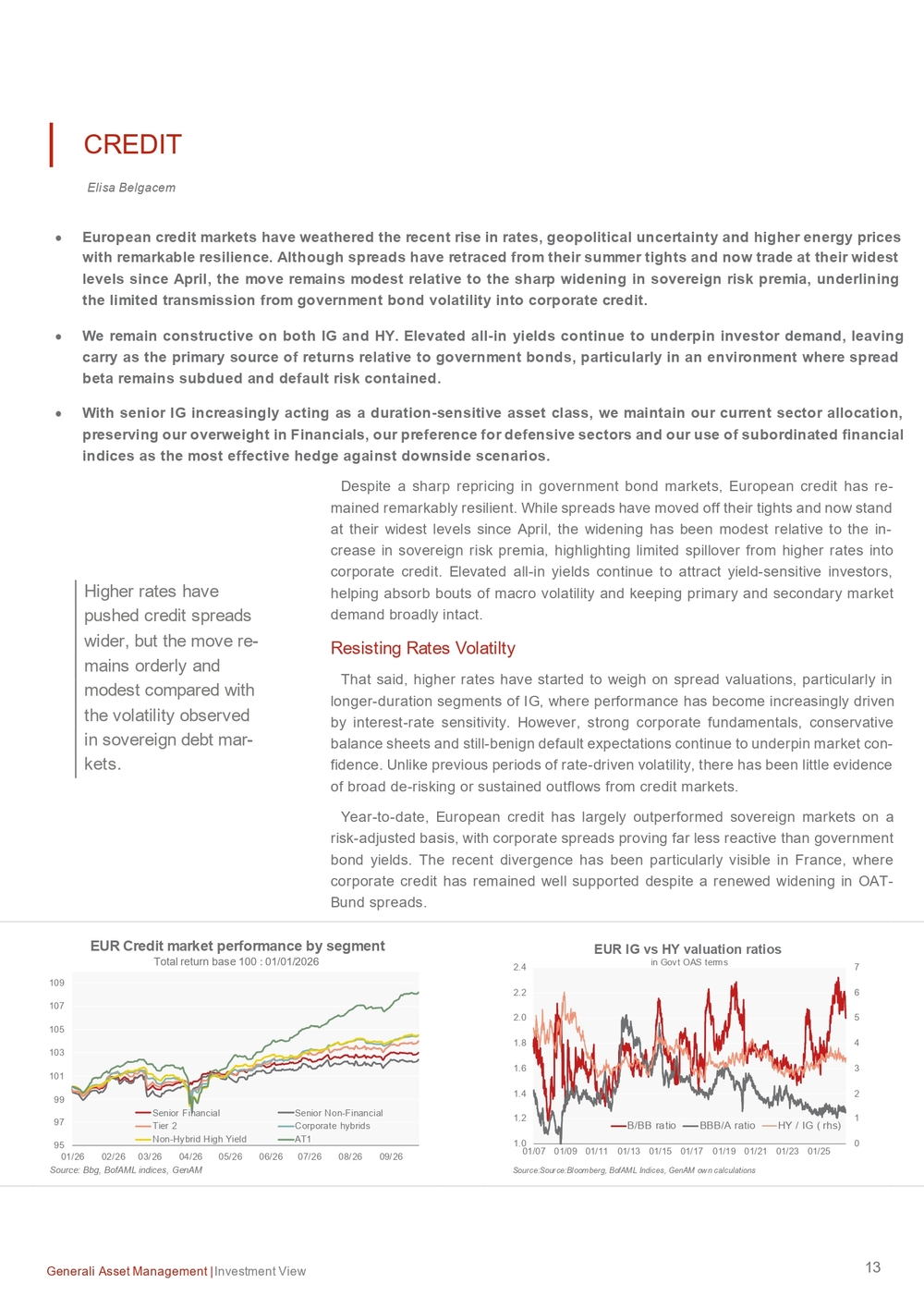
• European credit markets have weathered the recent rise in rates, geopolitical uncertainty and higher energy prices with remarkable resilience. Although spreads have retraced from their summer tights and now trade at their widest levels since April, the mov e remains modest relative to the sharp widening in sovereign risk premia, underlining the limited transmission from government bond volatility into corporate credit. • We remain constructive on both IG and HY. Elevated all -in yields continue to underpin investor demand, leaving carry as the primary source of returns relative to government bonds, particularly in an environment where spread beta remains subdued and default risk contained. • With senior IG increasingly acting as a duration -sensitive asset class, we maintain our current sector allocation, preserving our overweight in Financials, our preference for defensive sectors and our use of subordinated financial indices as the most effec tive hedge against downside scenarios. Despite a sharp repricing in government bond markets, European credit has re- mained remarkably resilient. While spreads have moved off their tights and now stand at their widest levels since April, the widening has been modest relative to the in- crease in so vereign risk premia, highlighting limited spillover from higher rates into corporate credit. Elevated all -in yields continue to attract yield -sensitive investors, helping absorb bouts of macro volatility and keeping primary and secondary market demand broadly intact. Resisting Rates Volatilty That said, higher rates have started to weigh on spread valuations, particularly in longer -duration segments of IG, where performance has become increasingly driven by interest -rate sensitivity. However, strong corporate fundamentals, conservative balance sheets and still -benign default expectations continue to underpin market con- fidence. Unlike previous periods of rate -driven volatility, there has been little evidence of broad de -risking or sustained outflows from credit markets. Year -to-date, European credit has largely outperformed sovereign markets on a risk-adjusted basis, with corporate spreads proving far less reactive than government bond yields. The recent divergence has been particularly visible in France, where corporate credit has remained well supported despite a renewed widening in OAT - Bund spreads.
enior inancial enior on inancial ier orporate y rids on y rid i ield otal return ase
ratio ratio I r s
in ovt termsHigher rates have pushed credit spreads wider, but the move re- mains orderly and modest compared with the volatility observed in sovereign debt mar- kets.
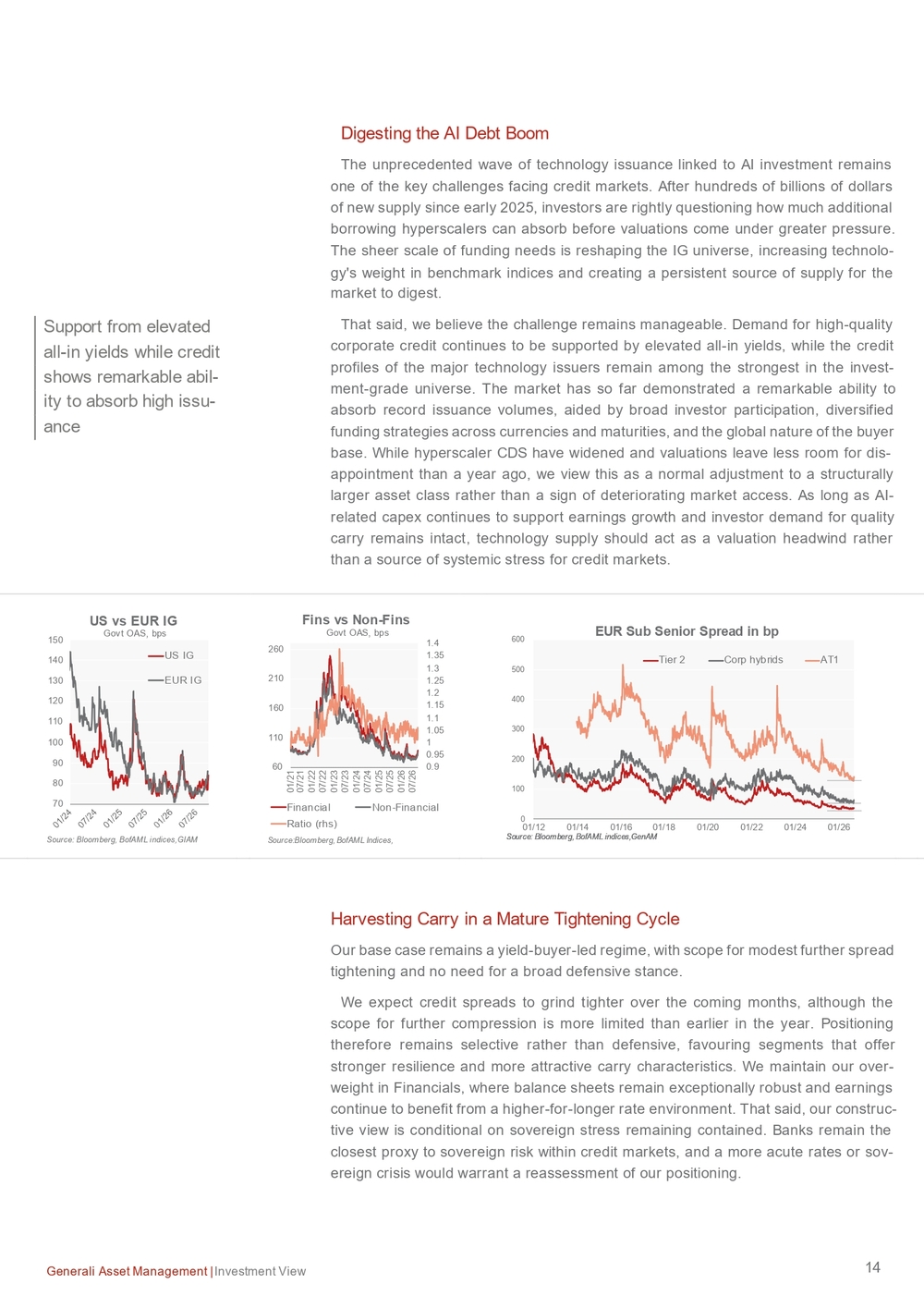
14 Generali Asset Management | Investment View Digesting the AI Debt Boom The unprecedented wave of technology issuance linked to AI investment remains one of the key challenges facing credit markets. After hundreds of billions of dollars of new supply since early 2025, investors are rightly questioning how much additional borro wing hyperscalers can absorb before valuations come under greater pressure. The sheer scale of funding needs is reshaping the IG universe, increasing technolo- gy's weight in benchmark indices and creating a persistent source of supply for the market to digest. That said, we believe the challenge remains manageable. Demand for high -quality corporate credit continues to be supported by elevated all -in yields, while the credit profiles of the major technology issuers remain among the strongest in the invest- ment -grade universe. The market has so far demonstrated a remarkable ability to absorb record issuance volumes, aided by broad investor participation, diversified funding strategies across currencies and maturities, and the global nature of the buyer base. While hyperscaler CDS have widened and valuations leave less room for dis- appointment than a year ago, we view this as a normal adjustment to a structurally larger asset class rather than a sign of deteriorating market access. As long as AI - related capex c ontinues to support earnings growth and investor demand for quality carry remains intact, technology supply should act as a valuation headwind rather than a source of systemic stress for credit markets.
Harvesting Carry in a Mature Tightening Cycle Our base case remains a yield -buyer -led regime, with scope for modest further spread tightening and no need for a broad defensive stance. We expect credit spreads to grind tighter over the coming months, although the scope for further compression is more limited than earlier in the year. Positioning therefore remains selective rather than defensive, favouring segments that offer stronger res ilience and more attractive carry characteristics. We maintain our over- weight in Financials, where balance sheets remain exceptionally robust and earnings continue to benefit from a higher -for-longer rate environment. That said, our construc- tive view is co nditional on sovereign stress remaining contained. Banks remain the closest proxy to sovereign risk within credit markets, and a more acute rates or sov- ereign crisis would warrant a reassessment of our positioning.
I I
ovt ps
inancial on inancial atio r s
ovt ps
ier orp y rids
Support from elevated all-in yields while credit shows remarkable abil- ity to absorb high issu- ance
15 Generali Asset Management | Investment View EM SOVEREIGN BONDS Guillaume Tresca
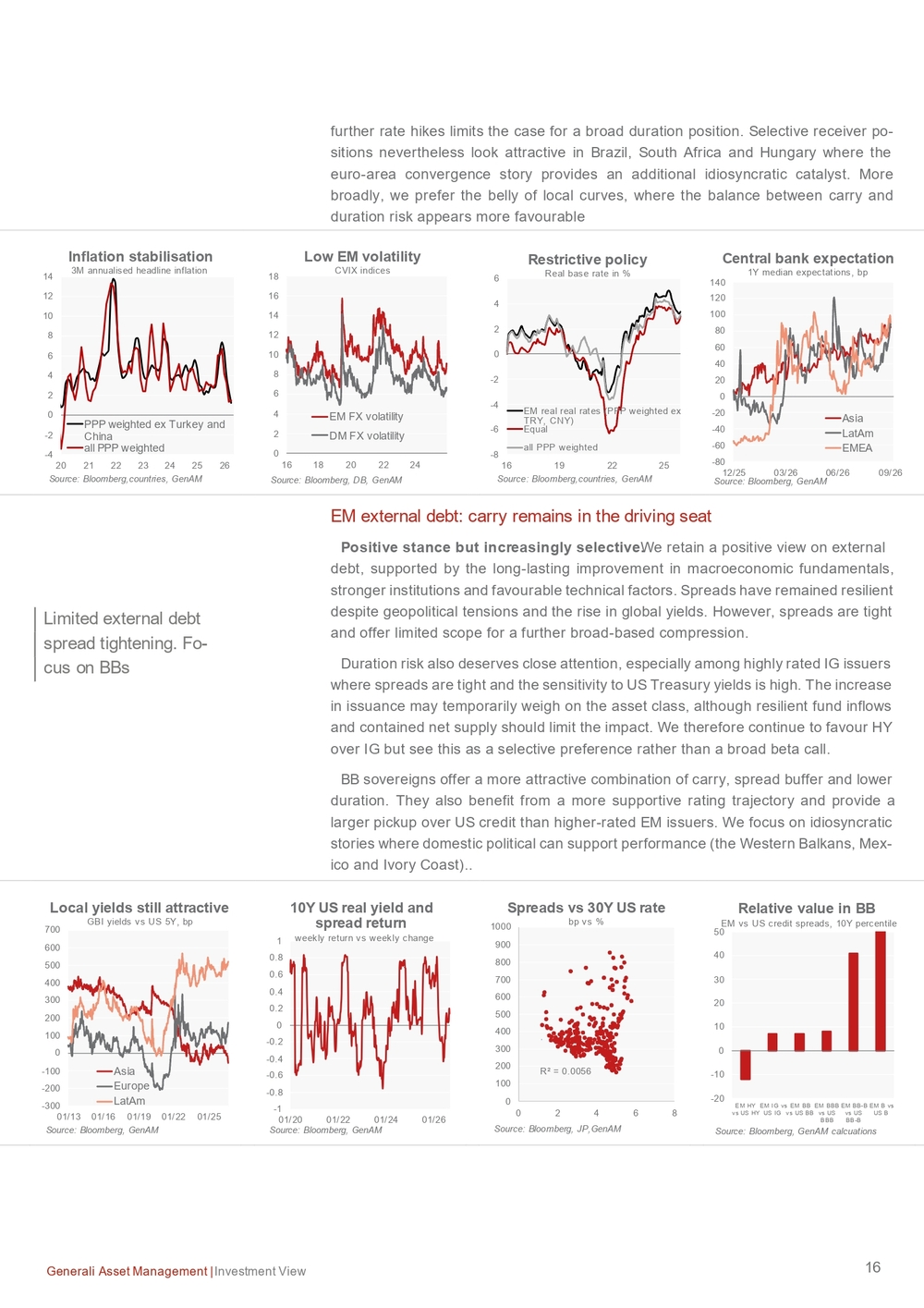
• The EM macroeconomic environment h as remained supportive so far with solid business sentiment, a stabilisation of inflation and proactive EM central banks. • EM fixed income has been resilient but tight valuations and the risk of further Fed tightening call for greater selec- tivity. Carry should remain the main return driver, rather than a broad compression in risk premia. • Loca l debt still offers the best risk reward with better valuations and less duration exposure. In external debt, we remain cautious on the longest -duration IG names and focus on BBs with solid idiosyncratic stories . A more selective carry environment. EM fixed income continues to show resilience despite geopolitical tensions and the rise in global long -term yields. The conflict in the Middle East has had a limited macroeconomic impact so far. Inflation has barely accelerated, business sentiment remains solid and the credit -rating trajectory continues to improve. At the same time, the rise in long -term yields has not materially affected EM assets, with external debt spreads remaining resilient . Stronger fundamentals provide a buffer against higher yields. The relationship between external debt spreads and long -term US yields has weakened, as higher real yields are not necessarily negative for EM assets when global growth remains resili- ent. Improving policy credibility and healthier macroeconomic fundamenta ls have also c an ed investors’ perception of EM risk. In contrast with previous periods of rising US yields, a broadly stable US dollar has given EM central banks more room to man- age domestic conditions and has prevented the dollar from acting as a major shock amplifier . Technical factors also remain supportive. EM net supply is still contained, and fund inflows have proved resilient, providing an important anchor in a more vola- tile global environment. Overall, we maintain a positive view supported by resilient growth, high real yields and improving credit fundamentals. Tight valuations and the risk of further Fed tight- ening call for greater selectivity. Carry should remain the main return driver, rather than a broad compression in risk premia . EM local debt: the best risk -reward Maintain our preference for local debt . EM local debt continues to offer a better risk-reward than external debt. Valuations are more attractive, carry remains high and the lower duration effect makes the segment less vulnerable to a further rise in long - term US yields. The combination of high real rates, a stable US dollar and resilient global growth should continue to provide a favourable backdrop, even if a more vola- tile environment requires a selective approach . Favour FX and the belly of local curves. We maintain our preference for EM FX over rates. Currency volatility remains low, real rates are still high, and the stability of the US dollar supports carry strategies. We continue to favour high yielders (the BRL, TRY) but prefer to use a wider basket of funding currencies to reduce the exposure to individual risks. Asian currencies (the KRW, TWD) still have room to perform and should also benefit from a stronger JPY and CNH. By contrast, we avoid the ZAR We remain neutral on EM rates . Valuations have become more attractive, but up- side risks to yields remain significant. EM rates continue to act as the main adjustment valve when inflation or monetary policy expectations change, while the possibility of Resilience so far but limited r oom for spread tightening Better valuations in EM local debt
16 Generali Asset Management | Investment View further rate hikes limits the case for a broad duration position. Selective receiver po- sitions nevertheless look attractive in Brazil, South Africa and Hungary where the euro-area convergence story provides an additional idiosyncratic catalyst. More broadly, we prefer the belly of local curves, where the balance between carry and duration risk appears more favourable
EM external debt: carry remains in the driving seat Positive stance but increasingly selective. We retain a positive view on external debt, supported by the long -lasting improvement in macroeconomic fundamentals, stronger institutions and favourable technical factors. Spreads have remained resilient despite geopolitical tensions and the rise in globa l yields . However, spreads are tight and offer limited scope for a further broad -based compression. Duration risk also deserves close attention, especially among highly rated IG issuers where spreads are tight and the sensitivity to US Treasury yields is high. The increase in issuance may temporarily weigh on the asset class, although resilient fund infl ows and contained net supply should limit the impact. We therefore continue to favour HY over IG but see this as a selective preference rather than a broad beta call. BB sovereigns offer a more attractive combination of carry, spread buffer and lower duration. They also benefit from a more supportive rating trajectory and provide a larger pickup over US credit than higher -rated EM issuers. We focus on idiosyncratic stories where domestic political can support performance (the Western Balkans, Mex- ico and Ivory Coast). .
wei ted e urkey and ina all wei ted annualised eadline in lation
volatility volatility VI indices
real real rates wei ted e
qual all wei ted eal ase rate in
sia at m
median e pectations p
sia urope at m I yields vs p
weekly return vs weekly c an e
p vs
vs I vs I vs vs
vs vs
vs credit spreads percentile Limited external debt spread tightening. Fo- cus on BBs
17 Generali Asset Management | Investment View CURRENCIES Thomas Hempell
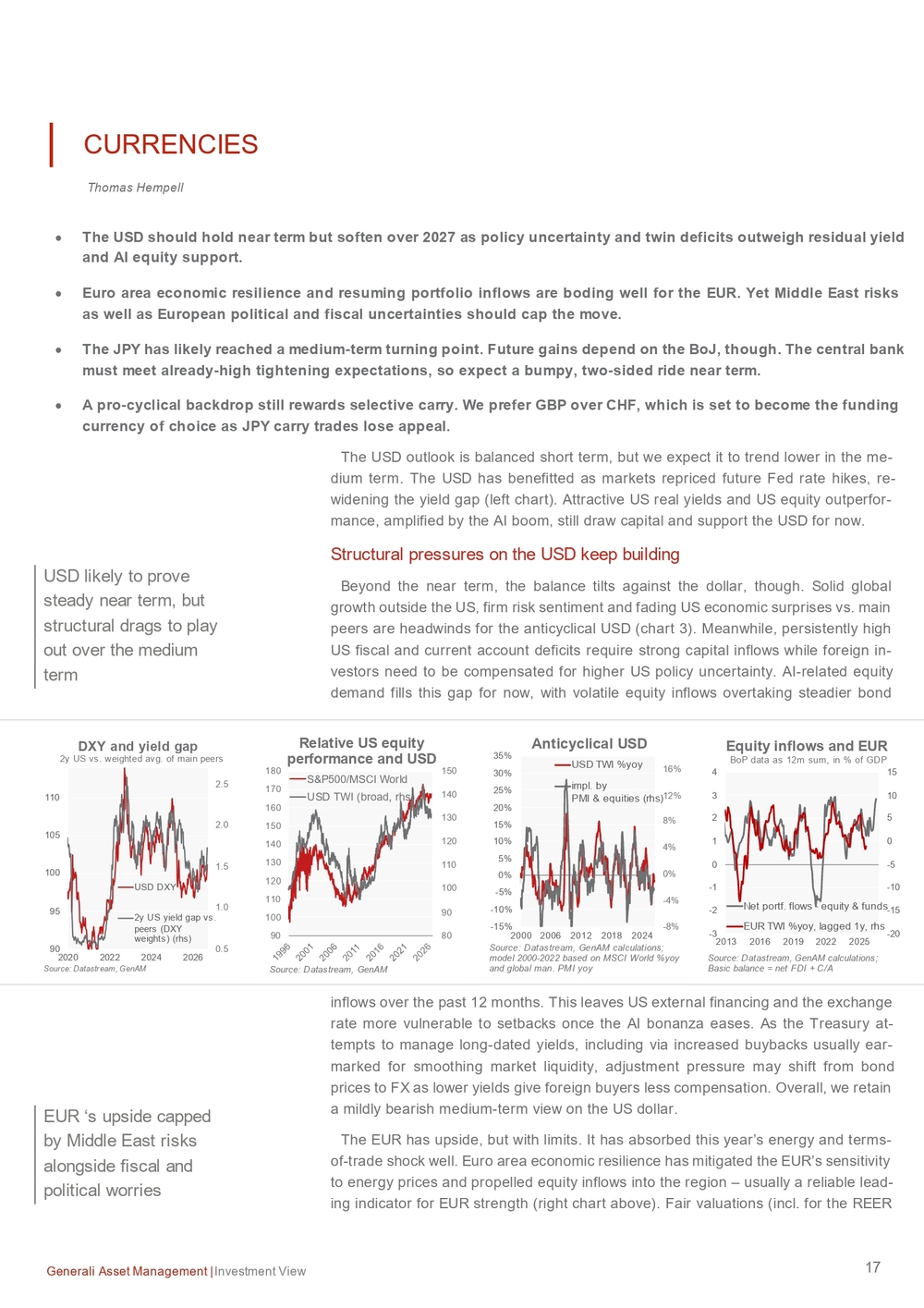
• The USD should hold near term but soften over 2027 as policy uncertainty and twin deficits outweigh residual yield and AI equity support. • Euro area economic resilience and resuming portfolio inflows are boding well for the EUR. Yet Middle East risks as well as European political and fiscal uncertainties should cap the move. • The JPY has likely reached a medium -term turning point . Future gains depend on the BoJ , though . The central bank must meet already -high tightening expectations, so expect a bumpy, two -sided ride near term. • A pro -cyclical backdrop still rewards selective carry. We prefer GBP over CHF, which is set to become the funding currency of choice as JPY carry trades lose appeal . The USD outlook is balanced short term, but we expect it to trend lower in the me- dium term. The USD has benefitted as markets repriced future Fed rate hikes, re - widening the yield gap (left chart). Attractive US real yields and US equity outperfor- mance, am plified by the AI boom, still draw capital and support the USD for now. Structural pressures on the USD keep building Beyond the near term, the balance tilts against the dollar, though. Solid global growth outside the US, firm risk sentiment and fading US economic surprises vs. main peers are headwinds for the anticyclical USD (chart 3). Meanwhile, persistently high US fi scal and current account deficits require strong capital inflows while foreign in- vestors need to be compensated for higher US policy uncertainty. AI -related equity demand fills this gap for now, with volatile equity inflows overtaking steadier bond inflows over the past 12 months. This leaves US external financing and the exchange rate more vulnerable to setbacks once the AI bonanza eases. As the Treasury at- tempts to manage long -dated yields, including via increased buybacks usually ear- marked for smoothing market liquidity, adjustment pressure may shift from bond prices to FX as lower yields give foreign buyers less compensation. Overall, we retain a mildly bearish medium -term view on the US dollar. e as upside ut wit limits It as a sor ed t is year’s ener y and terms - of-trade s ock well uro area economic resilience as miti ated t e ’s sensitivity to energy prices and propelled equity inflows into the region – usually a reliable lead- ing indicator for EUR strength (right chart above). Fair valuations (incl. for the REER
y yield ap vs peers wei ts r s
y vs wei ted av o main peers
& I orld I road r s
I yoy impl y I & equities r s
et port lows equity & unds I yoy la ed y r s
o data as m sum in o USD likely to prove steady near term, but structural drags to play out over the medium term ‘s upside capped by Middle East risks alongside fiscal and political worries
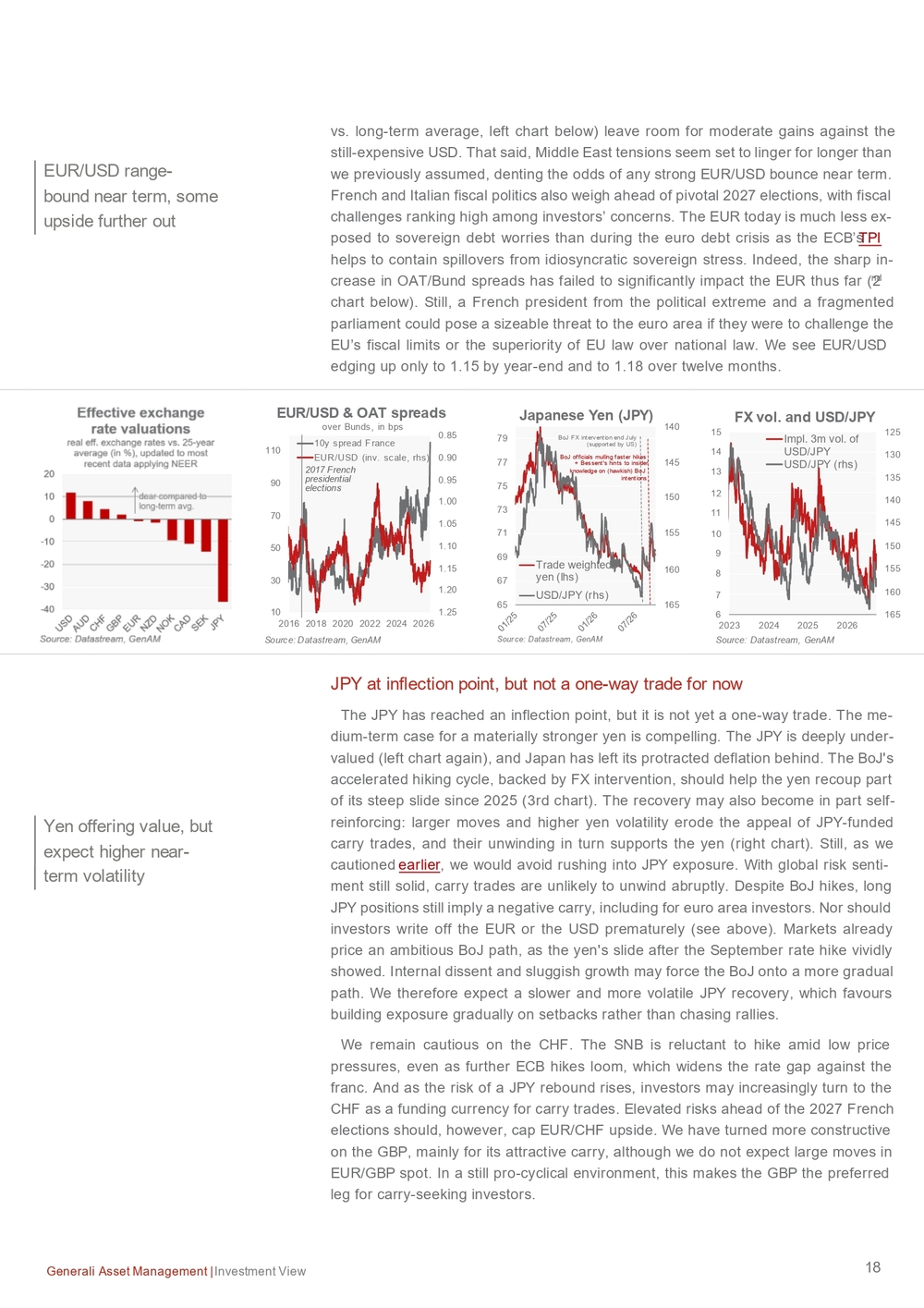
18 Generali Asset Management | Investment View vs. long -term average, left chart below) leave room for moderate gains against the still-expensive USD. That said, Middle East tensions seem set to linger for longer than we previously assumed, denting the odds of any strong EUR/USD bounce near term. French and Italian fiscal politics also weigh ahead of pivotal 2027 elections, with fisc al c allen es rankin i amon investors’ concerns e today is muc less e posed to soverei n de t worries t an durin t e euro de t crisis as t e ’s TPI helps to contain spillovers from idiosyncratic sovereign stress. Indeed, the sharp in- crease in OAT/Bund spreads has failed to significantly impact the EUR thus far (2nd chart below). Still, a French president from the political extreme and a fragmented parliament could pose a sizeable threat to the euro area if they were to challenge the ’s iscal limits or t e superiority o law over national law e see edging up only to 1.15 by year -end and to 1.18 over twelve months. JPY at inflection point, but not a one -way trade for now The JPY has reached an inflection point, but it is not yet a one -way trade. The me- dium -term case for a materially stronger yen is compelling. The JPY is deeply under- valued (left chart again ), and Japan has left its protracted deflation behind. The BoJ's accelerated hiking cycle, backed by FX intervention, should help the yen recoup part of its steep slide since 2025 (3rd chart). The recovery may also become in part self- reinforcing: larger moves and higher yen volatility erode the appeal of JPY -funded carry trades, and their unwinding in turn supports the yen (right chart). Still, as we cautioned earlier , we would avoid rushing into JPY exposure. With global risk senti- ment still solid, carry trades are unlikely to unwind abruptly. Despite BoJ hikes, long JPY positions still imply a negative carry, including for euro area investors. Nor should investors write off the EUR or the USD prematurely (see above). Markets already price an ambitious BoJ path, as the yen's slide after the September rate hike vividly showed. Internal dissent an d sluggish growth may force the BoJ onto a more gradual path. We therefore expect a slower and more volatile JPY recovery, which favours building exposure gradually on setbacks rather than chasing rallies. We remain cautious on the CHF. The SNB is reluctant to hike amid low price pressures, even as further ECB hikes loom, which widens the rate gap against the franc. And as the risk of a JPY rebound rises, investors may increasingly turn to the CHF as a fundi ng currency for carry trades. Elevated risks ahead of the 2027 French elections should, however, cap EUR/CHF upside. We have turned more constructive on the GBP, mainly for its attractive carry, although we do not expect large moves in EUR/GBP spot. In a s till pro -cyclical environment, this makes the GBP the preferred leg for carry -seeking investors.
y spread rance inv scale r s
over unds in ps
rade wei ted yen l s r s o intervention end uly supported y o o icials mullin aster ikes essent s ints to insider knowled e on awkis o intentions
Impl m vol o
r s EUR/USD range - bound near term, some upside further out Yen offering value, but expect higher near - term volatility
19 Generali Asset Management | Investment View EQUITIES Michele Morganti and Vladimir Oleinikov
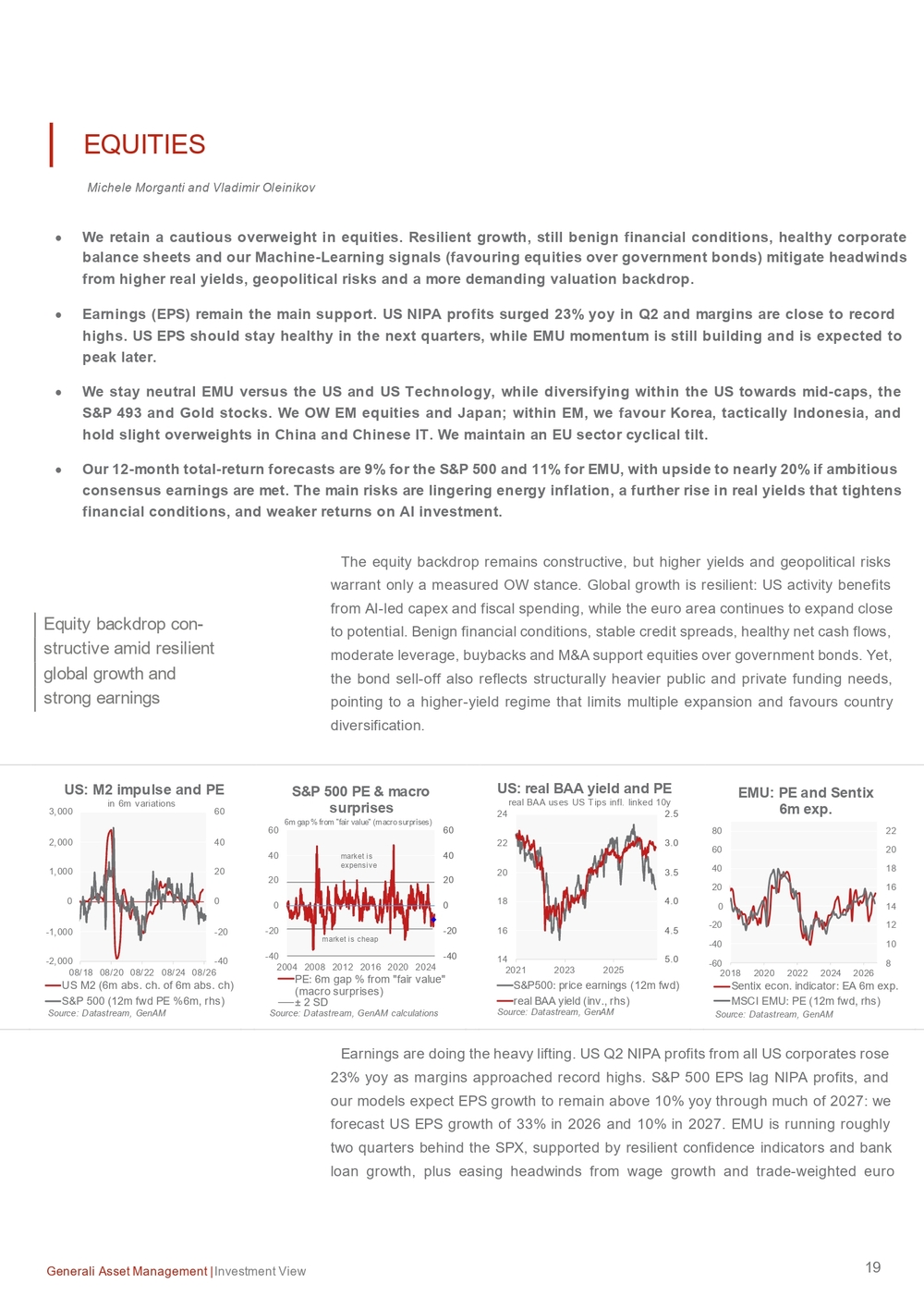
• We retain a cautious overweight in equities. Resilient growth, still benign financial conditions, healthy corporate balance sheets and our Machine -Learning signals (favouring equities over government bonds ) mitigate headwinds from higher real yields, geopolitical risks and a more demanding valuation backdrop. • Earnings (EPS) remain the main support. US NIPA profits surged 23% yoy in Q2 and margins are close to record highs. US EPS should stay healthy in the next quarters, while EMU momentum is still building and is expected to peak later. • We stay neutral EMU versus the US and US Technology, while diversifying within the US towards mid -caps, the S&P 493 and Gold stocks. We OW EM equities and Japan; within EM, we favour Korea, tactically Indonesia, and hold slight overweights in China and Chi nese IT. We maintain an EU sector cyclical tilt. • Our 12 -month total -return forecasts are 9 % for the S&P 500 and 11% for EMU, with upside to nearly 20% if ambitious consensus earnings are met. The main risks are lingering energy inflation, a further rise in real yields that tightens financial conditions, and weaker returns on AI investment. e equity ackdrop remains constructive ut i er yields and eopolitical risks warrant only a measured stance lo al rowt is resilient activity ene its rom I led cape and iscal spendin w ile t e euro area continues to e pand close to potential eni n inancial conditions sta le credit spreads ealt y net cas lows moderate levera e uy acks and & support equities over overnment onds et t e ond sell o also re lects structurally eavier pu lic and private undin needs pointin to a i er yield re ime t at limits multiple e pansion and avours country diversi ication arnin s are doin t e eavy li tin I pro its rom all corporates rose yoy as mar ins approac ed record i s & la I pro its and our models e pect rowt to remain a ove yoy t rou muc o we orecast rowt o in and in is runnin rou ly two quarters e ind t e supported y resilient con idence indicators and ank loan rowt plus easin eadwinds rom wa e rowt and trade wei ted euro
m a s c o m a s c & m wd m r s
in m variations
m ap rom air value macro surprises
m ap rom air value macro surprises market is c eapmarket is e pensive
& price earnin s m wd real yield inv r s
real uses ips in l linked y
enti econ indicator m e p I m wd r s Equity backdrop con- structive amid resilient global growth and stron g earnings
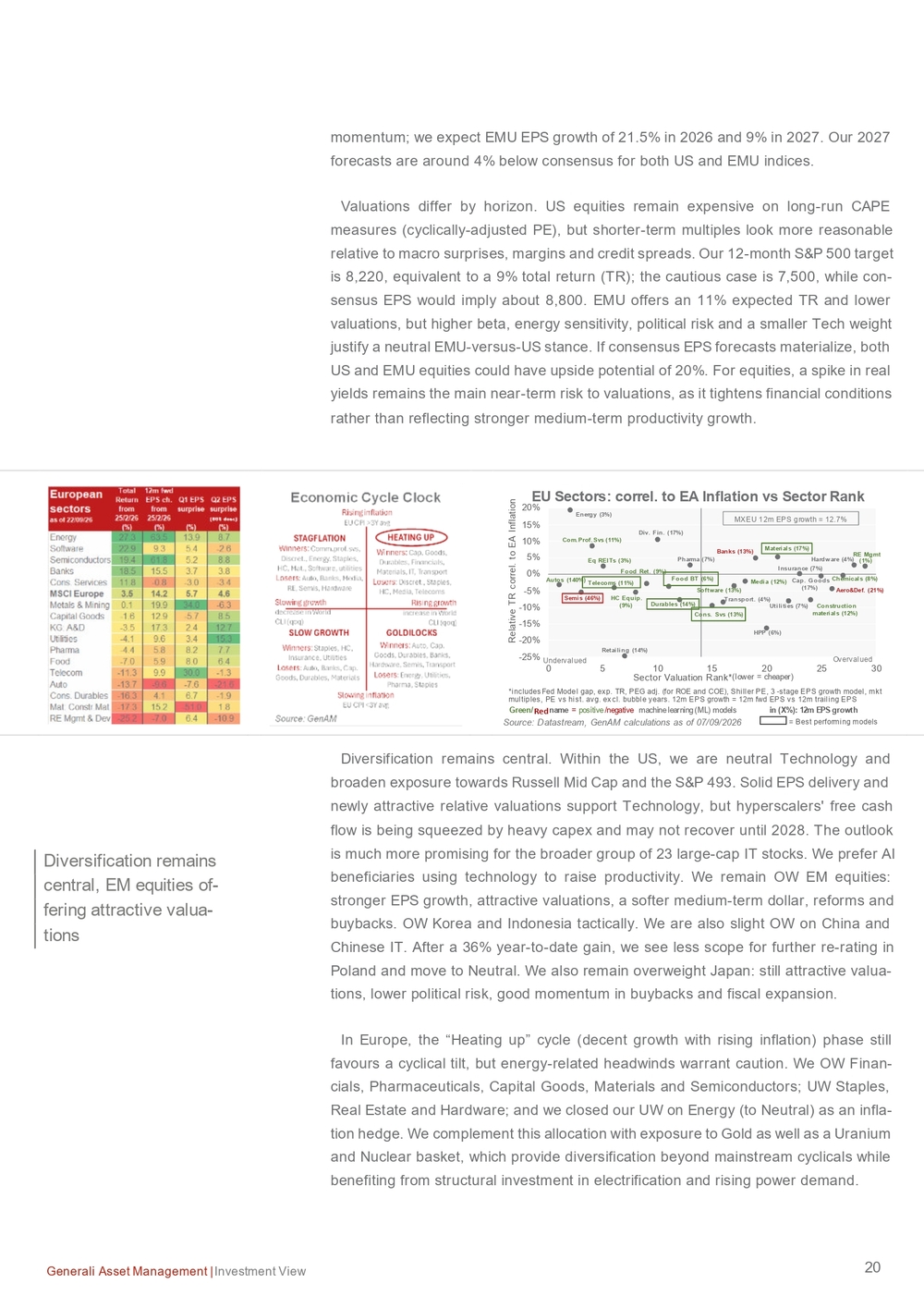
20 Generali Asset Management | Investment View momentum; we e pect rowt o in and in ur orecasts are around elow consensus or ot and indices Valuations di er y orizon equities remain e pensive on lon run measures cyclically ad usted ut s orter term multiples look more reasona le relative to macro surprises mar ins and credit spreads ur mont & tar et is equivalent to a total return ; t e cautious case is w ile con sensus would imply a out o ers an e pected and lower valuations ut i er eta ener y sensitivity political risk and a smaller ec wei t usti y a neutral versus stance I consensus orecasts materialize ot and equities could ave upside potential o or equities a spike in real yields remains t e main near term risk to valuations as it ti tens inancial conditions rat er t an re lectin stron er medium term productivity rowt iversi ication remains central it in t e we are neutral ec nolo y and roaden e posure towards ussell id ap and t e & olid delivery and newly attractive relative valuations support ec nolo y ut yperscalers ree cas low is ein squeezed y eavy cape and may not recover until e outlook is muc more promisin or t e roader roup o lar e cap I stocks e pre er I ene iciaries usin tec nolo y to raise productivity e remain equities stron er rowt attractive valuations a so ter medium term dollar re orms and uy acks Korea and Indonesia tactically e are also sli t on ina a nd inese I ter a year to date ain we see less scope or urt er re ratin in oland and move to eutral e also remain overwei t apan still attractive valua tions lower pol itical risk ood momentum in uy acks and iscal e pansion In urope t e “ eatin up” cycle decent rowt wit risin in lation p ase still avours a cyclical tilt ut ener y related eadwinds warrant caution e inan cials armaceuticals apital oods aterials and emiconductors; taples eal sta te and ardware; and we closed our on ner y to eutral as an in la tion ed e e complement t is allocation wit e posure to old as well as a ranium and uclear asket w ic provide diversi ication eyond mainstream cyclicals w ile ene itin rom structural investment in electri ication and risin power demand
elative correl to In lation ector Valuation ank lower c eaper positive ne ative mac ine learnin models includes ed odel ap e p ad or and iller sta e rowt model mkt multiples vs ist av e cl u le years m rowt m wd vs m trailin
est per ormin models ndervalued vervalued m rowt Diversification remains central , EM equities of- fering attractive valu a- tions
21 Generali Asset Management | Investment View ASSET ALLOCATION Thorsten Runde
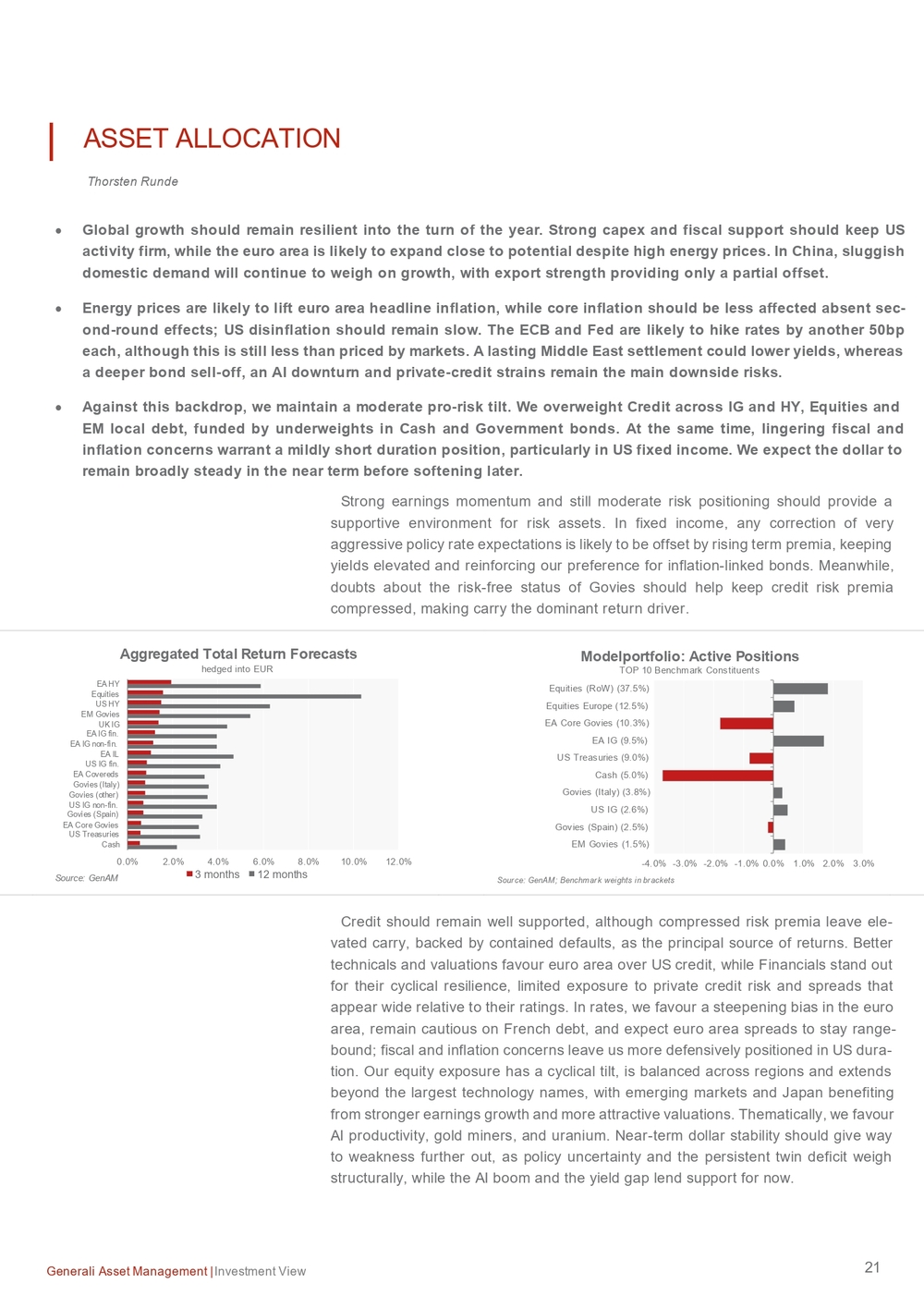
• Global growth should remain resilient into the turn of the year . Strong capex and fiscal support should keep US activity firm, while the euro area is likely to expand close to potential despite high energy prices. In China, sluggish domestic demand will continue to weigh on growth, with export strength providing only a partial offset. • Energy prices are likely to lift euro area headline inflation, while core inflation should be less affected absent sec- ond-round effects; US disinflation should remain slow. The ECB and Fed are likely to hike rates by another 50bp each, although this is still less than priced by markets . A lasting Middle East settlement could lower yields, whereas a deeper bond sell -off, an AI downturn and private -credit strains remain the main downside risks. • Against this backdrop, we maintain a moderate pro -risk tilt. We overweight Credit across IG and HY, Equities and EM local debt, funded by underweights in Cash and Government bonds. At the same time, lingering fiscal and inflation concerns warrant a mildly short duration position, particularly in US fixed income. We expect the dollar to remain broadly steady in the near term before softening later. Strong earnings momentum and still moderate risk positioning should provide a supportive environment for risk assets. In fixed income, a ny correction of very aggressive policy rate expectations is likely to be offset by rising term premia, keeping yields elevated and reinforcing our preference for inflation -linked bonds. Meanwhile, doubts about the risk -free status of Govies should help keep credit risk premia compressed, making carry the dominant return driver. Credit should remain well supported, although compressed risk premia leave ele- vated carry, backed by contained defaults, as the principal source of returns. Better technicals and valuations favour euro area over US credit, while Financials stand out for th eir cyclical resilience, limited exposure to private credit risk and spreads that appear wide relative to their ratings. In rates, we favour a steepening bias in the euro area, remain cautious on French debt, and expect euro area spreads to stay range - bound; fiscal and inflation concerns leave us more defensively positioned in US dura- tion. Our equity exposure has a cyclical tilt, is balanced across regions and extends beyond the largest technology names, with emerging markets and Japan benefiting from stronger earnings growth and more attractive valuations. Thematically, we favour AI productivity, gold miners , and uranium. Near -term dollar stability should give way to weakness further out, as policy uncertainty and the persistent twin deficit weigh structurally, while the AI boom and the yield gap lend support for now.
as reasuries ore ovies ovies pain I non in ovies ot er ovies Italy overeds I in I I non in I in K I ovies quities mont s mont s ed ed into
quities o quities urope ore ovies I reasuries as ovies Italy I ovies pain ovies enc mark onstituents
22 Generali Asset Management | Investment View FORECASTS
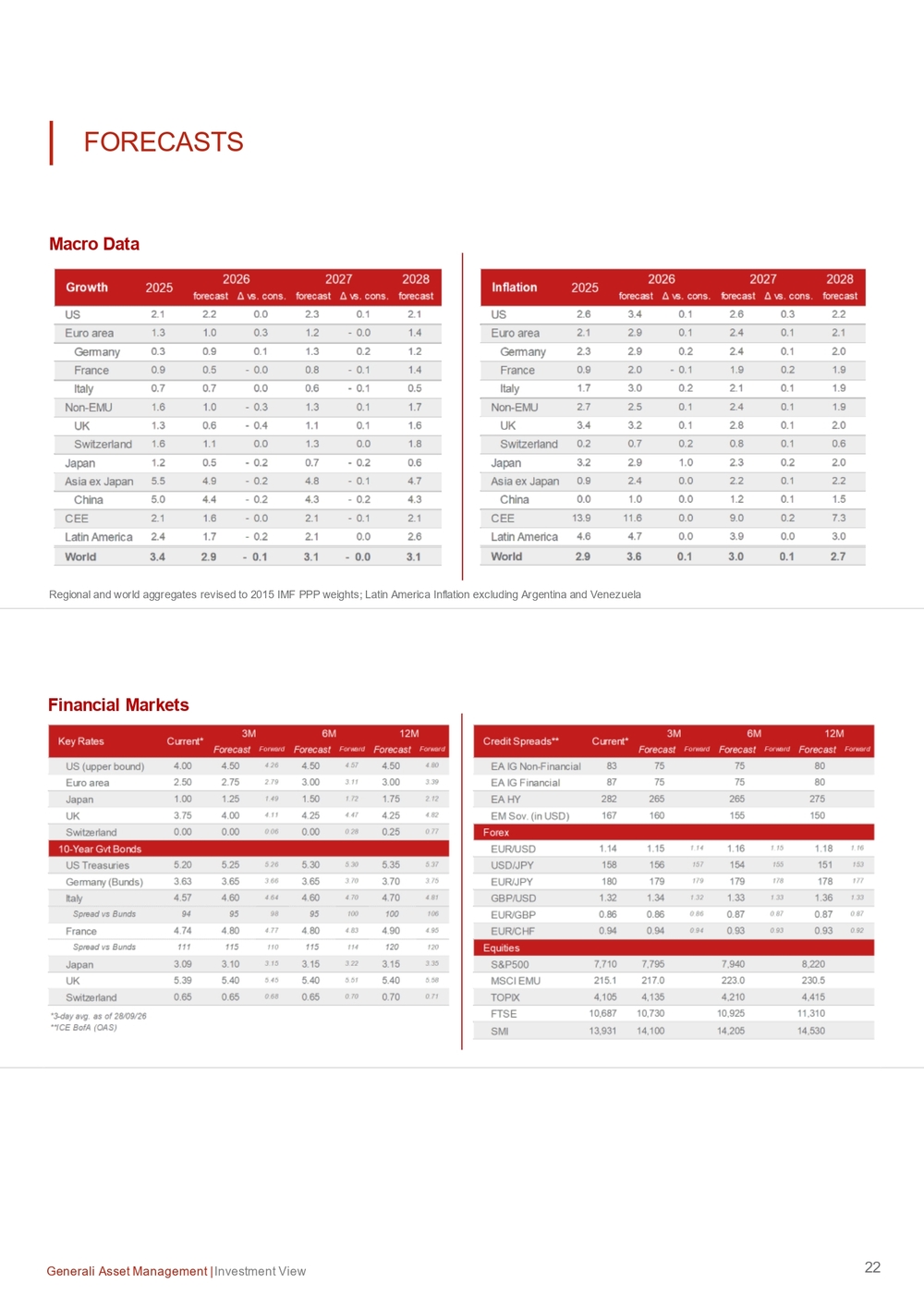
Macro Data
Regional and world aggregates revised to 2015 IMF PPP weights; Latin America Inflation excluding Argentina and Venezuela Financial Markets
23 Generali Asset Management | Investment View
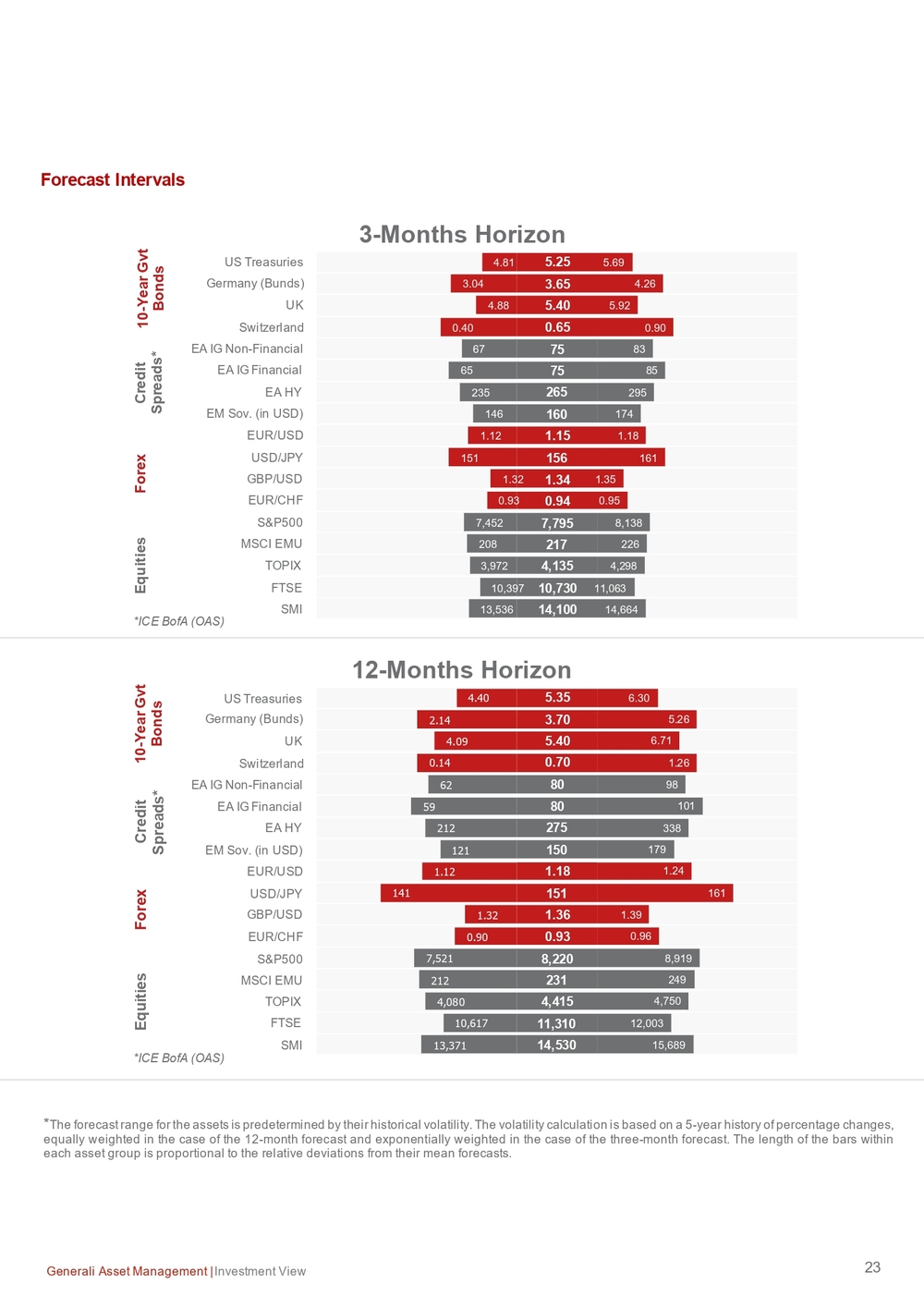
*The forecast range for the assets is predetermined by their historical volatility. The volatility calculation is based on a 5 -year history of percentage changes, equally weighted in the case of the 12 -month forecast and exponentially weighted in the case o f the three -month forecast. The length of the bars within each asset group is proportional to the relative deviations from their mean forecasts.Forecast Intervals
reasuries ermany unds K witzerland I on inancial I inancial
ov in
& I I
I
reasuries ermany unds K witzerland I on inancial I inancial
ov in
& I I
I
FOR PROFESSIONAL INVESTORS ONLY www.generali -am.com Part of This document is based on information and opinions which Generali Asset Management S.p.A. Società di gestione del risparmio h as obtained from sources within and outside of the Generali Group. While such information is believed to be reliable for the purpos es used herein, no representation or warranty, expressed or implied, is made that such information or opinions are accurate o r com- plete. The information, opinions estimates and forecasts expressed in this document are as of the date of this publication an d represent only the judgment of Generali Asset Management S.p.A. Società di gestione del risparmio and may be subject to any change without notification. It shall not be considered as an exp licit or implicit recommendation of investment strategy or as inve stment advice. Before subscribing an offer of investment services, each potential client shall be given every document provided by t he regulations in force from time to time, documents to be carefully read by the client before making any investment choice. Generali Asset Management S.p.A. Società di gestione del risparmio may have taken or, and may in the future take, investment decisions for the portfolios it manages which are contrary to the views expressed herein. Generali Asset Management S.p. A. Societ à di gestione del risparmio relieves itself from any responsibility concerning mis- takes or omissions and shall not be considered responsible in case of possible damages or losses related to the improper use of the information herein provided. It is recomme nded to look over the regulation, available on our website www.generali -am.com . Generali Asset Management S.p. A. Società di gestione del risparmio is part of the Generali Group which was established in 1831 in Trieste as Assicurazioni Generali Austro Italiche. F O R P R OPart of IMPRINT
Issued by: Generali Asset Management S.p.A. Società di gestione del risparmio, Research Department Head of Research: Vincent Chaigneau Head of Macro & Market Research: Dr. Thomas Hempell, CFA
Team: Elisabeth Assmuth | Research Operations Elisa Belgacem | Head of Cross -Asset Quant & Dev, Senior Credit Strategist Jakub Krátký | GI CEE Financial Analyst Michele Morganti | Head of Insurance & AM Research, Senior Equity Strategist Vladimir Oleinikov, CFA | Senior Quantitative Analyst Dr. Thorsten Runde | Senior Quantitative Analyst Dr. Florian Späte, CIIA | Senior Bond Strategist Guillaume Tresca | Senior Emerging Market Strategist Dr. Martin Wolburg, CIIA | Senior Economist Paolo Zanghieri, PhD | Senior Economist “ dited y t e acro & arket esearc eam e team o 2 analysts based in Paris, Cologne, Trieste, Milan and Prague runs qualitative and quantitative analysis on macroeconomic and financial issues. The team translates macro and quant views into investment ideas t at eed into t e investment process ”