FP_BondReset_102026
by Generali Investments
The global bond reset to a structurally higher yield regime
Florian Späte, Martin Wolburg, Paolo Zanghieri 19 October, 2026
Your Partner for Progress. Generali Asset Management | Focal Point Our Focal Point series explores topical issues on macro, markets and investment
• Global bond markets have moved towards a structurally higher -yield equilibrium as persistent fiscal demands, greater capex needs and fading central -bank support rebuild term premia. • Our base case allows for tactical rallies as stretched key rate expectations unwind, but rising term premia should keep long -dated yields volatile and higher for longer . • A strategic duration overweight therefore remains premature, while sell -off overshoots can create tactical en- try points; carry, selectivity and active risk management should drive portfolio returns.
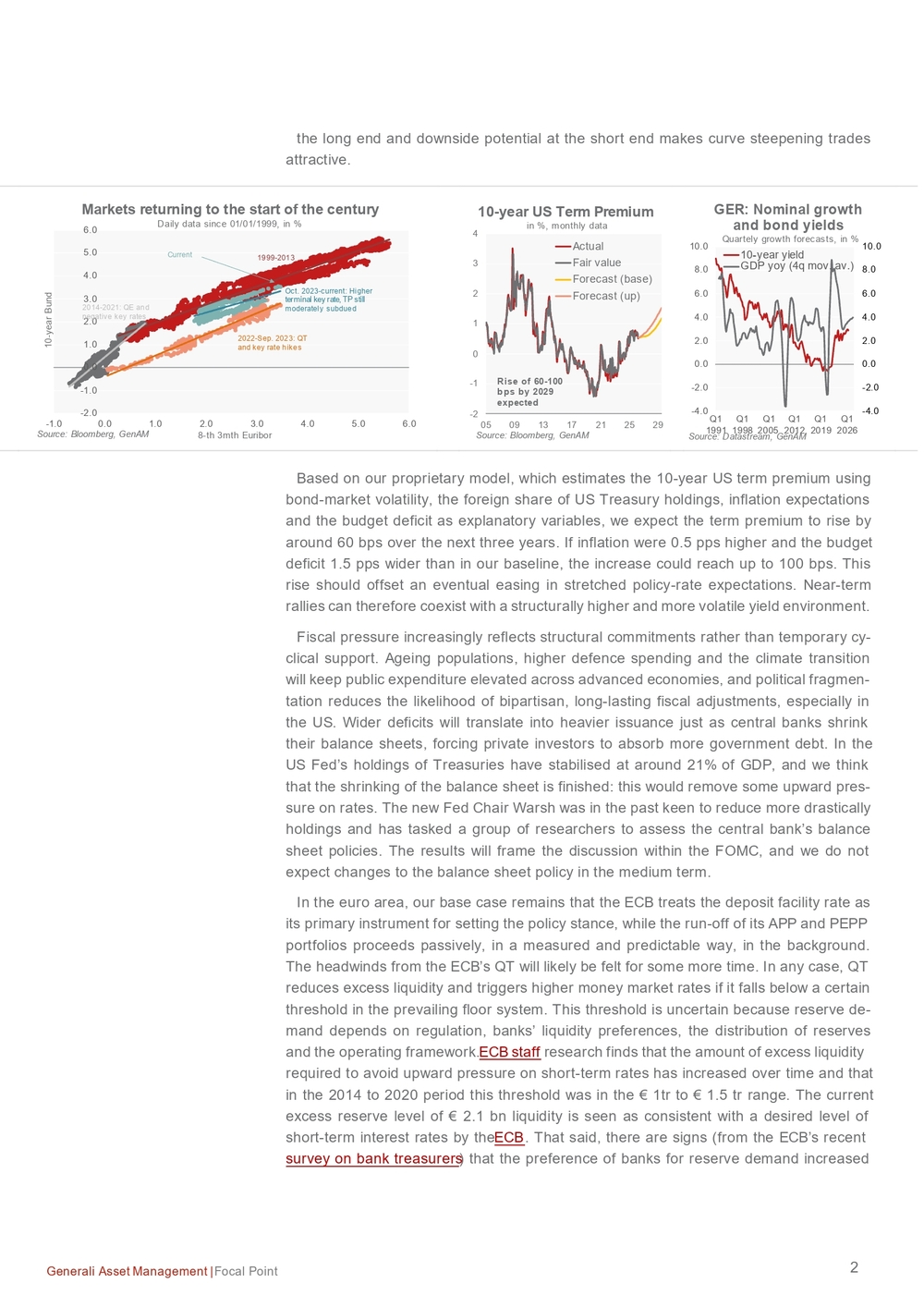
Global bond markets are undergoing a structural repricing. Persistent fiscal pressure, inflation uncertainty due to recu rring supply shocks , heavier funding needs and fewer rate insensiti ve buyers are pushing yields towards a higher equilibrium. Favourable g eo- political developments may interrupt this adjustment but are unlikely to reverse it. Our baseline is therefore a durable high -yield regime, not an uninterrupted rise in yields. Markets will still rally when economic growth disappoints , risk conditions deteriorate and/or policy expectations soften, but investors should not assume that every sell -off will lead back to the exceptionally low yields of the previous cycle. Why yields are structurally higher The initial withdrawal of monetary accommodation pushed both expected policy rates and term premia higher. Looking ahead, however, the two components may diverge: stretched policy -rate expectations leave scope for some cyclical reversal, while structural fiscal, inflation and supply pressures should continue to lift the term premium. Policy expectations look overly hawkish: 5y3m OIS rates in the US and the euro area temporarily rose to around 4.75% and 3.5%, respectively – about 100 bps above our estimates of the corresponding neutral rates and therefore clearly too high. As markets price out this excessive tightening, yields should decline noticeably, particularly at shorter maturities. A durable resolution of the Middle East conflict would reinforce this risk sce- nario by lowering energy prices and inflation pressure. By contrast, and more structurally, the term premium should continue to rise as investors are faced with greater inflation uncertainty and growing bond supply. This combination of upside potential for yields at
2 Generali Asset Management | Focal Point the long end and downside potential at the short end makes curve steepening trades attractive. Based on our proprietary model, which estimates the 10 -year US term premium using bond -market volatility, the foreign share of US Treasury holdings, inflation expectations and the budget deficit as explanatory variables, we expect the term premium to rise by around 60 bps over the next three years. If inflation were 0.5 pps higher and the budget deficit 1.5 pps wider than in our baseline, the increase could reach up to 100 bps. This rise should offset an eventual easing in stretched policy -rate expectations. Near -term rallies can therefore coexist with a structurally higher and more volatile yield environment. Fiscal pressure increasingly reflects structural commitments rather than temporary cy- clical support. Ageing populations, higher defence spending and the climate transition will keep public expenditure elevated across advanced economies , and political fragmen- tation reduces the likelihood of bipartisan, long -lasting fiscal adjustments, especially in the US . Wider deficits will translate into heavier issuance just as central banks shrink their balance sheets, forcing private investors to absorb more government debt. In the US Fed’s holdings of Treasuries have stabilised at around 21% of GDP, and we think that the shrinking of the balance sheet is finished: this would remove some upward pres- sure on rates. The new Fed Chair Warsh was in the past keen to reduce more drastically holdings and has tasked a group of researchers to assess the central bank’s balance sheet policies. The results will frame the discussion within the FOMC, and we do not expect changes to the balance sheet policy in the medium term . In the euro area, our base case remains that the ECB treats the deposit facility rate as its primary instrument for setting the policy stance, while the run -off of its APP and PEPP portfolios proceeds passively, in a measured and predictable way, in the background. The headwinds from the ECB’s QT will likely be felt for some more time. In any case, QT reduces excess liquidity and triggers higher money market rates if it falls below a certain threshold in the prevailing floor system. This threshold is uncertain because reserve de- mand depends on regulation, banks’ liquidity preferences, the distribution of reserves and the operating framework. ECB staff research finds that the amount of excess liquidity required to avoid upward pressure on short -term rates has increased over time and that in the 2014 to 2020 period this threshold was in the € 1tr to € 1.5 tr range. The current excess reserve level of € 2.1 bn liquidity is seen as consistent with a desired level of short -term interest rates by the ECB. That said, there are signs (from the ECB’s recent survey on bank treasurers ) that the preference of banks for reserve demand increased
2.0 1.00.01.02.0 .04.05.0 .0 1.0 0.0 1.0 2.0 .0 4.0 5.0 .0 Daily data since 01 01 1 , in % th mth Euribor10 year Bund 1 201 2014 2021 QE and negative key rates 2022 Sep . 202 QT and key rate hikes ct. 202 current igher terminal key rate , TP still moderately subduedCurrent 2 1012 4 05 0 1 1 21 25 2 ctual Fair value Forecast (base Forecast (up in %, monthly data
4.0 2.00.02.04.0 .0 .010.0 4.0 2.00.02.04.0 .0 .010.0 Q1 1 1Q1 1 Q1 2005Q1 2012Q1 201 Q1 202
Quartely growth forecasts , in % 10 year yield GDP yoy (4q mov . av.
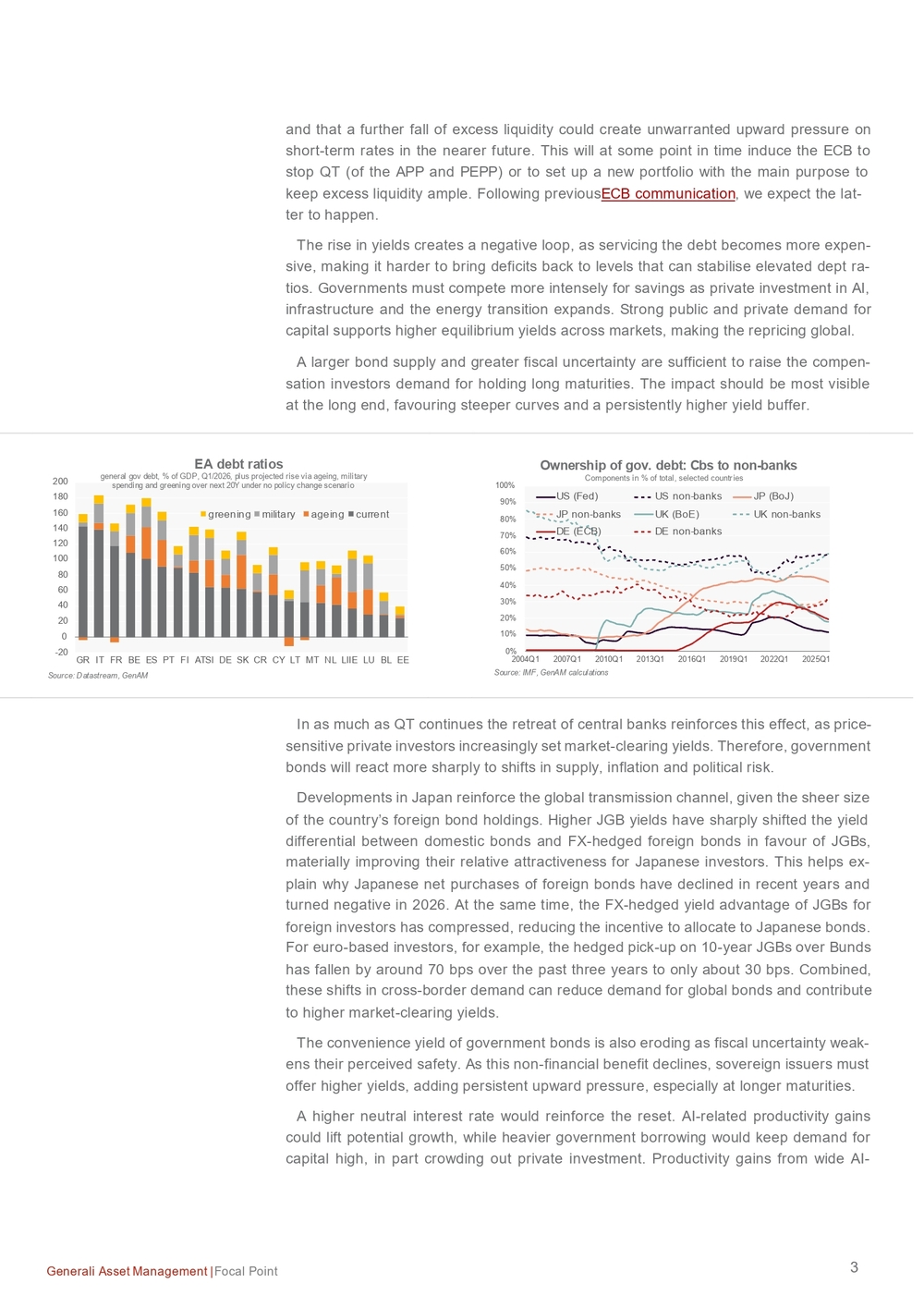
3 Generali Asset Management | Focal Point and that a further fall of excess liquidity could create unwarranted upward pressure on short -term rates in the nearer future. This will at some point in time induce the ECB to stop QT (of the APP and PEPP) or to set up a new portfolio with the main purpose to keep excess liquidity ample . Following previous ECB communication , we expect the lat- ter to happen. The rise in yields creates a negative loop , as servicing the debt becomes more expen- sive, making it harder to bring deficits back to levels that can stabilise elevated dept ra- tios. Governments must compete more intensely for savings as private investment in AI, infrastructure and the energy transition expands. Strong public and private demand for capital supports higher equilibrium yields across markets, making the repricing global. A larger bond supply and greater fiscal uncertainty are sufficient to raise the compen- sation investors demand for holding long maturities. The impact should be most visible at the long end, favouring steeper curves and a persistently higher yield buffer. In as much as QT continues t he retreat of central banks reinforces this effect, as price - sensitive private investors increasingly set market -clearing yields. Therefore, government bonds will react more sharply to shifts in supply, inflation and political risk. Developments in Japan reinforce the global transmission channel, given the sheer size of the country’s foreign bond holdings. igher JGB yields have sharply shifted the yield differential between domestic bonds and FX -hedged foreign bonds in favour of JGBs , materially improving their relative attractiveness for Japanese investors. This helps ex- plain why Japanese net purchases of foreign bonds have declined in recent years and turned negative in 2026. At the same time, the FX -hedged yield advantage of JGBs f or foreign investors has compressed, reducing the incentive to allocate to Japanese bonds. For euro -based investors, for example, the hedged pick -up on 10 -year JGBs over Bunds has fallen by around 70 bps over the past three years to only about 30 bps. Combined, these shifts in cross -border demand can reduce demand for global bonds and contribute to higher market -clearing yields. The convenience yield of government bonds is also eroding as fiscal uncertainty weak- ens their perceived safety. As this non -financial benefit declines, sovereign issuers must offer higher yields, adding persistent upward pressure, especially at longer matu rities. A higher neutral interest rate would reinforce the reset. AI -related productivity gains could lift potential growth, while heavier government borrowing would keep demand for capital high , in part crowding out private investment . Productivity gains from wide AI -
2002040 0 01001201401 01 0200 G TF BE ES PT F T S DE S C C T T E U B EE general gov debt , % of GDP , Q1 202 , plus pro ected rise via ageing , military spending and greening over next 20 under no policy change scenario greening military ageing current
0%10%20% 0%40%50% 0% 0% 0% 0%100 % 2004 Q1 200 Q1 2010 Q1 201 Q1 201 Q1 201 Q1 2022 Q1 2025 Q1 Components in % of total , selected countries US (Fed US non banks JP (BoJ JP non banks U (BoE U non banks DE (ECB DE non banks
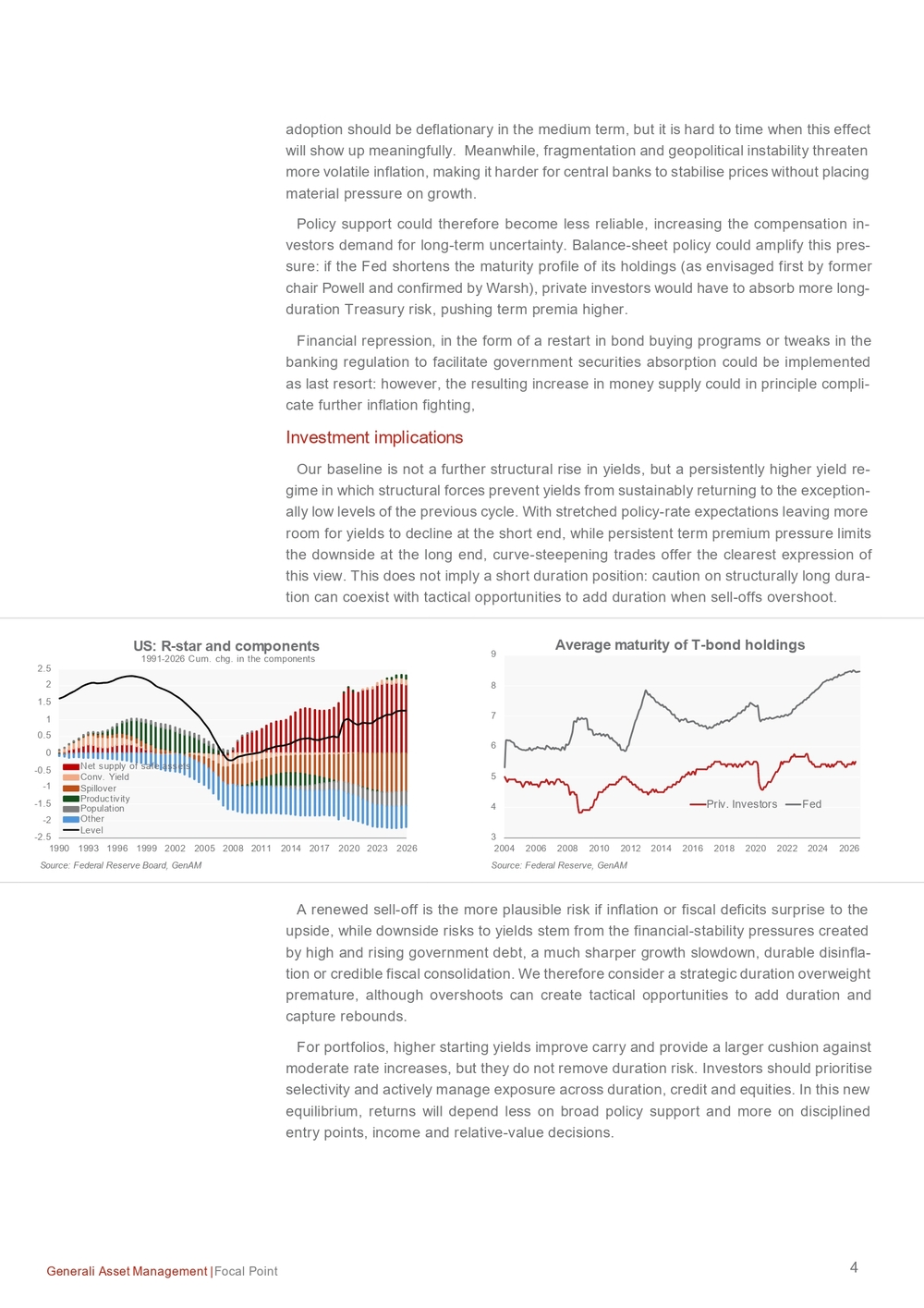
4 Generali Asset Management | Focal Point adoption should be deflationary in the medium term , but it is hard to time when this effect will show up meaningfully. Meanwhile, fragmentation and geopolitical instability threaten more volatile inflation, making it harder for central banks to stabilise prices without placing material pressure on growth. Policy support could therefore become less reliable, increasing the compensation in- vestors demand for long -term uncertainty. Balance -sheet policy could amplify this pres- sure: if the Fed shortens the maturity profile of its holdings (as envisaged first by f ormer chair Powel l and confirmed by Warsh), private investors would have to absorb more long - duration Treasury risk, pushing term premia higher. Financial repression, in the form of a restart in bond buying programs or tweaks in the banking regulation to facilitate government securities absorption could be implemented as last resort: however, the resulting increase in money supply could in principle compli- cate further inflation fighting, Investment implications Our baseline is not a further structural rise in yields, but a persistently higher yield re- gime in which structural forces prevent yields from sustainably returning to the exception- ally low levels of the previous cycle. With stretched policy -rate expectati ons leaving more room for yields to decline at the short end, while persistent term premium pressure limits the downside at the long end, curve -steepening trades offer the clearest expression of this view. This does not imply a short duration position: caution on structurally long dura- tion can coexist with tactical opportunities to add duration when sell -offs overshoot. A renewed sell -off is the more plausible risk if inflation or fiscal deficits surprise to the upside, while downside risks to yields stem from the financial -stability pressures created by high and rising government debt, a much sharper growth slowdown, dur able disinfla- tion or credible fiscal consolidation. We therefore consider a strategic duration overweight premature, although overshoots can create tactical opportunities to add duration and capture rebounds. For portfolios, higher starting yields improve carry and provide a larger cushion against moderate rate increases, but they do not remove duration risk. Investors should prioritise selectivity and actively manage exposure across duration, credit and equiti es. In this new equilibrium, returns will depend less on broad policy support and more on disciplined entry points, income and relative -value decisions.
2.5 2 1.5 1 0.500.511.522.5 1 0 1 1 1 2002 2005 200 2011 2014 201 2020 202 202 et supply of safe assets Conv . ield Spillover Productivity Population ther evel 1 1 202 Cum . chg. in the components
45 2004 200 200 2010 2012 2014 201 201 2020 2022 2024 202 Priv . nvestors Fed
FOR PROFESSIONAL INVESTORS ONLY www.generali -am.com Part of This document is based on information and opinions which Generali Asset Management S.p.A. Società di gestione del risparmio h as obtained from sources within and outside of the Generali Group. While such information is believed to be reliable for the purpos es used herein, no representation or warranty, expressed or implied, is made that such information or opinions are accurate o r com- plete. The information, opinions estimates and forecasts expressed in this document are as of the date of this publication an d represent only the judgment of Generali Asset Management S.p.A. Società di gestione del risparmio and may be subject to any change without notification. It shall not be considered as an exp licit or implicit recommendation of investment strategy or as inve stment advice. Before subscribing an offer of investment services, each potential client shall be given every document provided by t he regulations in force from time to time, documents to be carefully read by the client before making any investment choice. Generali Asset Management S.p.A. Società di gestione del risparmio may have taken or, and may in the future take, investment decisions for the portfolios it manages which are contrary to the views expressed herein. Generali Asset Management S.p. A. Societ à di gestione del risparmio relieves itself from any responsibility concerning mis- takes or omissions and shall not be considered responsible in case of possible damages or losses related to the improper use of the information herein provided. It is recomme nded to look over the regulation, available on our website www.generali -am.com . Generali Asset Management S.p. A. Società di gestione del risparmio is part of the Generali Group which was established in 1831 in Trieste as Assicurazioni Generali Austro Italiche. F O R P R OPart of IMPRINT
Issued by: Generali Asset Management S.p.A. Società di gestione del risparmio, Research Department Head of Research: Vincent Chaigneau Head of Macro & Market Research: Dr. Thomas Hempell, CFA
Team: Elisabeth Assmuth | Research Operations Elisa Belgacem | Head of Cross -Asset Quant & Dev, Senior Credit Strategist Jakub Krátký | GI CEE Financial Analyst Michele Morganti | Head of Insurance & AM Research, Senior Equity Strategist Vladimir Oleinikov, CFA | Senior Quantitative Analyst Dr. Thorsten Runde | Senior Quantitative Analyst Dr. Florian Späte, CIIA | Senior Bond Strategist Guillaume Tresca | Senior Emerging Market Strategist Dr. Martin Wolburg, CIIA | Senior Economist Paolo Zanghieri, PhD | Senior Economist “Edited by the acro & arket esearch Team. The team of 1 2 analysts based in Paris, Cologne, Trieste, Milan and Prague runs qualitative and quantitative analysis on macroeconomic and financial issues. The team translates macro and quant views into investment ideas that feed into the investment process.”