RS_GenAM_MP_0826
by Generali Investments
Generali Asset Management | Market PerspectivesMarketing communication for professional investors only. GenAM Macro & Market Research Your Partner for Progress. ContentMarket Perspectives ‘Market Perspectives’ provide our monthly macro & market outlook and investment recommendations 1.Global View 2 2.USA 3 3.Euro area 4 4.Japan 5 5.China 6 6.Central andEastern Europe 7 7.Government Bonds 8 8.Credit 10 9.EMSovereign Bonds 11 10.Currencies 12 11.Equities 13 12.Asset Allocation 15 13.Forecast Tables 16 14.Imprint 17•Solid growth and resilient earnings should keep risk assets afloat, but‘chips andcrude’ —recurring worries about theAIboom and theIran war—will make forabumpy ride through thin summer markets . •China's fast-improving AImodels and push into chipmaking equipment challenge the premium priced into tech leaders ;with indices soconcentrated, any wobble now moves equity markets .Yet high stock dispersion andbroadening earnings gains are making indices more robust . •The US-Iran ceasefire has collapsed and pushed energy prices higher .Our base case sees acontained re-escalation, with no further ECB hikes and only one delayed Fed move, but extended hostilities would put September hikes back onthetable . •Westay pro-risk buttrim exposure, favouring Credit over Govies despite tight spreads and staying cautious onduration, especially inthe US.31 July 2026Chips and Crude
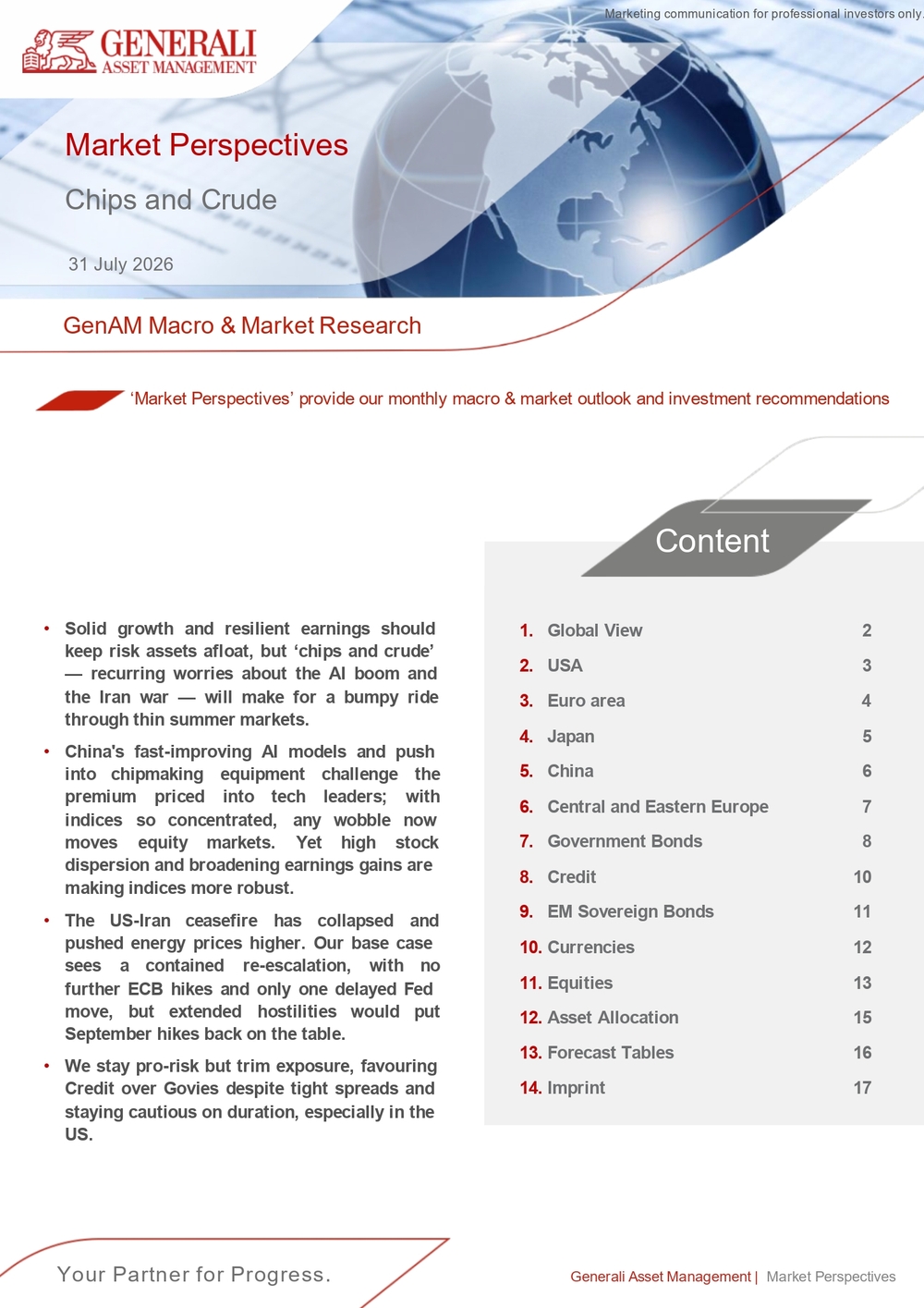
Generali Asset Management | Market Perspectives Global View –Chips and Crude Thomas Hempell •Solid growth and resilient earnings should keep risk assets afloat, but‘chips andcrude’—recurring worries about theAIboom and theIran war—will make forabumpy ride through thin summer markets . •China's fast-improving AImodels and push into chipmaking equipment challenge thepremium priced into tech leaders ;with indices soconcentrated, any wobble now moves equity markets .Yethigh stock dispersion and broadening earnings gains are making indices more robust . •The US-Iran ceasefire has collapsed and pushed energy prices higher .Ourbase case sees acontained re-escalation, with nofurther ECB hikes andonly one delayed Fed move, butextended hostilities would put September hikes back onthetable . •Westay pro-risk buttrim exposure, favouring Credit over Govies despite tight spreads and staying cautious onduration, especially intheUS. Solid global growth andsustained earnings should keep the backdrop supportive forrisk assets .Yetlingering doubts about theAIboom andtheIranwarwillkeep them onedge . Strong sales andearnings growth stillunderpins theoutlook forAIand semiconductor stocks .Yet investors keep questioning thelofty expectations priced intothem .InJuly thesector sold offasconcerns mounted over heavy capex and margin risks from Chinese competition, after start-up Moonshot AIreleased itsKimi K3model .Reports thatChina has begun making domestic DUV lithography machines added pressure onDutch supplier ASML .The Philadelphia semiconductor index hasdropped c.25%from itsJune peak (left chart), and theNasdaq 100 almost 10%.Because indices aresoconcentrated intech, these wobbles quickly spill into broader market volatility .Wewould notwrite off tech and AIleaders, given AI's huge productivity potential, butweprefer tohold ourmoderate equity exposure throughbroader indices rather than thecrowded mega -caps . Meanwhile, theUS-Iranceasefire struck inJune hasbroken down, pushing energy prices higher and weighing on equities and bonds .The global economy, and theUSin particular, has weathered theshock well sofar.Butthe longer energy prices stay elevated, themore hawkish central banks turn.Inour base case, the reescalation stays contained, andtheStrait ofHormuz soon reopens ;theECB then holds andtheFeddelivers only onehike latethisyear. Intheriskcase, hostilities drag onandenergy markets stay strained, tilting both central banks towards September hikes . Positioning :favouring Credit, cautious onduration Wetherefore keep, buttrim, ourpro-risktiltover theless liquid summer weeks (weaker seasonals) .Within riskassets, weconcentrate onanoverweight inCredit versus Govies : thecarry cushions against summer volatility, andCredit has proven resilient through riskappetite and cyclical swings . WecutourEquity overweight back toamarginal position . Westay prudent onduration–neutral inEUR fixed income and slightly short intheUS.Heavy supply and rising term premia keep usbiased towards slightly higher long-term yields .Amore durable US-Iran peace deal could ease inflation worries and upside pressures onyields .Butwe would notchase aknee -jerkbond rally onfalling oilprices, given thestructural headwinds from high public debt and upward pressure onterm premia .This holds especially for 10yUSTreasuries :realyields now look attractive after their 50bpclimb to2.4%since May (right chart), yettheinflation compensation of2.25%ishardly compelling, amounting to halfthe4.5%average seen over thepast fiveyears . Recent USD strength may persist fornow onUSeconomic resilience .Still, weseeEUR/USD drifting modestly higher by year-end, asbullish dollar positioning looks stretched anda mild second -halfrecovery intheeuro area lends support . 2
Phil semicond inde
&P
M M hips r erc s er
re ased to end
re sur ie d
cumulated chan e y components
in ps
y in l reakeven P
y real yield P
y nom yield
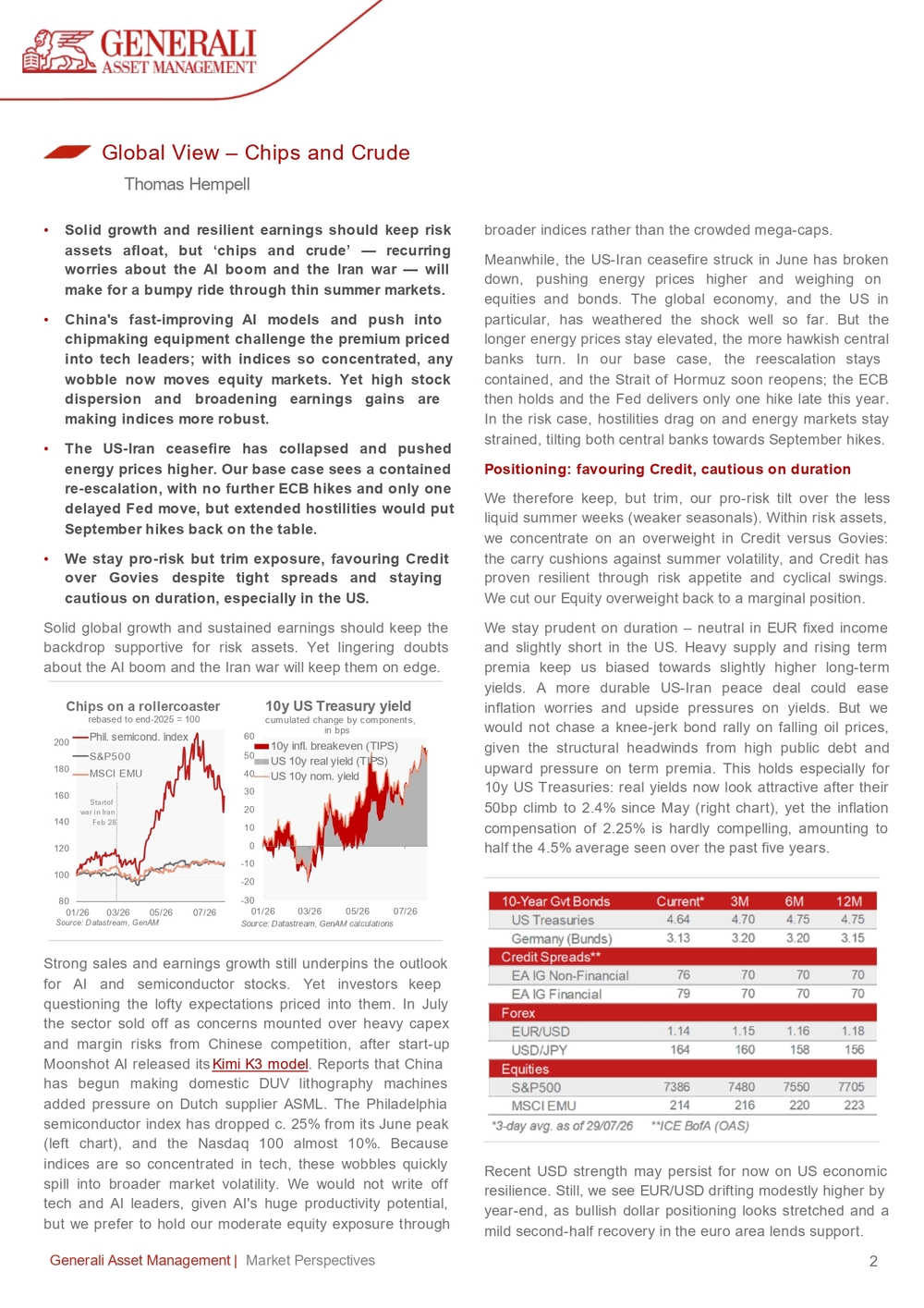
Generali Asset Management | Market Perspectives United States Paolo Zanghieri •Despite theweak headline Q2GDP figure, demand continues togrow steadily thanks toAIinvestment and healthy consumption .Werevised upour GDP forecast, to2.2%thisyear and2.1%next. •Inflation remains above target due tariffs, energy and AI-related pressures .Weseecore PCE justabove 3% byyear end. •AttheJuly meeting chair Warsh reiterated theFed's commitment tofight inflation, butlack ofaction on rates sent arather dovish and confusing message . Weexpect arate hike byyear-end, most likely in December . The weak Q2growth reading (1.5%qoq ann.)was due toa large drop innetexports and abigde-stocking .Domestic demand growth picked upmarkedly .Capex remains strong : consistent with softinformation from surveys andhard data on orders, itisnolonger driven byjust AI-related expenditure . Consumption grew byastrong 3.2%ann.butthiswasdriven by one-offtaxrefunds, andthesaving rateremains atalow3%. Jobcreation picked upfrom thelowlevels seen attheendof lastyear, butitremains concentrated inacyclical sectors like healthcare .Yetunemployment isbroadly stable atalow4.2% andlayoffs remain contained, .Slowing wage growth andlabour market developments are unlikely tobecome amajor inflationary risk, especially forservices . Inflation remains thekeychallenge, butJune delivered good news, with thecore PCE ratecooling to3.3%yoythanks tothe retrenchment ingoods inflation .Theimpact ofexisting tariffs is fading, butlingering pass -through from earlier increases in energy costs andstrong demand fortechnology -related goods continue tokeep price pressures elevated .Although wage growth isslowing and housing inflation iscooling, progress towards theFederal Reserve's 2%target islikely toremain gradual andweexpect core PCE inflation toendtheyear atjust above 3%. Fedtoraise rates byyear end AttheJuly meeting theFed kept rates onhold.Chair Warsh was notsuccessful inexplaining how thestrong commitment to stick tothehard 2%inflation target isconsistent with norate hike, given how sticky inflation remains .This was perceived as overall dovish, and thebond market started questioning the Fed's credibility .Weexpect arate hike bytheendoftheyear. Our baseline isDecember, buttheneed torestore credibility soon may tiltthebalance toamove already inSeptember . 3
ons
nvest et port ov t tocks P inal sales to dom purchasers r h d dri ers o annualised
ore
ervices
erv e housin
oods rhs i i
ch yoy
urrent ec un ec
en M M r e i p ied p h r he ed u ds r e
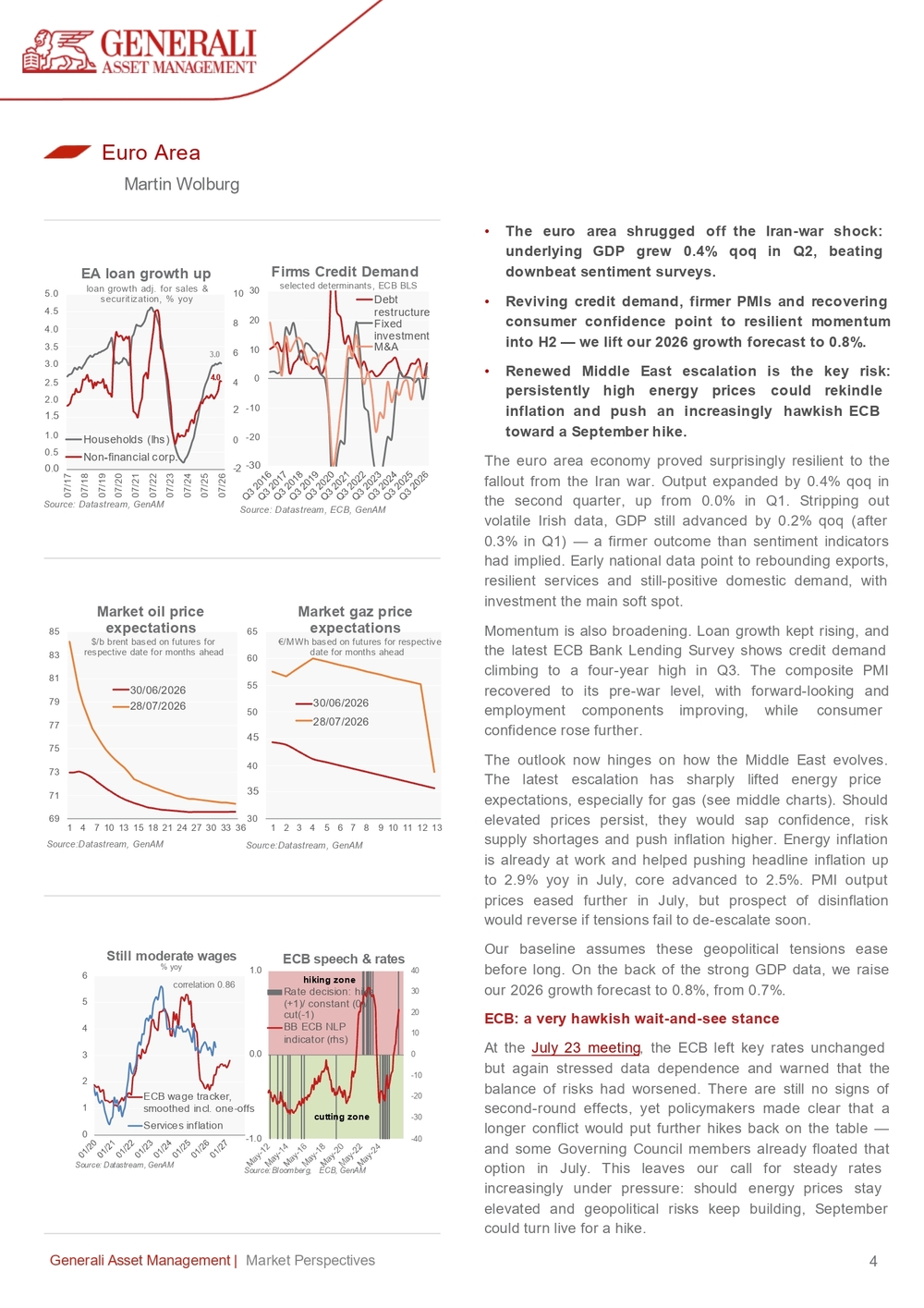
Generali Asset Management | Market Perspectives Euro Area Martin Wolburg •The euro area shrugged offthe Iran-war shock : underlying GDP grew 0.4%qoq inQ2,beating downbeat sentiment surveys . •Reviving credit demand, firmer PMIs and recovering consumer confidence point toresilient momentum into H2—weliftour2026 growth forecast to0.8%. •Renewed Middle East escalation isthe key risk: persistently high energy prices could rekindle inflation and push anincreasingly hawkish ECB toward aSeptember hike. The euro area economy proved surprisingly resilient tothe fallout from theIran war.Output expanded by0.4%qoqin thesecond quarter, upfrom 0.0%inQ1.Stripping out volatile Irish data, GDP stilladvanced by0.2%qoq (after 0.3%inQ1)—afirmer outcome than sentiment indicators hadimplied .Early national data point torebounding exports, resilient services and still-positive domestic demand, with investment themain softspot. Momentum isalso broadening .Loan growth kept rising, and thelatest ECB Bank Lending Survey shows credit demand climbing toafour-year high inQ3.The composite PMI recovered toitspre-war level, with forward -looking and employment components improving, while consumer confidence rose further . The outlook now hinges onhow theMiddle East evolves . The latest escalation has sharply lifted energy price expectations, especially forgas(see middle charts) .Should elevated prices persist, they would sap confidence, risk supply shortages andpush inflation higher .Energy inflation isalready atwork andhelped pushing headline inflation up to2.9%yoyinJuly, core advanced to2.5%.PMI output prices eased further inJuly, butprospect ofdisinflation would reverse iftensions failtode-escalate soon . Our baseline assumes these geopolitical tensions ease before long.Ontheback ofthestrong GDP data, weraise our2026 growth forecast to0.8%,from 0.7%. ECB :avery hawkish wait-and-seestance AttheJuly 23meeting ,theECB leftkeyrates unchanged butagain stressed data dependence and warned that the balance ofrisks had worsened .There arestillnosigns of second -round effects, yetpolicymakers made clear that a longer conflict would putfurther hikes back onthetable— andsome Governing Council members already floated that option inJuly.This leaves our call forsteady rates increasingly under pressure :should energy prices stay elevated and geopolitical risks keep building, September could turnliveforahike. 4
r h up
loan ro th ad or sales &
securiti ation yoy
ouseholds lhs
on inancial corp
ir s redi e d
selected determinants
e t
restructure
i ed
investment
M&
r e price
e pec i s M h ased on utures or respective date or months ahead
r e i price
e pec i s rent ased on utures or respective date or months ahead
speech r es
ate decision hike
constant
cut
P
indicator rhs
hi i e
cu i e
i der e es
yoy
a e tracker
smoothed incl one o s
ervices in lation
correlation
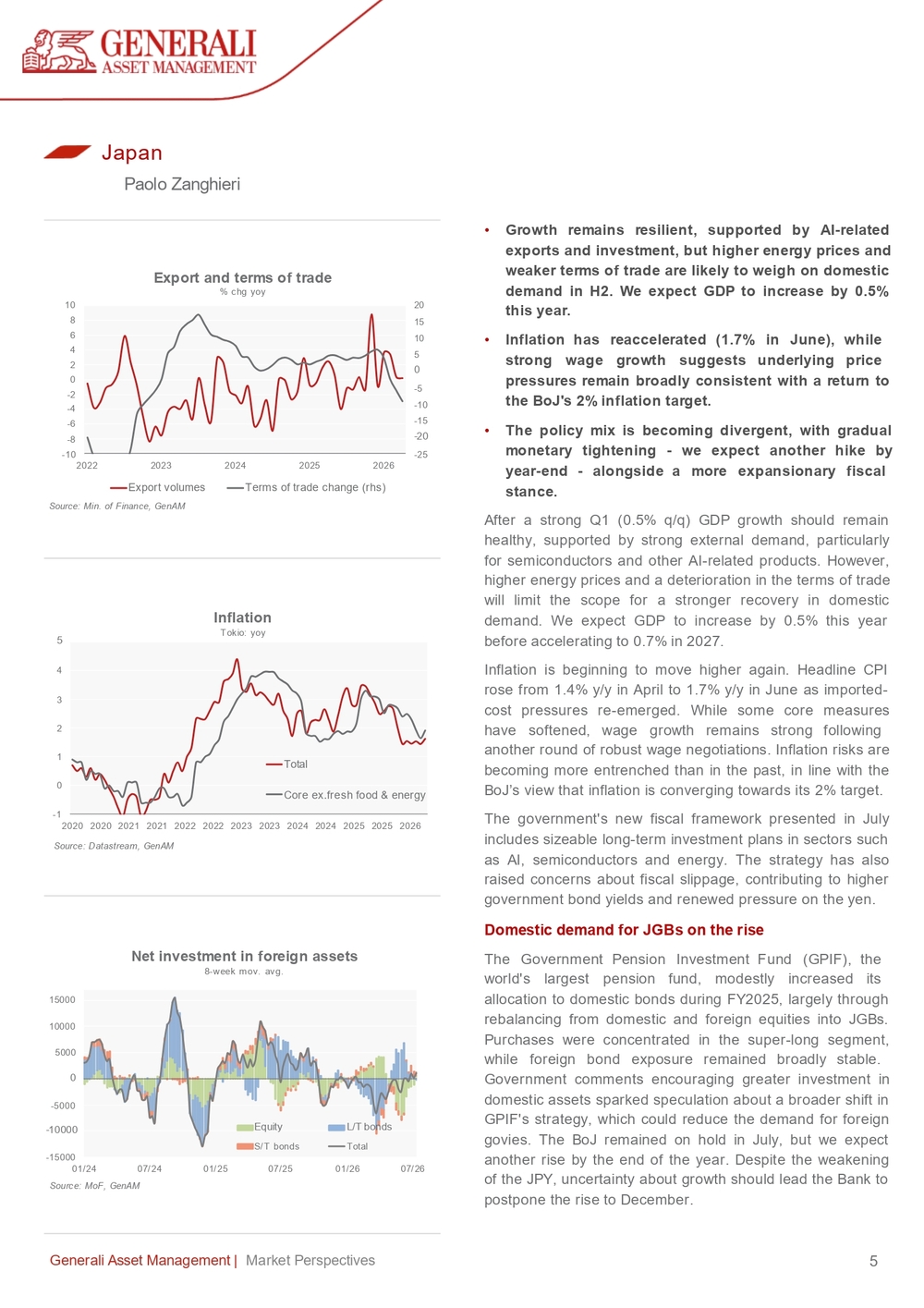
Generali Asset Management | Market Perspectives Japan Paolo Zanghieri •Growth remains resilient, supported byAI-related exports andinvestment, buthigher energy prices and weaker terms oftrade arelikely toweigh ondomestic demand inH2.Weexpect GDP toincrease by0.5% thisyear. •Inflation has reaccelerated (1.7%inJune), while strong wage growth suggests underlying price pressures remain broadly consistent with areturn to theBoJ's 2%inflation target . •The policy mix isbecoming divergent, with gradual monetary tightening -weexpect another hike by year-end -alongside amore expansionary fiscal stance . After astrong Q1(0.5%q/q) GDP growth should remain healthy, supported bystrong external demand, particularly forsemiconductors andother AI-related products .However, higher energy prices andadeterioration intheterms oftrade willlimit thescope forastronger recovery indomestic demand .Weexpect GDP toincrease by0.5%this year before accelerating to0.7%in2027 . Inflation isbeginning tomove higher again .Headline CPI rose from 1.4%y/yinApril to1.7%y/yinJune asimported - cost pressures re-emerged .While some core measures have softened, wage growth remains strong following another round ofrobust wage negotiations .Inflation risks are becoming more entrenched than inthepast, inlinewith the o ’s view thatinflation isconverging towards its2%target . The government's new fiscal framework presented inJuly includes sizeable long-term investment plans insectors such asAI,semiconductors and energy .The strategy has also raised concerns about fiscal slippage, contributing tohigher government bond yields andrenewed pressure ontheyen. Domestic demand forJGBs ontherise The Government Pension Investment Fund (GPIF), the world's largest pension fund, modestly increased its allocation todomestic bonds during FY2025 ,largely through rebalancing from domestic and foreign equities intoJGBs . Purchases were concentrated inthesuper -long segment, while foreign bond exposure remained broadly stable . Government comments encouraging greater investment in domestic assets sparked speculation about abroader shift in GPIF's strategy, which could reduce thedemand forforeign govies .The BoJ remained onhold inJuly, butweexpect another risebytheendoftheyear.Despite theweakening oftheJPY, uncertainty about growth should lead theBank to postpone therisetoDecember . 5
port volumes erms o trade chan e rhs p r d er s r de ch yoy
otal
ore e resh ood & ener y i
okio yoy
                            uity      onds
 onds  otal e  i  es  e   i    rei    sse s
eek mov av
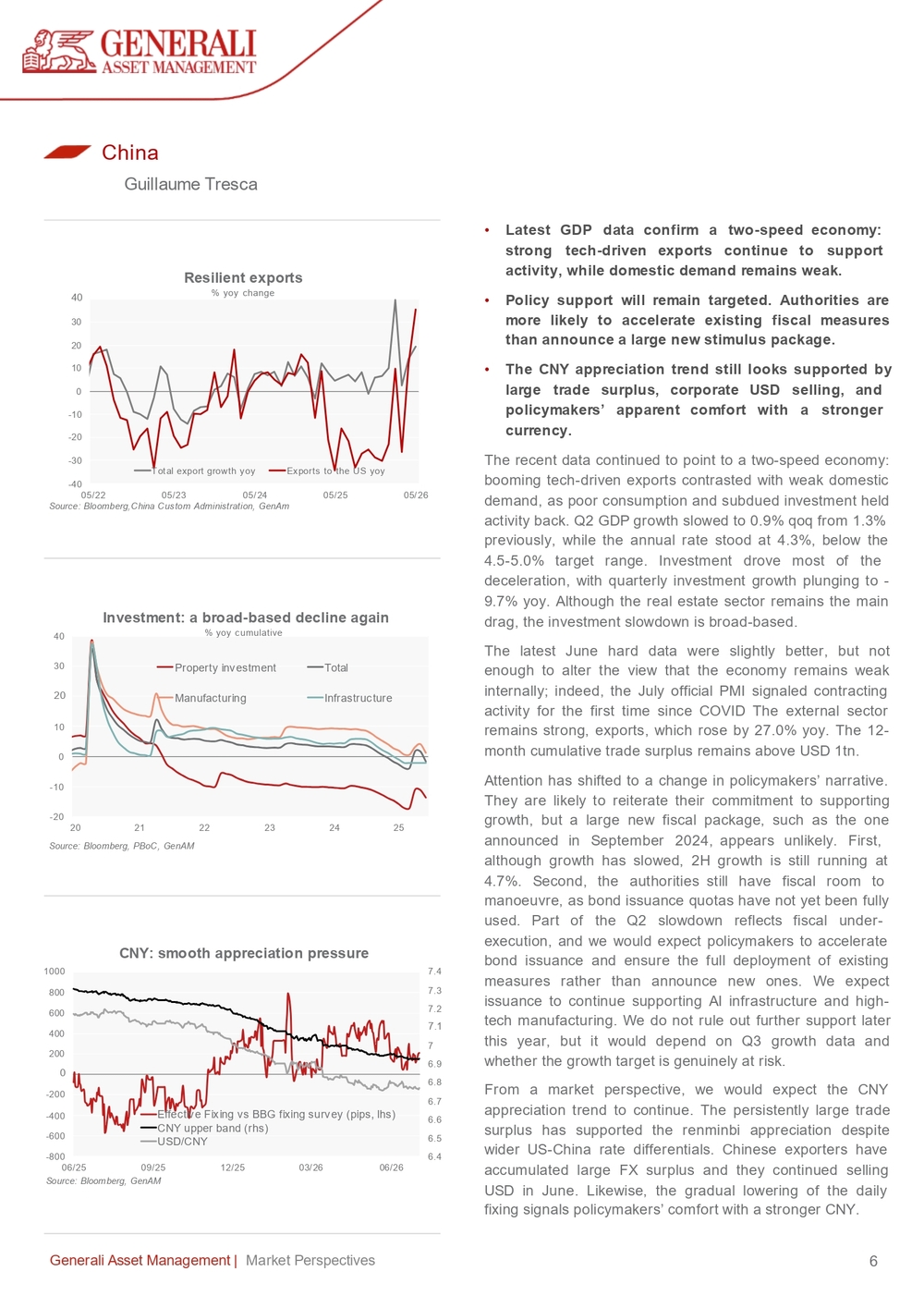
Generali Asset Management | Market Perspectives China Guillaume Tresca •Latest GDP data confirm atwo-speed economy : strong tech-driven exports continue tosupport activity, while domestic demand remains weak . •Policy support will remain targeted .Authorities are more likely toaccelerate existing fiscal measures than announce alarge new stimulus package . •The CNY appreciation trend still looks supported by large trade surplus, corporate USD selling, and p ic ers’ apparent comfort with astronger currency . Therecent data continued topoint toatwo-speed economy : booming tech-driven exports contrasted with weak domestic demand, aspoor consumption andsubdued investment held activity back .Q2GDP growth slowed to0.9%qoqfrom 1.3% previously, while theannual rate stood at4.3%,below the 4.5-5.0%target range .Investment drove most ofthe deceleration, with quarterly investment growth plunging to- 9.7%yoy.Although therealestate sector remains themain drag, theinvestment slowdown isbroad -based . The latest June hard data were slightly better, butnot enough toalter theview that theeconomy remains weak internally ;indeed, theJuly official PMI signaled contracting activity forthefirst time since COVID The external sector remains strong, exports, which rose by27.0%yoy.The12- month cumulative trade surplus remains above USD 1tn. Attention hasshifted toachange inpolicymakers’ narrative . They arelikely toreiterate their commitment tosupporting growth, butalarge new fiscal package, such astheone announced inSeptember 2024 ,appears unlikely .First, although growth has slowed, 2Hgrowth isstillrunning at 4.7%.Second, the authorities still have fiscal room to manoeuvre ,asbond issuance quotas have notyetbeen fully used .Part ofthe Q2slowdown reflects fiscal under - execution, andwewould expect policymakers toaccelerate bond issuance and ensure thefulldeployment ofexisting measures rather than announce new ones .We expect issuance tocontinue supporting AIinfrastructure and high- tech manufacturing .Wedonotruleoutfurther support later this year, butitwould depend onQ3growth data and whether thegrowth target isgenuinely atrisk. From amarket perspective, wewould expect theCNY appreciation trend tocontinue .The persistently large trade surplus has supported therenminbi appreciation despite wider US-China rate differentials .Chinese exporters have accumulated large FXsurplus and they continued selling USD inJune .Likewise, thegradual lowering ofthedaily fixing signalspolicymakers’ comfort withastronger CNY . 6
otal e port ro th yoy ports to the yoy esi ie e p r s
yoy chan e
Property investment otal
Manu acturin n rastructure es e r d sed dec i e i yoy cumulative
                        ective  i in  vs      i in  survey  pips  lhs
upper  and  rhs
       s    h  ppreci  i   pressure
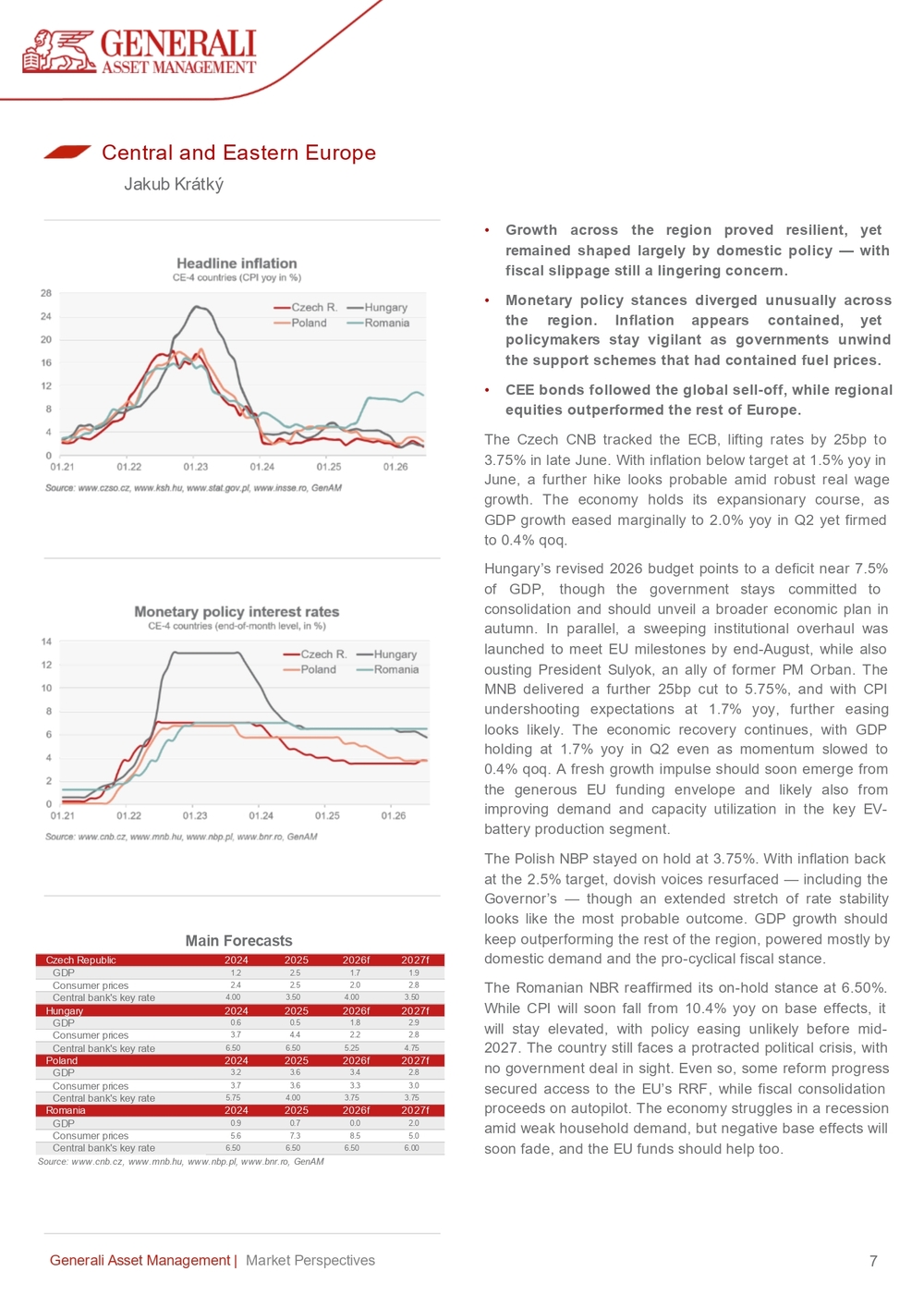
Generali Asset Management | Market Perspectives 7Central and Eastern Europe Jakub Krátký •Growth across the region proved resilient, yet remained shaped largely bydomestic policy—with fiscal slippage stillalingering concern . •Monetary policy stances diverged unusually across the region .Inflation appears contained, yet policymakers stay vigilant asgovernments unwind thesupport schemes that hadcontained fuelprices . •CEE bonds followed theglobal sell-off,while regional equities outperformed therest ofEurope . The Czech CNB tracked theECB, lifting rates by25bpto 3.75%inlateJune .With inflation below target at1.5%yoyin June, afurther hike looks probable amid robust real wage growth .The economy holds itsexpansionary course, as GDP growth eased marginally to2.0%yoyinQ2yetfirmed to0.4%qoq. un ary’s revised 2026 budget points toadeficit near 7.5% ofGDP, though the government stays committed to consolidation andshould unveil abroader economic plan in autumn .Inparallel, asweeping institutional overhaul was launched tomeet EUmilestones byend-August, while also ousting President Sulyok, anallyofformer PMOrban .The MNB delivered afurther 25bpcutto5.75%,and with CPI undershooting expectations at1.7%yoy,further easing looks likely .The economic recovery continues, with GDP holding at1.7%yoyinQ2even asmomentum slowed to 0.4%qoq.Afresh growth impulse should soon emerge from thegenerous EUfunding envelope and likely also from improving demand and capacity utilization inthekeyEV- battery production segment . ThePolish NBP stayed onhold at3.75%.With inflation back atthe2.5%target, dovish voices resurfaced —including the overnor’s —though anextended stretch ofrate stability looks likethemost probable outcome .GDP growth should keep outperforming therestoftheregion, powered mostly by domestic demand andthepro-cyclical fiscal stance . TheRomanian NBR reaffirmed itson-hold stance at6.50%. While CPIwillsoon fallfrom 10.4%yoyonbase effects, it willstay elevated, with policy easing unlikely before mid- 2027 .Thecountry stillfaces aprotracted political crisis, with nogovernment deal insight .Even so,some reform progress secured access tothe ’s RRF, while fiscal consolidation proceeds onautopilot .Theeconomy struggles inarecession amid weak household demand, butnegative base effects will soon fade, andtheEUfunds should help too. Main Forecasts Czech Republic 2024 2025 2026f 2027f GDP 1.2 2.5 1.7 1.9 Consumer prices 2.4 2.5 2.0 2.8 Central bank's key rate 4.00 3.50 4.00 3.50 Hungary 2024 2025 2026f 2027f GDP 0.6 0.5 1.8 2.9 Consumer prices 3.7 4.4 2.2 2.8 Central bank's key rate 6.50 6.50 5.25 4.75 Poland 2024 2025 2026f 2027f GDP 3.2 3.6 3.4 2.8 Consumer prices 3.7 3.6 3.3 3.0 Central bank's key rate 5.75 4.00 3.75 3.75 Romania 2024 2025 2026f 2027f GDP 0.9 0.7 0.0 2.0 Consumer prices 5.6 7.3 8.5 5.0 Central bank's key rate 6.50 6.50 6.50 6.00 Source: www.cnb.cz, www.mnb.hu, www.nbp.pl, www.bnr.ro, GenAM
Generali Asset Management | Market Perspectives Government Bonds Florian Späte •Long -dated yields stay vulnerable tofiscal pressure, heavy issuance, persistent inflation risk and ongoing term -premium normalisation, with USyields facing thestrongest upward pressure . •Stay positioned forsteeper curves :front ends look over -hawkish and broadly anchored, while ILBs offer attractive protection against arenewed inflation scare . •Euro area non-core spreads stay range -bound with a modest tightening bias–scarce summer supply and yield -hungry demand cap the upside, keeping the market broadly resilient despite geopolitical uncertainty . Two opposing forces arepulling government bond markets apart .Atthefront end, investors have priced amore hawkish central bank path with sticky inflation and resilient labour markets prompting markets toabandon rate-cut bets altogether and instead pullexpected rate hikes forward .At thelong end, acommon setofglobal drivers keeps pushing yields higher :persistent fiscal deficits, rising public debt, heavy sovereign issuance, higher defence spending andthe gradual withdrawal ofQuantitative Easing areallnormalising term premia .Renewed geopolitical tensions and higher energy prices add totheriskthat inflation proves stickier than markets assume .Onbalance, weexpect these long- end forces todominate, keeping theyield curve biased steeper and leaving long-dated bonds exposed tofurther upside asissuance stays heavy intotheautumn . Against this backdrop, westay constructive oninflation - linked bonds (ILBs) .Inflation compensation stilllooks toolow fortheriskenvironment :despite Middle East tensions and rising oilforward prices, medium -term inflation expectations sitwell below thelevels seen inprevious energy shocks . Markets look overly confident that inflation will glide smoothly back totarget, yetwesee afargreater riskof renewed upward pressure than current pricing implies .Even amodest upside surprise on inflation would leave breakevens with meaningful room towiden, reinforcing the case forholding realover nominal exposure .ILBs therefore remain one ofthemost attractive ways toposition forthis environment . These forces should liftlong-term yields onboth sides ofthe Atlantic, buttheadjustment should bemost pronounced in theUS.The recent climb in10-year USreal yields above 2.4%isstriking yetbroadly justified bystronger productivity, resilient activity, persistent deficits and rising public debt. More telling areinflation expectations, which stay below 2.3%despite years ofelevated inflation andcontinued price 8
e r i d re ie ds
in
eal yield n lation e pectation om yield rhs
uch priced r he
in
or ard rate Mar onia or ard y m
ur e s eep ess dri e r e e pec i s
in
m uri or un y y inverted rhs
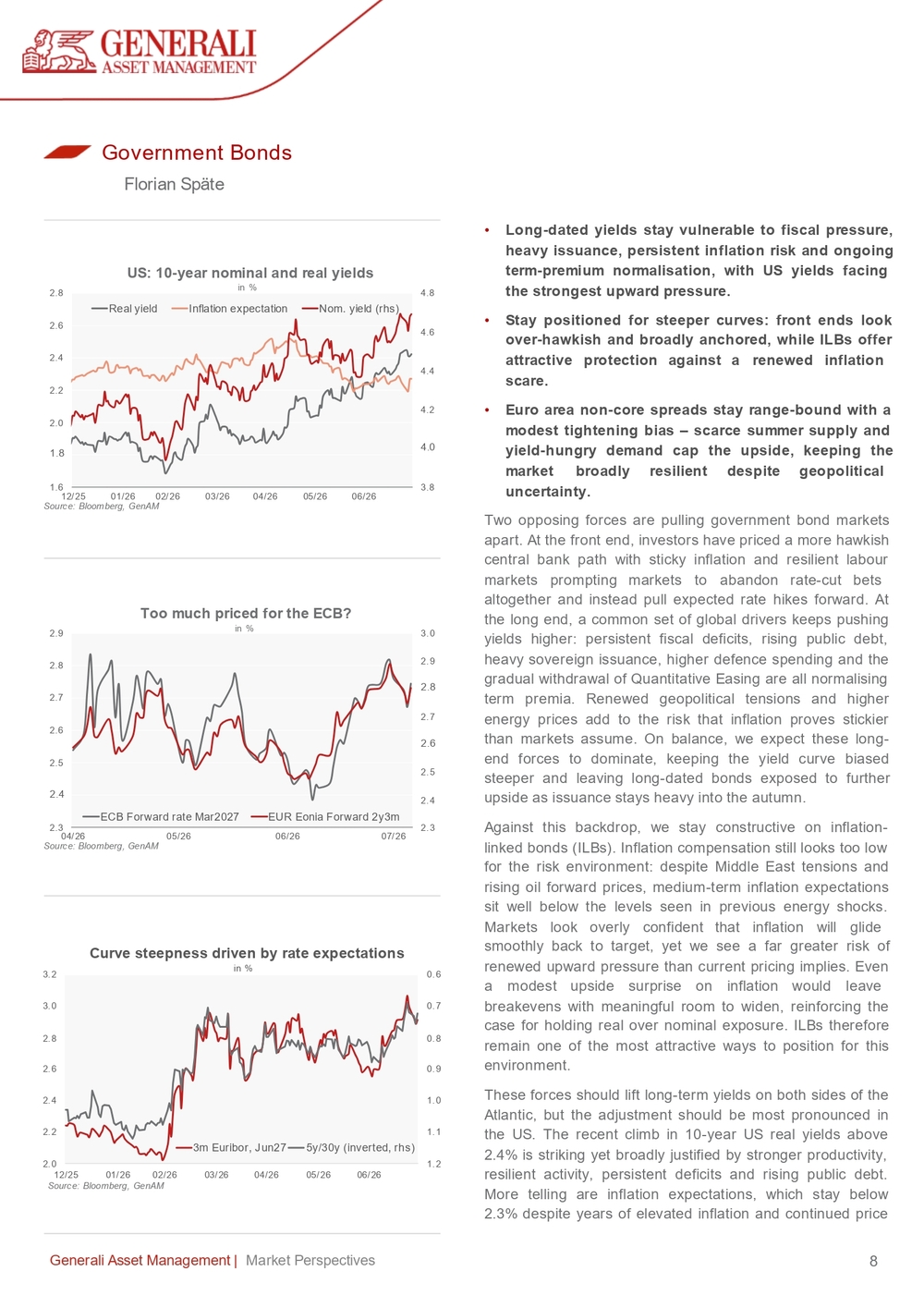
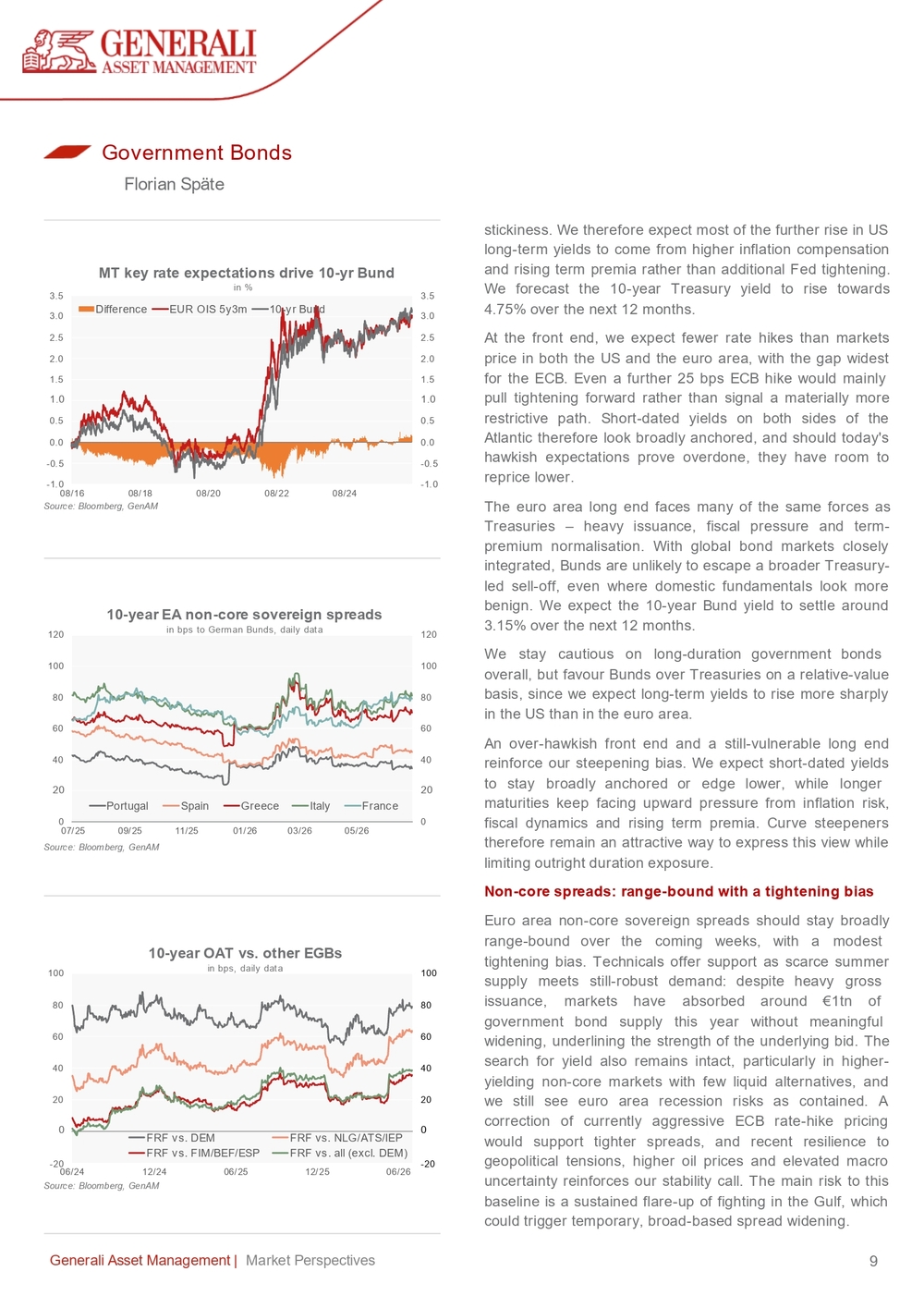
Generali Asset Management | Market Perspectives Government Bonds Florian Späte stickiness .Wetherefore expect most ofthefurther riseinUS long-term yields tocome from higher inflation compensation andrising term premia rather than additional Fedtightening . We forecast the10-year Treasury yield torise towards 4.75%over thenext 12months . Atthefront end, weexpect fewer rate hikes than markets price inboth theUSandtheeuro area, with thegapwidest fortheECB.Even afurther 25bpsECB hike would mainly pulltightening forward rather than signal amaterially more restrictive path.Short -dated yields onboth sides ofthe Atlantic therefore look broadly anchored, andshould today's hawkish expectations prove overdone, they have room to reprice lower . The euro area long endfaces many ofthesame forces as Treasuries –heavy issuance, fiscal pressure and term- premium normalisation .With global bond markets closely integrated, Bunds areunlikely toescape abroader Treasury - ledsell-off,even where domestic fundamentals look more benign .Weexpect the10-year Bund yield tosettle around 3.15%over thenext 12months . We stay cautious onlong-duration government bonds overall, butfavour Bunds over Treasuries onarelative -value basis, since weexpect long-term yields torisemore sharply intheUSthan intheeuro area. Anover-hawkish front end and astill-vulnerable long end reinforce oursteepening bias.Weexpect short -dated yields tostay broadly anchored oredge lower, while longer maturities keep facing upward pressure from inflation risk, fiscal dynamics and rising term premia .Curve steepeners therefore remain anattractive waytoexpress thisview while limiting outright duration exposure . Non-core spreads :range -bound with atightening bias Euro area non-core sovereign spreads should stay broadly range -bound over the coming weeks, with amodest tightening bias.Technicals offer support asscarce summer supply meets still-robust demand :despite heavy gross issuance, markets have absorbed around 1tnof government bond supply this year without meaningful widening, underlining thestrength oftheunderlying bid.The search foryield also remains intact, particularly inhigher - yielding non-core markets with fewliquid alternatives, and westill see euro area recession risks ascontained .A correction ofcurrently aggressive ECB rate-hike pricing would support tighter spreads, and recent resilience to geopolitical tensions, higher oilprices and elevated macro uncertainty reinforces ourstability call.Themain risktothis baseline isasustained flare-upoffighting intheGulf, which could trigger temporary, broad -based spread widening . 9
e r e e pec i s dri e r u d
in
i erence y m yr und
e r c re s erei spre ds
in ps to erman unds daily data Portu al pain reece taly rance
e r s her s
in ps daily data vs M vs P vs M P vs all e cl M
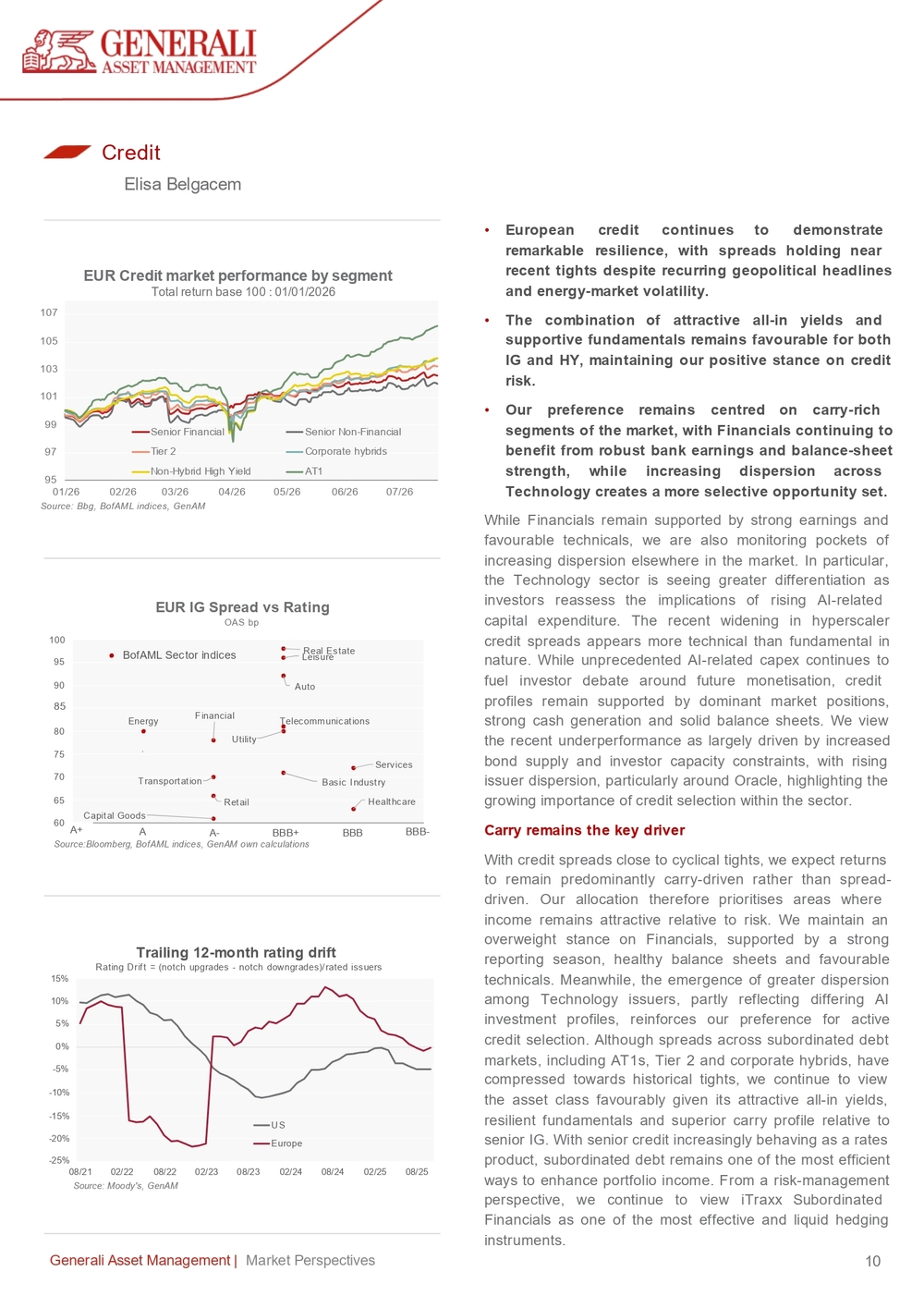
Generali Asset Management | Market Perspectives Credit Elisa Belgacem •European credit continues to demonstrate remarkable resilience, with spreads holding near recent tights despite recurring geopolitical headlines andenergy -market volatility . •The combination ofattractive all-inyields and supportive fundamentals remains favourable forboth IGand HY,maintaining ourpositive stance oncredit risk. •Our preference remains centred on carry -rich segments ofthemarket, with Financials continuing to benefit from robust bank earnings and balance -sheet strength, while increasing dispersion across Technology creates amore selective opportunity set. While Financials remain supported bystrong earnings and favourable technicals, wearealso monitoring pockets of increasing dispersion elsewhere inthemarket .Inparticular, theTechnology sector isseeing greater differentiation as investors reassess the implications ofrising AI-related capital expenditure .The recent widening inhyperscaler credit spreads appears more technical than fundamental in nature .While unprecedented AI-related capex continues to fuel investor debate around future monetisation, credit profiles remain supported bydominant market positions, strong cash generation andsolid balance sheets .Weview therecent underperformance aslargely driven byincreased bond supply and investor capacity constraints, with rising issuer dispersion, particularly around Oracle, highlighting the growing importance ofcredit selection within thesector . Carry remains thekeydriver With credit spreads close tocyclical tights, weexpect returns toremain predominantly carry -driven rather than spread - driven .Our allocation therefore prioritises areas where income remains attractive relative torisk.Wemaintain an overweight stance onFinancials, supported byastrong reporting season, healthy balance sheets and favourable technicals .Meanwhile, theemergence ofgreater dispersion among Technology issuers, partly reflecting differing AI investment profiles, reinforces our preference foractive credit selection .Although spreads across subordinated debt markets, including AT1s,Tier2andcorporate hybrids, have compressed towards historical tights, wecontinue toview theasset class favourably given itsattractive all-inyields, resilient fundamentals and superior carry profile relative to senior IG.With senior credit increasingly behaving asarates product, subordinated debt remains oneofthemost efficient ways toenhance portfolio income .From arisk-management perspective, we continue toview iTraxx Subordinated Financials asone ofthemost effective and liquid hedging instruments . 10
enior inancial enior on inancial
ier orporate hy rids
on y rid i h ield redi r e per r ce se e
otal return ase
uto asic ndustry apital oods ner y ransportation eisure elecommunications eal state etail ervices inancial tility ealthcare
                      pre d  s    i
 p
o M ector indices
r i i h r i dri
atin ri t notch up rades notch do n rades rated issuers
urope
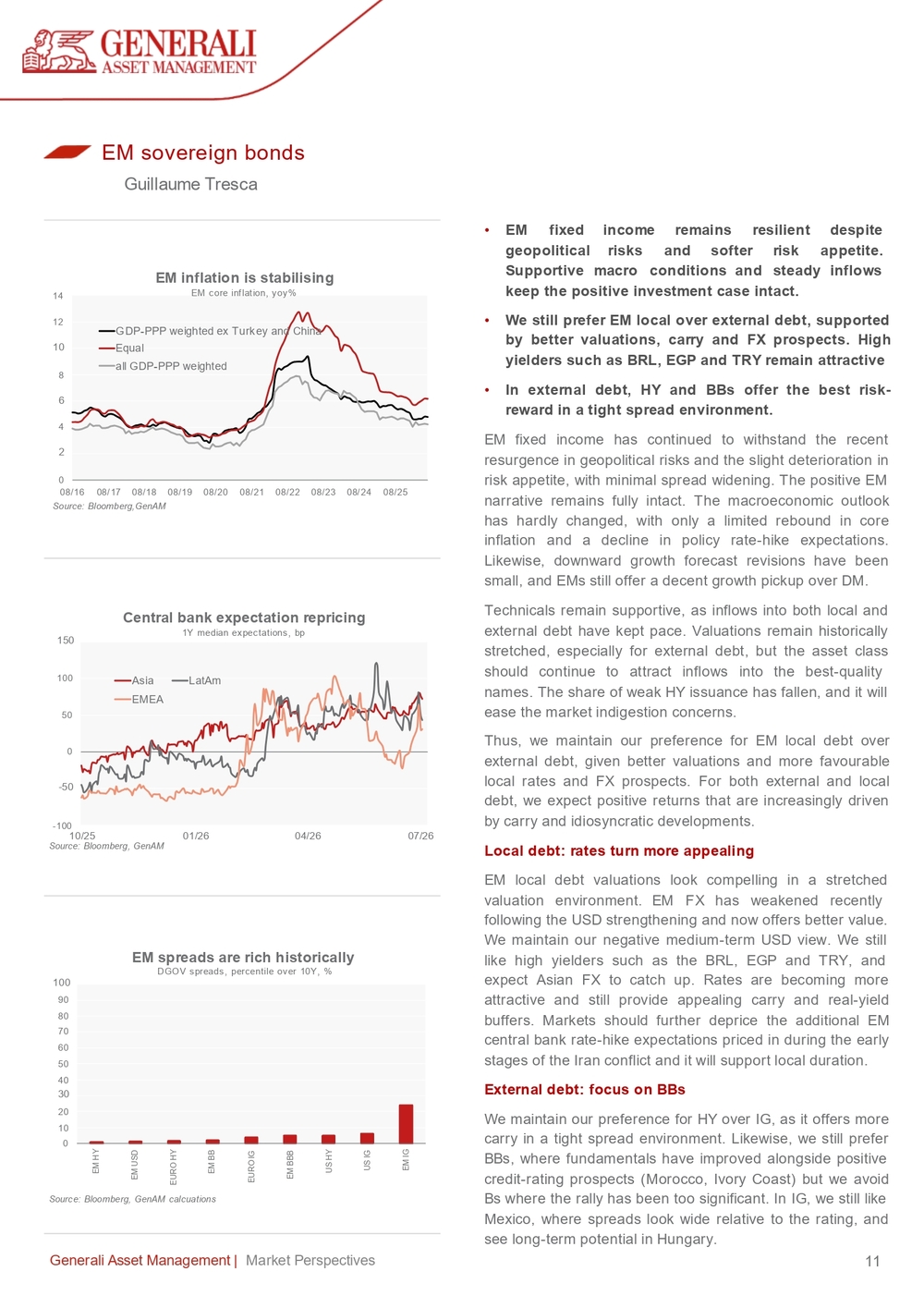
Generali Asset Management | Market Perspectives EM sovereign bonds Guillaume Tresca •EM fixed income remains resilient despite geopolitical risks and softer risk appetite . Supportive macro conditions and steady inflows keep thepositive investment case intact . •Westillprefer EMlocal over external debt, supported bybetter valuations, carry and FXprospects .High yielders such asBRL, EGP andTRY remain attractive •Inexternal debt, HYand BBs offer the best risk- reward inatight spread environment . EM fixed income has continued towithstand therecent resurgence ingeopolitical risks andtheslight deterioration in riskappetite, withminimal spread widening .Thepositive EM narrative remains fully intact .The macroeconomic outlook has hardly changed, with only alimited rebound incore inflation and adecline inpolicy rate-hike expectations . Likewise, downward growth forecast revisions have been small, andEMs stilloffer adecent growth pickup over DM. Technicals remain supportive, asinflows intoboth local and external debt have kept pace .Valuations remain historically stretched, especially forexternal debt, buttheasset class should continue toattract inflows into the best-quality names .Theshare ofweak HYissuance hasfallen, anditwill ease themarket indigestion concerns . Thus, wemaintain ourpreference forEMlocal debt over external debt, given better valuations and more favourable local rates and FXprospects .Forboth external and local debt, weexpect positive returns thatareincreasingly driven bycarry andidiosyncratic developments . Local debt :rates turn more appealing EM local debt valuations look compelling inastretched valuation environment .EM FXhas weakened recently following theUSD strengthening andnow offers better value . Wemaintain ournegative medium -term USD view.Westill likehigh yielders such astheBRL, EGP and TRY, and expect Asian FXtocatch up.Rates arebecoming more attractive and stillprovide appealing carry and real-yield buffers .Markets should further deprice theadditional EM central bank rate-hike expectations priced induring theearly stages oftheIranconflict anditwillsupport local duration . External debt :focus onBBs Wemaintain ourpreference forHYover IG,asitoffers more carry inatight spread environment .Likewise, westillprefer BBs, where fundamentals have improved alongside positive credit -rating prospects (Morocco, Ivory Coast) butweavoid Bswhere therally hasbeen toosignificant .InIG,westilllike Mexico, where spreads look wide relative totherating, and seelong-term potential inHungary . 11
P PPP ei hted e urkey and hina
ual
all P PPP ei hted i i is s i isi
M core in lation yoy
sia at m
M e r e pec i reprici
median e pectations p
M
M
M
M
M spre ds re rich his ric
spreads percentile over
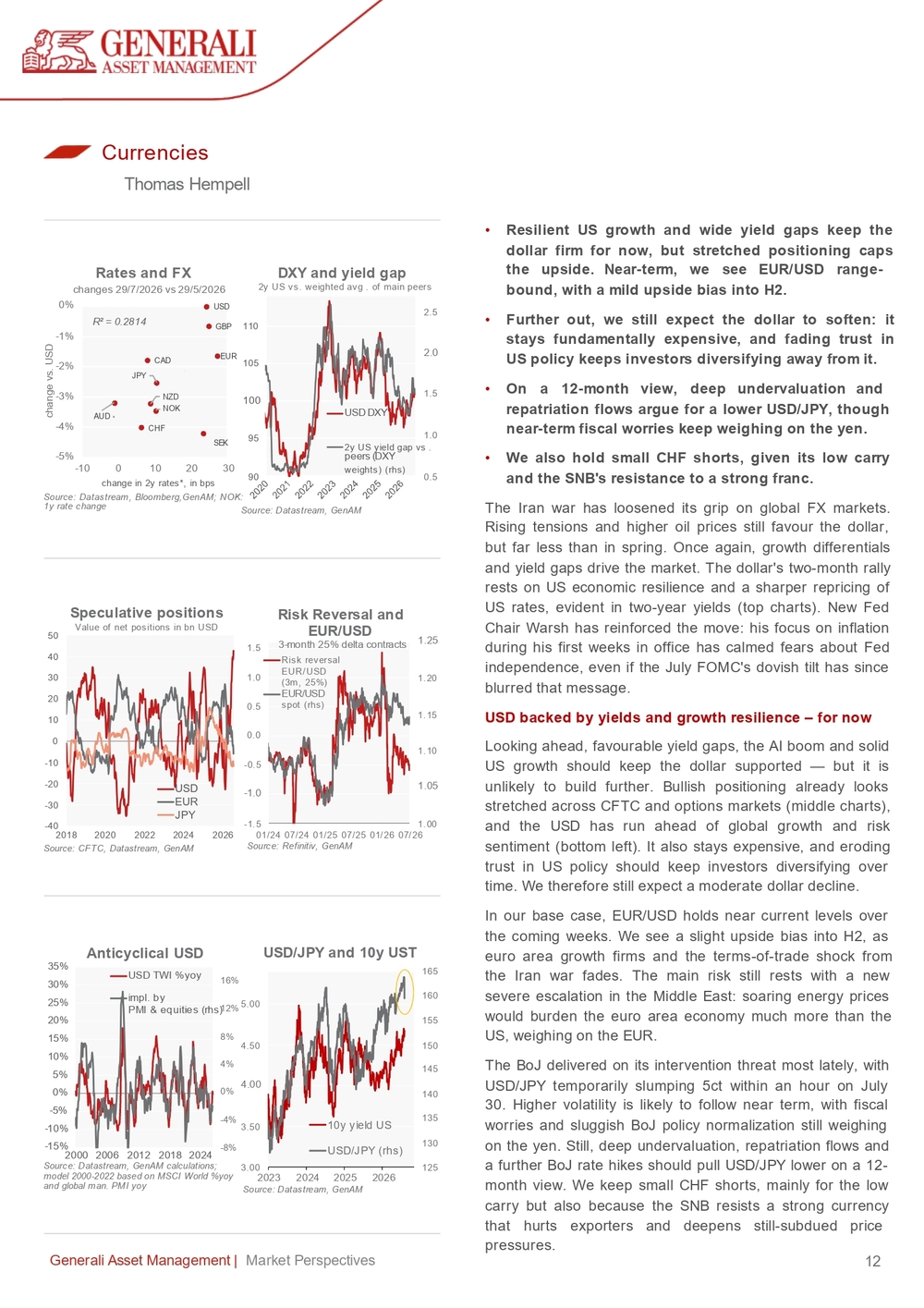
Generali Asset Management | Market Perspectives Currencies Thomas Hempell •Resilient USgrowth and wide yield gaps keep the dollar firm fornow, butstretched positioning caps the upside .Near -term, we see EUR/USD range - bound, with amild upside bias into H2. •Further out, westill expect thedollar tosoften :it stays fundamentally expensive, and fading trust in USpolicy keeps investors diversifying away from it. •On a12-month view, deep undervaluation and repatriation flows argue foralower USD/JPY, though near -term fiscal worries keep weighing ontheyen. •Wealso hold small CHF shorts, given itslow carry andtheSNB's resistance toastrong franc . The Iran warhasloosened itsgrip onglobal FXmarkets . Rising tensions and higher oilprices stillfavour thedollar, butfarless than inspring .Once again, growth differentials andyield gaps drive themarket .Thedollar's two-month rally rests onUSeconomic resilience andasharper repricing of USrates, evident intwo-year yields (top charts) .New Fed Chair Warsh hasreinforced themove :hisfocus oninflation during hisfirstweeks inoffice hascalmed fears about Fed independence, even iftheJuly FOMC's dovish tilthassince blurred thatmessage . USD backed byyields andgrowth resilience –fornow Looking ahead, favourable yield gaps, theAIboom andsolid USgrowth should keep thedollar supported —butitis unlikely tobuild further .Bullish positioning already looks stretched across CFTC andoptions markets (middle charts), and theUSD has runahead ofglobal growth and risk sentiment (bottom left).Italso stays expensive, anderoding trust inUSpolicy should keep investors diversifying over time.Wetherefore stillexpect amoderate dollar decline . Inourbase case, EUR/USD holds near current levels over thecoming weeks .Weseeaslight upside bias intoH2,as euro area growth firms and theterms -of-trade shock from theIran war fades .The main risk stillrests with anew severe escalation intheMiddle East:soaring energy prices would burden theeuro area economy much more than the US,weighing ontheEUR . TheBoJdelivered onitsintervention threat most lately, with USD/JPY temporarily slumping 5ctwithin anhour onJuly 30.Higher volatility islikely tofollow near term, with fiscal worries andsluggish BoJ policy normalization stillweighing ontheyen.Still, deep undervaluation, repatriation flows and afurther BoJratehikes should pullUSD/JPY lower ona12- month view.Wekeep small CHF shorts, mainly forthelow carry butalso because theSNB resists astrong currency that hurts exporters and deepens still-subdued price pressures . 12 -40-30-20-1001020304050 2018 2020 2022 2024 2026Speculative positions Value of net positions in bn USD USD EUR JPY Source: CFTC, Datastream, GenAM
isk reversal
m
spot rhs is e ers d
month delta contracts
y yield ap vs
peers
ei hts rhs
d ie d p
y vs ei hted av o main peers
P P
chan e vs
chan e in y rates in pschan es vs
es d
-8%-4%0%4%8%12%16% -15%-10%-5%0%5%10%15%20%25%30%35% 2000 2006 2012 2018 2024Anticyclical USD USD TWI %yoy impl. by PMI & equities (rhs) Source: Datastream, GenAM calculations; model 2000 -2022 based on MSCI World %yoy and global man. PMI yoy
d
y yield
P rhs
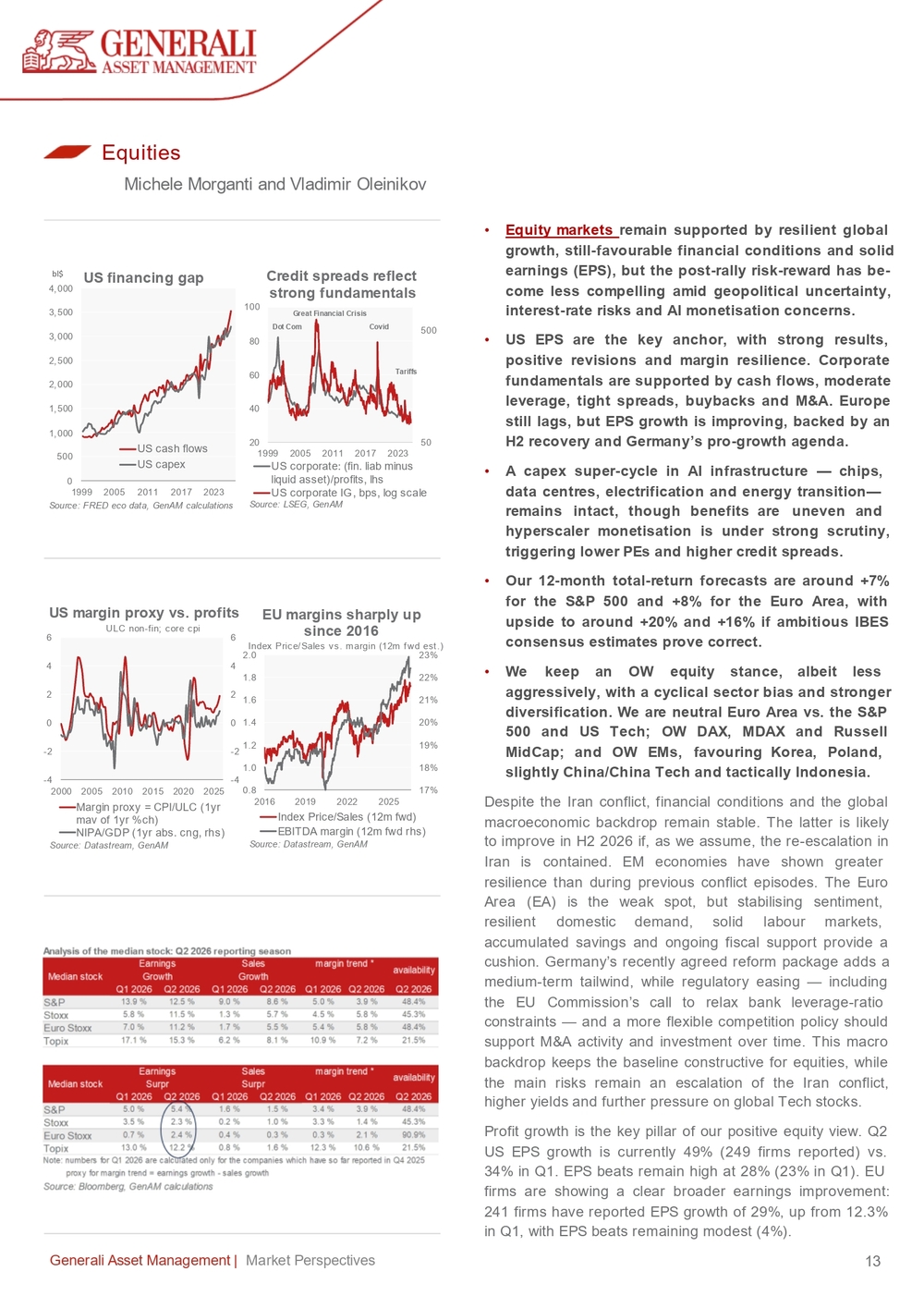
Generali Asset Management | Market Perspectives Equities Michele Morganti and Vladimir Oleinikov •Equity markets remain supported byresilient global growth, still-favourable financial conditions and solid earnings (EPS), butthepost -rally risk-reward hasbe- come less compelling amid geopolitical uncertainty, interest -rate risks andAImonetisation concerns . •USEPS are the key anchor, with strong results, positive revisions and margin resilience .Corporate fundamentals aresupported bycash flows, moderate leverage, tight spreads, buybacks and M&A .Europe stilllags, butEPS growth isimproving, backed byan H2recovery and er ’s pro-growth agenda . •Acapex super -cycle inAIinfrastructure —chips, data centres, electrification and energy transition — remains intact, though benefits are uneven and hyperscaler monetisation isunder strong scrutiny, triggering lower PEs andhigher credit spreads . •Our 12-month total -return forecasts arearound +7% fortheS&P 500 and +8%fortheEuro Area, with upside toaround +20%and +16%ifambitious IBES consensus estimates prove correct . •We keep an OW equity stance, albeit less aggressively, with acyclical sector bias and stronger diversification .Weareneutral Euro Area vs.theS&P 500 and US Tech ;OW DAX, MDAX and Russell MidCap ;and OW EMs, favouring Korea, Poland, slightly China/China Tech andtactically Indonesia . Despite theIran conflict, financial conditions andtheglobal macroeconomic backdrop remain stable .The latter islikely toimprove inH22026 if,asweassume, there-escalation in Iran iscontained .EM economies have shown greater resilience than during previous conflict episodes .The Euro Area (EA) isthe weak spot, but stabilising sentiment, resilient domestic demand, solid labour markets, accumulated savings and ongoing fiscal support provide a cushion . ermany’s recently agreed reform package adds a medium -term tailwind, while regulatory easing—including the EU ommission’s call torelax bank leverage -ratio constraints —andamore flexible competition policy should support M&A activity andinvestment over time.This macro backdrop keeps thebaseline constructive forequities, while themain risks remain anescalation oftheIran conflict, higher yields andfurther pressure onglobal Tech stocks . Profit growth isthekeypillar ofourpositive equity view.Q2 USEPS growth iscurrently 49%(249 firms reported) vs. 34%inQ1.EPS beats remain high at28%(23%inQ1).EU firms areshowing aclear broader earnings improvement : 241firms have reported EPS growth of29%,upfrom 12.3% inQ1,withEPS beats remaining modest (4%). 13 05001,0001,5002,0002,5003,0003,5004,000 1999 2005 2011 2017 2023US cash flows US capexUS financing gap Source: FRED eco data, GenAM calculationsbl$ 50500 1999 2005 2011 2017 202320406080100 US corporate: (fin. liab minus liquid asset)/profits, lhs US corporate IG, bps, log scale Source: LSEG, GenAMDot ComGreat Financial Crisis Covid TariffsCredit spreads reflect strong fundamentals -4-20246 -4-20246 2000 2005 2010 2015 2020 2025 Margin proxy = CPI/ULC (1yr mav of 1yr %ch) NIPA/GDP (1yr abs. cng, rhs) Source: Datastream, GenAMUS margin proxy vs. profits ULC non -fin; core cpi 17%18%19%20%21%22%23% 0.81.01.21.41.61.82.0 2016 2019 2022 2025 Index Price/Sales (12m fwd) EBITDA margin (12m fwd rhs) Source: Datastream, GenAMEU margins sharply up since 2016 Index Price/Sales vs. margin (12m fwd est.)
Generali Asset Management | Market Perspectives
Equities
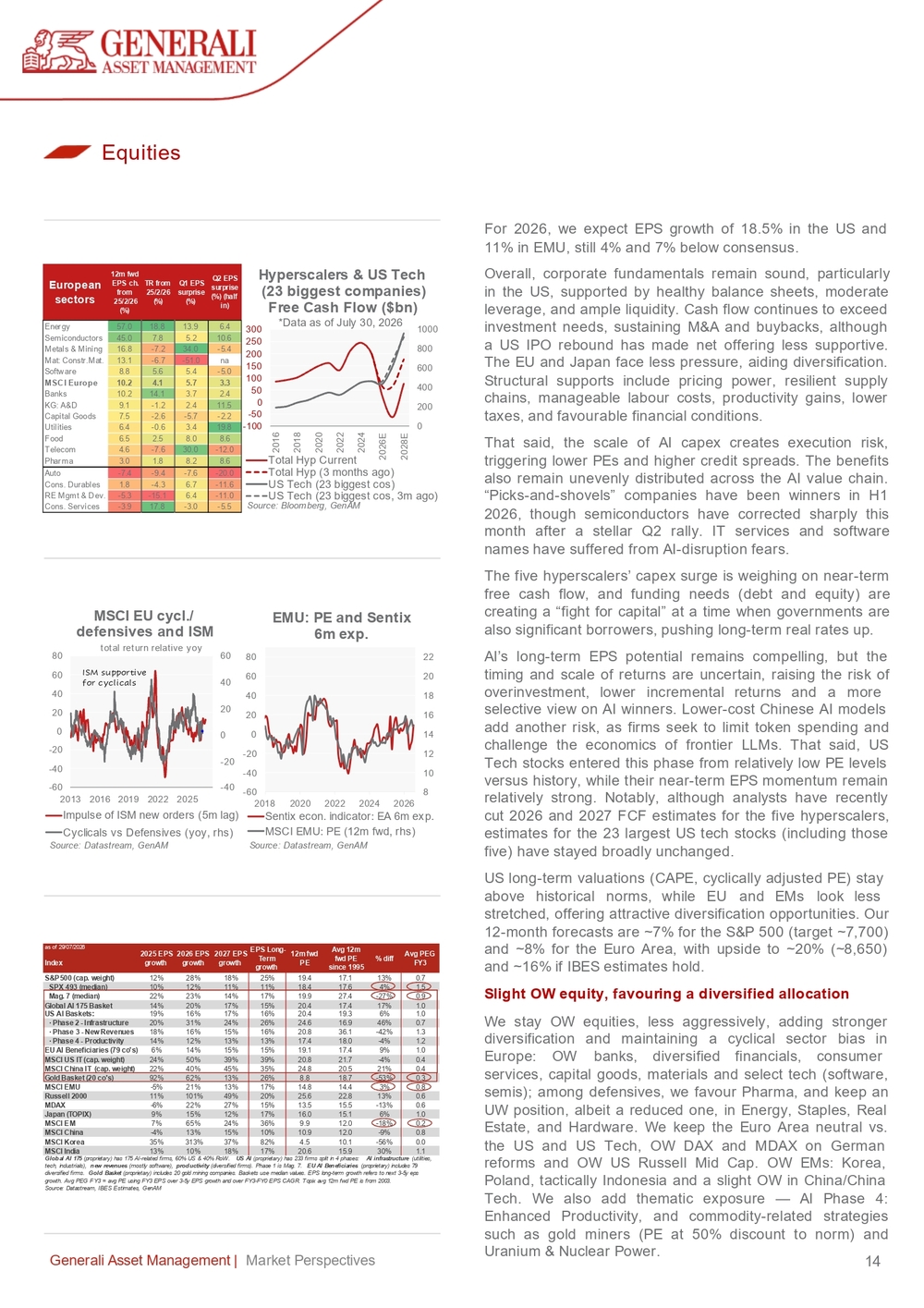
For2026 ,weexpect EPS growth of18.5%intheUSand
11%inEMU, still4%and7%below consensus .
Overall, corporate fundamentals remain sound, particularly
intheUS, supported byhealthy balance sheets, moderate
leverage, andample liquidity .Cash flow continues toexceed
investment needs, sustaining M&A andbuybacks, although
aUSIPO rebound hasmade netoffering less supportive .
TheEUandJapan face less pressure, aiding diversification .
Structural supports include pricing power, resilient supply
chains, manageable labour costs, productivity gains, lower
taxes, andfavourable financial conditions .
That said, thescale ofAIcapex creates execution risk,
triggering lower PEs andhigher credit spreads .Thebenefits
also remain unevenly distributed across theAIvalue chain .
“Picks -and-shovels” companies have been winners inH1
2026 ,though semiconductors have corrected sharply this
month after astellar Q2rally.ITservices and software
names have suffered from AI-disruption fears .
Thefivehyperscalers’ capex surge isweighing onnear-term
free cash flow, and funding needs (debt and equity) are
creating a“ i ht forcapital” atatime when governments are
also significant borrowers, pushing long-term realrates up.
’s long-term EPS potential remains compelling, butthe
timing andscale ofreturns areuncertain, raising theriskof
overinvestment, lower incremental returns and amore
selective view onAIwinners .Lower -cost Chinese AImodels
addanother risk, asfirms seek tolimit token spending and
challenge theeconomics offrontier LLMs .That said, US
Tech stocks entered thisphase from relatively lowPElevels
versus history, while their near-term EPS momentum remain
relatively strong .Notably, although analysts have recently
cut2026 and2027 FCF estimates forthefivehyperscalers,
estimates forthe23largest UStech stocks (including those
five) have stayed broadly unchanged .
USlong-term valuations (CAPE, cyclically adjusted PE)stay
above historical norms, while EU and EMs look less
stretched, offering attractive diversification opportunities .Our
12-month forecasts are~7%fortheS&P 500(target ~7,700)
and 8%fortheEuro Area, with upside to20%(8,650)
and16%ifIBES estimates hold.
Slight OWequity, favouring adiversified allocation
Westay OW equities, less aggressively, adding stronger
diversification and maintaining acyclical sector bias in
Europe :OW banks, diversified financials, consumer
services, capital goods, materials andselect tech (software,
semis) ;among defensives, wefavour Pharma, andkeep an
UWposition, albeit areduced one, inEnergy, Staples, Real
Estate, and Hardware .Wekeep theEuro Area neutral vs.
theUSand USTech, OW DAX and MDAX onGerman
reforms and OW USRussell Mid Cap.OW EMs:Korea,
Poland, tactically Indonesia andaslight OWinChina/China
Tech .We also add thematic exposure —AIPhase 4:
Enhanced Productivity, and commodity -related strategies
such asgold miners (PE at50%discount tonorm) and
Uranium &Nuclear Power .14
as of 29/07/2026
Index
S&P500 (cap. weight) 12% 28% 18% 25% 19.4 17.1 13% 0.7
SPX 493 (median) 10% 12% 11% 11% 18.4 17.6 4% 1.5
Mag. 7 (median) 22% 23% 14% 17% 19.9 27.4 -27% 0.9
Global AI 175 Basket 14% 20% 17% 15% 20.4 17.4 17% 1.0
US AI Baskets: 19% 16% 17% 16% 20.4 19.3 6% 1.0
· Phase 2 - Infrastructure 20% 31% 24% 26% 24.6 16.9 46% 0.7
· Phase 3 - New Revenues 18% 16% 15% 16% 20.8 36.1 -42% 1.3
· Phase 4 - Productivity 14% 12% 13% 13% 17.4 18.0 -4% 1.2
EU AI Beneficiaries (79 co's) 6% 14% 15% 15% 19.1 17.4 9% 1.0
MSCI US IT (cap. weight) 24% 50% 39% 39% 20.8 21.7 -4% 0.4
MSCI China IT (cap. weight) 22% 40% 45% 35% 24.8 20.5 21% 0.4
Gold Basket (20 co's) 92% 62% 13% 26% 8.8 18.7 -53% 0.3
MSCI EMU -5% 21% 13% 17% 14.8 14.4 3% 0.8
Russell 2000 11% 101% 49% 20% 25.6 22.8 13% 0.6
MDAX -6% 22% 27% 15% 13.5 15.5 -13% 0.6
Japan (TOPIX) 9% 15% 12% 17% 16.0 15.1 6% 1.0
MSCI EM 7% 65% 24% 36% 9.9 12.0 -18% 0.2
MSCI China -4% 13% 15% 10% 10.9 12.0 -9% 0.8
MSCI Korea 35% 313% 37% 82% 4.5 10.1 -56% 0.0
MSCI India 13% 10% 18% 17% 20.6 15.9 30% 1.1
Global AI 175 (proprietary) has 175 AI-related firms, 60% US & 40% RoW. US AI (proprietary) has 233 firms split in 4 phases: AI infrastructure (utilities,
tech, industrials), new revenues (mostly software), productivity (diversified firms). Phase 1 is Mag. 7. EU AI Beneficiaries (proprietary) includes 79
diversified firms. Gold Basket (proprietary) includes 20 gold mining companies. Baskets use median values. EPS long-term growth refers to next 3-5y eps
growth. Avg PEG FY3 = avg PE using FY3 EPS over 3-5y EPS growth and over FY3-FY0 EPS CAGR. Topix avg 12m fwd PE is from 2003.
Source: Datastream, IBES Estimates, GenAM2025 EPS
growth2026 EPS
growth2027 EPS
growthEPS Long-
Term
growth12m fwd
PEAvg 12m
fwd PE
since 1995% diffAvg PEG
FY3
-40-200204060
-60-40-20020406080
2013 2016 2019 2022 2025
Impulse of ISM new orders (5m lag)
Cyclicals vs Defensives (yoy, rhs)
Source: Datastream, GenAMMSCI EU cycl./
defensives and ISM
total return relative yoy
ISM supportive
for cyclicals
810121416182022
-60-40-20020406080
2018 2020 2022 2024 2026EMU: PE and Sentix
6m exp.
Sentix econ. indicator: EA 6m exp.
MSCI EMU: PE (12m fwd, rhs)
Source: Datastream, GenAM
12m fwd
EPS ch.
from
25/2/26
(%)TR from
25/2/26
(%)Q1 EPS
surprise
(%)Q2 EPS
surprise
(%) (half
in)
Energy 57.0 18.8 13.9 6.4
Semiconductors 45.0 7.8 5.2 10.6
Metals & Mining 16.8 -7.2 34.0 -5.4
Mat: Constr.Mat. 13.1 -6.7 -51.0 na
Software 8.8 5.6 5.4 -5.0
MSCI Europe 10.2 4.1 5.7 3.3
Banks 10.2 14.1 3.7 2.4
KG: A&D 9.1 -1.2 2.4 11.5
Capital Goods 7.5 -2.6 -5.7 -2.2
Utilities 6.4 -0.6 3.4 19.8
Food 6.5 2.5 8.0 8.6
Telecom 4.6 -7.6 30.0 -12.0
Pharma 3.0 1.8 8.2 8.6
Auto -7.4 -9.4 -7.6 -20.0
Cons. Durables 1.8 -4.3 6.7 -11.6
RE Mgmt & Dev. -5.3 -15.1 6.4 -11.0
Cons. Services -3.9 17.8 -3.0 -5.5European
sectors
02004006008001000
-100-50050100150200250300
2016
2018
2020
2022
2024
2026E
2028ETotal Hyp Current
Total Hyp (3 months ago)
US Tech (23 biggest cos)
US Tech (23 biggest cos, 3m ago)Hyperscalers & US Tech
(23 biggest companies)
Free Cash Flow ($bn)
*Data as of July 30, 2026
Source: Bloomberg, GenAM
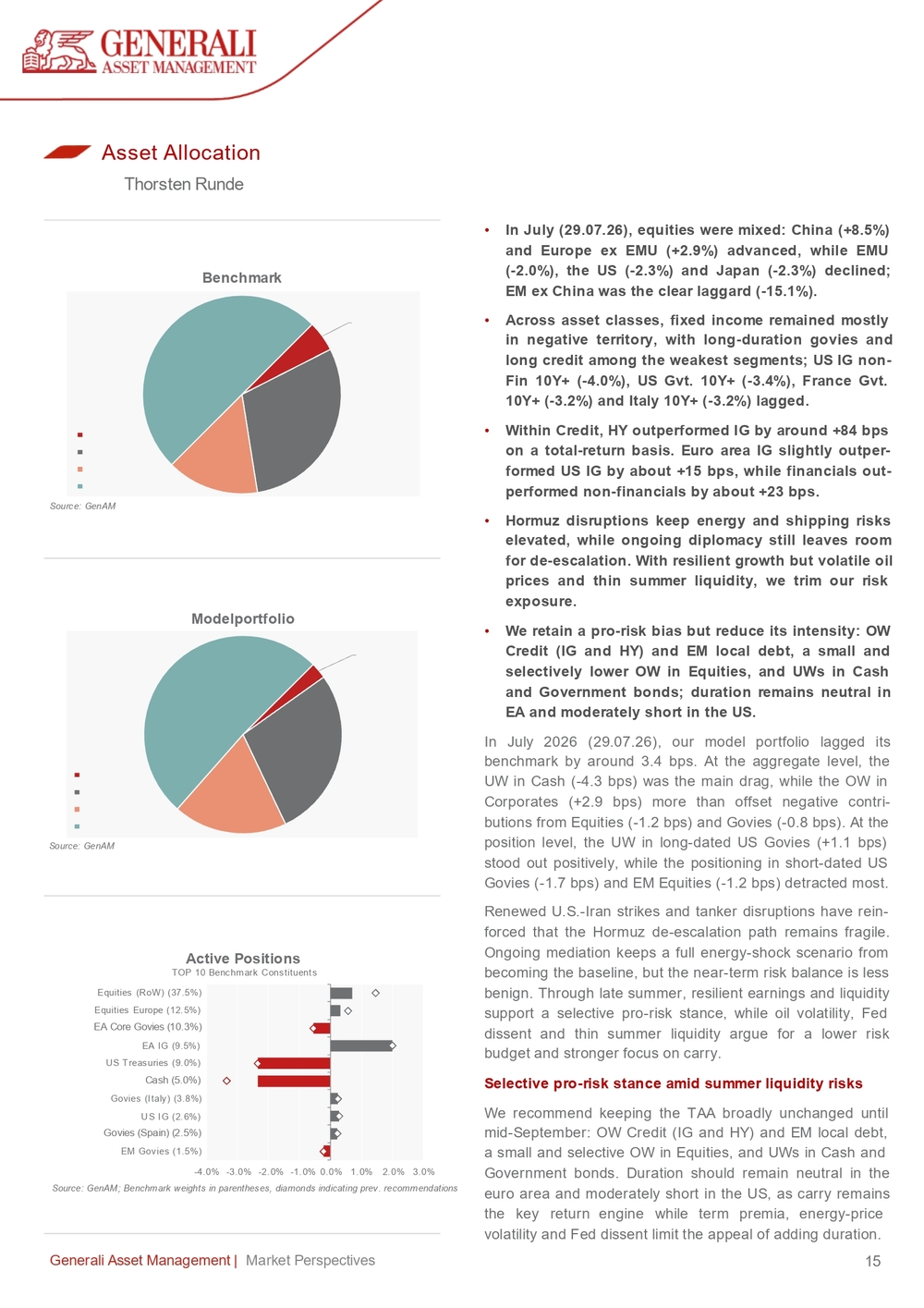
Generali Asset Management | Market Perspectives Asset Allocation Thorsten Runde •InJuly (29.07.26),equities were mixed :China (+8.5%) and Europe exEMU (+2.9%)advanced, while EMU (-2.0%),theUS(-2.3%)and Japan (-2.3%)declined ; EMexChina was theclear laggard (-15.1%). •Across asset classes, fixed income remained mostly innegative territory, with long -duration govies and long credit among theweakest segments ;USIGnon- Fin10Y+(-4.0%),USGvt.10Y+(-3.4%),France Gvt. 10Y+(-3.2%)andItaly 10Y+(-3.2%)lagged . •Within Credit, HYoutperformed IGbyaround +84bps onatotal -return basis .Euro area IGslightly outper - formed USIGbyabout +15bps, while financials out- performed non-financials byabout +23bps. •Hormuz disruptions keep energy and shipping risks elevated, while ongoing diplomacy still leaves room forde-escalation .With resilient growth butvolatile oil prices and thin summer liquidity, wetrim our risk exposure . •Weretain apro-risk bias butreduce itsintensity :OW Credit (IGand HY) and EMlocal debt, asmall and selectively lower OW inEquities, and UWs inCash and Government bonds ;duration remains neutral in EAandmoderately short intheUS. InJuly 2026 (29.07.26),our model portfolio lagged its benchmark byaround 3.4bps.Attheaggregate level, the UWinCash (-4.3bps) was themain drag, while theOW in Corporates (+2.9bps) more than offset negative contri - butions from Equities (-1.2bps) andGovies (-0.8bps).Atthe position level, theUW inlong-dated USGovies (+1.1bps) stood outpositively, while thepositioning inshort -dated US Govies (-1.7bps) andEMEquities (-1.2bps) detracted most . Renewed U.S.-Iranstrikes andtanker disruptions have rein- forced that theHormuz de-escalation path remains fragile . Ongoing mediation keeps afullenergy -shock scenario from becoming thebaseline, butthenear-term riskbalance isless benign .Through latesummer, resilient earnings andliquidity support aselective pro-riskstance, while oilvolatility, Fed dissent and thin summer liquidity argue foralower risk budget andstronger focus oncarry . Selective pro-riskstance amid summer liquidity risks Werecommend keeping theTAA broadly unchanged until mid-September :OW Credit (IGandHY)andEMlocal debt, asmall andselective OWinEquities, andUWs inCash and Government bonds .Duration should remain neutral inthe euro area andmoderately short intheUS,ascarry remains the key return engine while term premia, energy -price volatility andFeddissent limittheappeal ofadding duration . 15
ash ovies orporates uities e ch r
ash ovies orporates uities de p r i
uities o
uities urope
ore ovies
reasuries
ash
ovies taly
ovies pain
M ovies c i e si i s
P enchmark onstituents
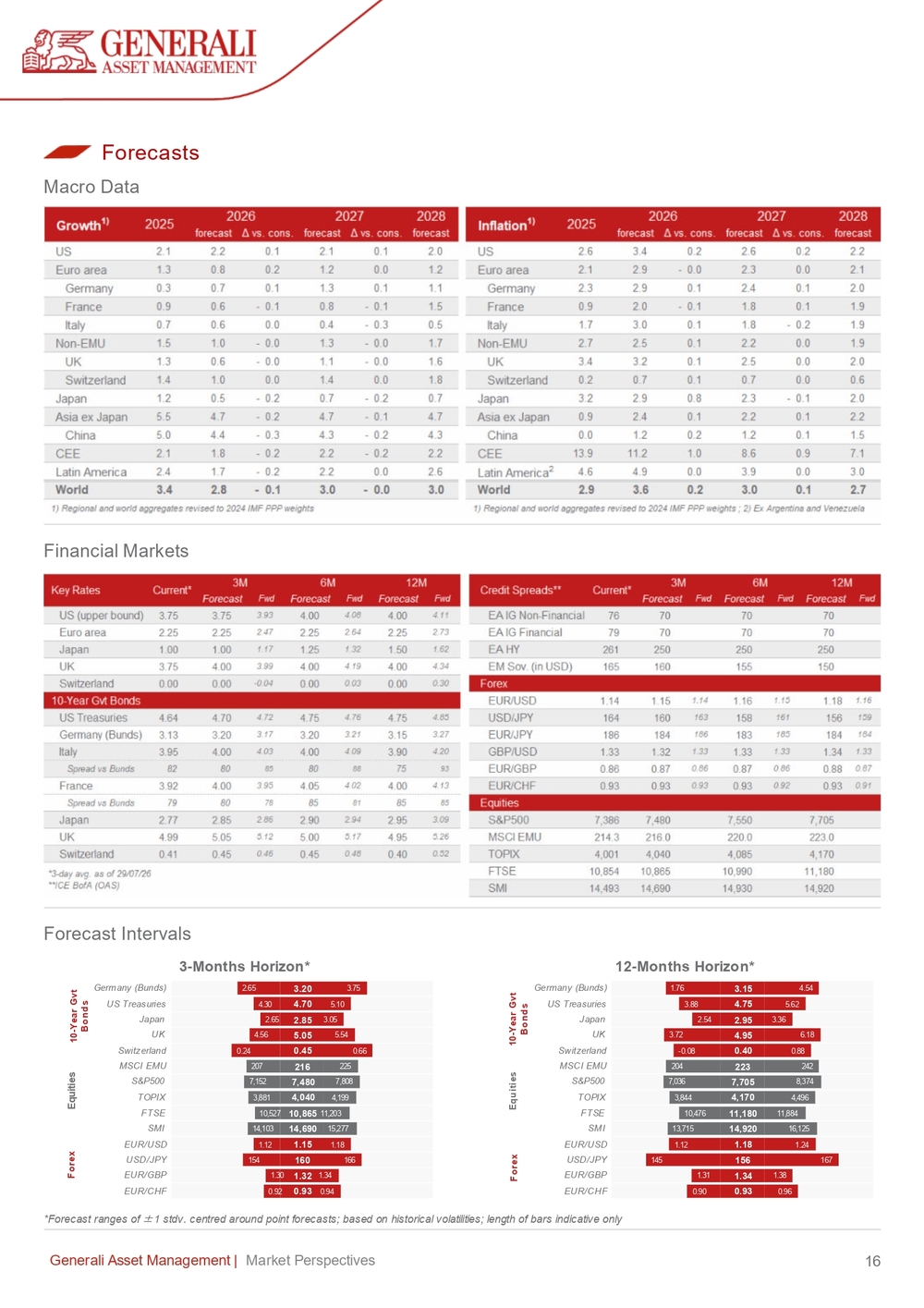
Forecasts Macro Data Financial Markets Forecast Intervals *Forecast ranges of±1stdv.centred around point forecasts ;based onhistorical volatilities ;length ofbars indicative only Generali Asset Management | Market Perspectives 16
hs ri e r
ds ui ies re
hs ri ui ies re e r
ds
“ dited y the Macro & Market esearch eam he team o analysts ased in Paris olo ne rieste
Milan and Prague runs qualitative and quantitative analysis on macroeconomic and financial issues. The team
translates macro and uant vie s into investment ideas that eed into the investment process ”
Partof
Imprint
Issued by: Generali Asset Management S.p.A. Società di gestione del risparmio | Research
Department
Head of Research: Vincent Chaigneau
Head of Macro &
Market Research:Dr. Thomas Hempell, CFA
Team: Elisabeth Assmuth | Research Operations
Elisa Belgacem | Head of Cross -Asset Quant & Dev, Senior Credit Strategist
Jakub Krátký | GI CEE Financial Analyst
Michele Morganti |Head of Insurance & AM Research, Senior Equity Strategist
Vladimir Oleinikov, CFA | Senior Quantitative Analyst
Dr. Thorsten Runde | Senior Quantitative Analyst
Dr. Florian Späte, CIIA | Senior Bond Strategist
Guillaume Tresca | Senior Emerging Market Strategist
Dr. Martin Wolburg, CIIA | Senior Economist
Paolo Zanghieri, PhD | Senior Economist
www.generali-am.comThis document is based on information and opinions which Generali Asset Management S.p.A. Società di gestione del risparmio h as obtained from sources within and outside of the Generali Group.
While such information is believed to be reliable for the purposes used herein, no representation or warranty, expressed or i mplied, is made that such information or opinions are accurate or
complete. The information, opinions estimates and forecasts expressed in this document are as of the date of this publication and represent only the judgment of Generali Asset Management S.p.A.
Società di gestione del risparmio and may be subject to any change without notification. It shall not be considered as an exp licit or implicit recommendation of investment strategy or as investment
advice. Before subscribing an offer of investment services, each potential client shall be given every document provided by t he regulations in force from time to time, documents to be carefully read
by the client before making any investment choice. Generali Asset Management S.p.A. Società di gestione del risparmio may hav e taken or, and may in the future take, investment decisions for the
portfolios it manages which are contrary to the views expressed herein. Generali Asset Management S.p. A. Società di gestione del risparmio relieves itself from any responsibility concerning
mistakes or omissions and shall not be considered responsible in case of possible damages or losses related to the improper u se of the information herein provided. It is recommended to look over
the regulation, available on our website www.generali -am.com . Generali Asset Management S.p. A. Società di gestione del risparmio is part of the Generali Group which was established in 1831 in
Trieste as Assicurazioni Generali Austro Italiche.
FOR PROFESSIONAL INVESTORS ONLY
www.generali -am.com